
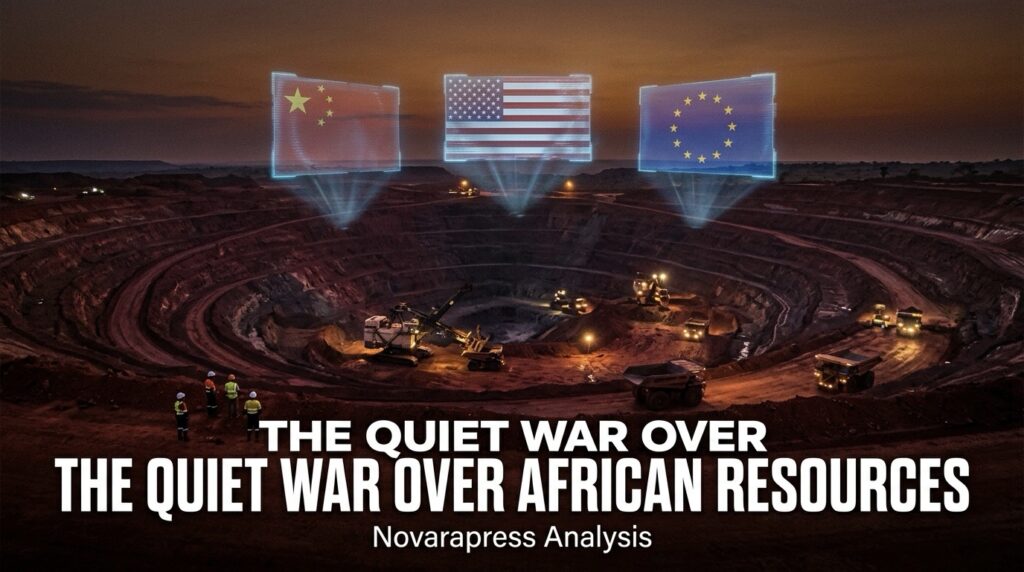
In 2009, a Chinese state-owned company signed a deal with the Democratic Republic of Congo. The terms were straightforward on paper: China would build roads, hospitals, and railways. In exchange, it would receive access to ten million tons of copper and 620,000 tons of cobalt — minerals worth, at current prices, somewhere between $50 billion and $100 billion.
The Congolese government called it a development partnership. Critics called it the largest resource extraction deal in African history dressed in infrastructure clothing. Both descriptions were accurate.
This deal did not happen in secret. It was signed publicly, reported by journalists, debated by analysts. And yet the basic logic it represented — that Africa’s mineral wealth is the most contested prize in 21st-century geopolitics, and that the competition to control it is reshaping the continent’s politics, conflicts, and futures — remains poorly understood outside the circles of people who profit from it.
The Minerals Underneath Everything
The green energy transition that wealthy countries have committed to — electric vehicles, solar panels, wind turbines, battery storage — requires minerals in quantities that dwarf current production capacity. And those minerals are not evenly distributed across the planet.
The Democratic Republic of Congo holds approximately 70 percent of the world’s known cobalt reserves — a mineral essential for the lithium-ion batteries that power electric vehicles and store renewable energy. The DRC also holds significant deposits of coltan, the ore that produces tantalum, used in the capacitors inside every smartphone, laptop, and electronic device on the planet.
Zimbabwe, Zambia, and the DRC together hold some of the world’s largest lithium deposits. Guinea holds the largest known bauxite reserves on earth — bauxite being the ore from which aluminum is refined. South Africa holds the majority of the world’s platinum group metals, essential for hydrogen fuel cells and catalytic converters. Niger and Namibia hold uranium deposits that have powered European nuclear plants for decades.
The continent that the world has historically treated as peripheral to global economic and political affairs sits on the raw materials that the next phase of the global economy cannot function without. This is not a future reality. It is the present one. And the competition to control these resources — between China, the United States, Europe, Gulf states, and various regional powers — is already reshaping African politics in ways that most Western coverage does not connect to their underlying cause.
China’s Twenty-Year Head Start
China understood the strategic importance of African minerals before most Western governments did. Beginning in the early 2000s, Chinese state-owned enterprises began systematically acquiring mining concessions, building infrastructure, and establishing political relationships across the continent — operating with a long-term strategic patience that private Western companies, accountable to quarterly earnings cycles, could not match.
By the time Western governments began seriously worrying about Chinese influence in Africa — roughly around 2015 to 2018 — China had already established dominant positions in cobalt mining in the DRC, copper mining in Zambia, iron ore in Guinea, and a network of port, road, and railway infrastructure that created logistical dependencies binding African governments to Chinese supply chains.
The Belt and Road Initiative, launched in 2013, formalized and accelerated what had already been underway for a decade. African countries received infrastructure financing — roads, ports, power plants — that genuinely addressed real development needs. The financing came with terms that have since been scrutinized: interest rates higher than concessional lending, collateral arrangements involving strategic assets, and procurement requirements that channeled contracts to Chinese companies rather than building local capacity.
The “debt trap” framing — the argument that China deliberately engineers debt to seize strategic assets — has been contested by researchers who note that no African country has actually lost a strategic asset to Chinese creditors. But the subtler dependency that Chinese infrastructure investment creates — in logistics, in technical systems, in political relationships — is real and consequential even without a formal asset seizure.
The New Scramble and Its Violence
The competition for African resources is not conducted only through contracts and diplomacy. It is conducted through the conflicts that contracts and diplomacy fail to resolve — and the connection between mineral wealth and armed conflict in Africa is one of the most thoroughly documented relationships in the academic literature on civil war.
Eastern DRC — the region containing the country’s richest mineral deposits — has been in a state of near-continuous armed conflict for thirty years. The M23 rebel group, which seized the city of Goma in early 2024 with documented support from Rwanda, operates in areas containing significant mineral deposits. The connection between the conflict and resource competition is not incidental. It is structural.
In Sudan, the RSF’s rapid expansion into gold-producing regions in the early years of the current war was not a military coincidence. Control of gold mines in Jebel Amer and other areas provided the revenue that funded the RSF’s operations and made it financially independent of the central government — a precondition for the confrontation that eventually became full-scale war.
In the Central African Republic, Mali, and Niger, the presence of Wagner — now reorganized as the Africa Corps — in mineral-producing regions follows a pattern too consistent to be coincidental. Security contracts and mining concessions arrive together. The guns protect the extraction. The extraction finances the guns.
The Western Awakening — Late and Incomplete
The United States and European governments have spent the past several years attempting to build what they call “critical mineral supply chains” that reduce dependence on Chinese processing and, where possible, Chinese mining. The language of critical minerals — cobalt, lithium, rare earth elements, nickel, manganese — has entered the vocabulary of Western industrial policy in a way it had not before approximately 2020.
The initiatives that have followed are real but insufficient. The US Minerals Security Partnership, the EU Critical Raw Materials Act, the G7’s Partnership for Global Infrastructure and Investment — these represent genuine attempts to redirect investment toward African mineral projects with better terms and stronger governance requirements than Chinese financing offers.
The problem is the starting position. China processes approximately 60 percent of the world’s lithium, 70 percent of its cobalt, and 90 percent of its rare earth elements. Even if new Western-backed mining projects come online on schedule — which mining projects historically do not — the processing chokehold will take decades to address.
African governments, watching this competition unfold, are increasingly attempting to convert their mineral wealth into genuine leverage — demanding local processing requirements, higher royalty rates, and technology transfer as conditions for new mining agreements. Zambia and Zimbabwe have both imposed restrictions on raw mineral exports, attempting to force value addition on the continent rather than exporting raw ore to be processed elsewhere. Whether this strategy succeeds depends on whether African governments can maintain the political cohesion to enforce it against the pressure of powerful external actors who prefer the status quo.
The Human Cost at the Bottom of the Supply Chain
The competition between great powers for African minerals is conducted at a level of abstraction — trade policy, investment frameworks, diplomatic relationships — that obscures what happens at the bottom of the supply chain.
In the DRC’s artisanal cobalt mines — informal operations that exist alongside the large industrial mines and supply roughly 15 to 20 percent of global cobalt production — children as young as six work in conditions that Amnesty International and other organizations have documented in detail. They dig with hand tools in tunnels that lack structural support. They carry sacks of ore that weigh more than they do. They are paid by the sack, not by the hour, and the price they receive bears no relationship to the price the cobalt commands on global commodity markets.
The electric vehicle that a consumer in Germany or California purchases as an environmental choice contains cobalt that may have passed through these mines on its way to the battery. The supply chain between the child in the tunnel and the consumer at the dealership passes through enough intermediaries — artisanal traders, comptoirs, exporters, refiners, battery manufacturers, car companies — that accountability for conditions at the source is diffused to the point of invisibility.
This is not unknown. Every major electric vehicle manufacturer has published supply chain due diligence commitments. The gap between those commitments and the conditions on the ground in Kolwezi and Kipushi is the gap between what global supply chains are required to report and what they are required to change.
What Africa Gets From Its Own Wealth
The DRC — a country sitting on mineral wealth that the rest of the world is competing to access — has a GDP per capita of approximately $600. It ranks among the ten poorest countries on earth by most measures. The relationship between its extraordinary resource endowment and its extraordinary poverty is not a paradox. It is a system — a system in which the value generated by resource extraction flows outward, and the costs of that extraction, including environmental damage, conflict, and governance distortion, remain.
This is the resource curse in its modern form. Not the simple story of oil wealth producing lazy governments, but the more complex reality of mineral extraction producing revenues that are captured by elites, contested by armed groups, and intermediated by foreign companies in ways that leave the population of the extracting country with neither the wealth nor the institutional development that the wealth could have funded.
The quiet war over African resources is quiet only from the outside. For the people living inside it — in eastern DRC, in Sudan’s gold regions, in the Sahel’s uranium belt — it is neither quiet nor distant. It is the organizing fact of daily life, the reason the armed group controls the road, the reason the mine employs children, the reason the government signs the deal that its population would not have approved.
The electric vehicle revolution will not save them. Not unless the supply chain that runs from the mine to the showroom is built on different terms than the one that currently exists.
If this analysis interests you, read next: Why the Sahel Is the New Middle East