
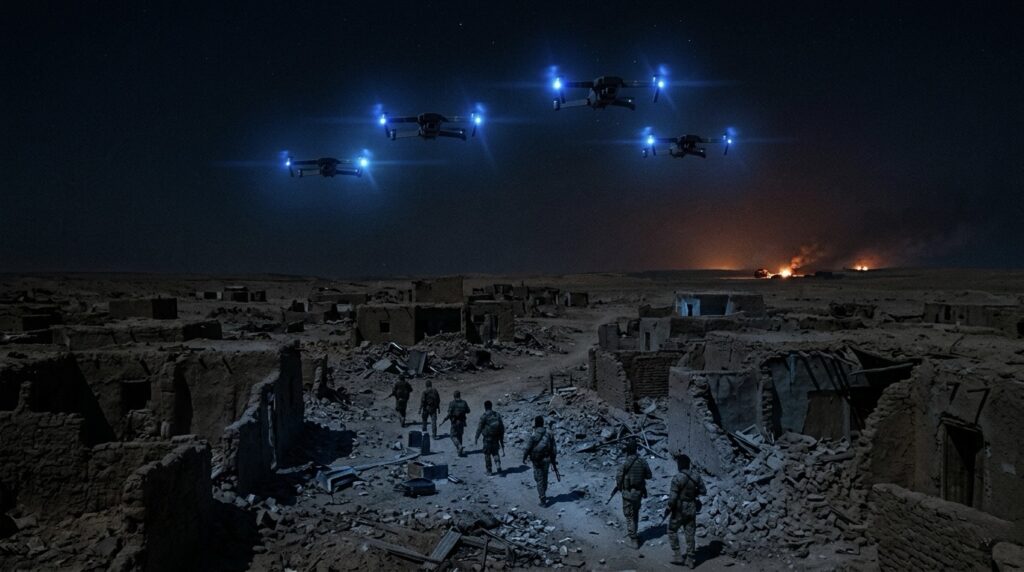
Modern wars are no longer fought between armies. They are fought through layers — drones, militias, private contractors, and cutouts — designed to deliver military outcomes while keeping the sponsoring state’s hands officially clean.
This is the new proxy war formula. It did not emerge overnight. It was refined through two decades of conflict in the Middle East, Africa, and Central Asia, and it has now become the default model for how powerful states project force without paying the political cost of direct intervention.
What Changed
Cold War proxy conflicts were relatively legible. The United States backed one faction. The Soviet Union backed another. Weapons, money, and advisors flowed through identifiable channels. The proxies were often conventional armed movements with territorial control and political programs.
The new model is deliberately harder to read. Sponsoring states now use multiple layers of intermediaries — each one adding deniability to the chain. A government funds a private military company. The private military company trains a militia. The militia operates drones purchased through a third-country broker. When the drone strikes a hospital, nobody’s fingerprints are on the trigger.
This is not an accident of organizational complexity. It is the point.
The Drone Layer
Unmanned aerial systems have transformed proxy warfare in ways that are still being absorbed by analysts and policymakers.
Drones extend the reach of proxy forces far beyond their organic military capability. A militia that could previously only control territory it could physically occupy can now strike targets dozens of kilometers away, conduct reconnaissance over wide areas, and deliver precision munitions without exposing its fighters.
The sponsoring state’s contribution — the drones themselves, the training, the targeting data — can be transferred quietly and denied publicly. When the Houthis in Yemen strike shipping lanes in the Red Sea, the munitions often reflect Iranian technical capability. But the operational deniability remains intact because no Iranian soldier pulled the trigger.
This pattern repeats across theaters. Turkish drones in Libya and Azerbaijan. Iranian drones in Yemen, Iraq, and Gaza. Loitering munitions showing up in African conflicts supplied through networks that deliberately obscure their origin. The drone has become the defining instrument of deniable force projection.
The Militia Layer
Militias offer sponsoring states something that conventional forces cannot: local legitimacy combined with external capability.
A militia is rooted in a specific community, ethnicity, or sectarian identity. It recruits locally, understands local terrain, and can sustain operations in areas where a foreign force would face immediate resistance. The sponsoring state provides weapons, financing, training, and intelligence. The militia provides the bodies and the local cover.
Iran’s network of proxy militias across the Middle East — Hezbollah in Lebanon, the Popular Mobilization Forces in Iraq, the Houthis in Yemen, various factions in Syria — represents the most developed version of this model. Each group has its own identity, its own political program, and its own local base. Iran provides strategic direction and material support. The groups maintain enough independence to be credibly described as autonomous actors.
This structure is intentional. It allows Iran to project force across the region while maintaining that it does not control the groups it supplies. The claim is partially true, which makes it more effective as cover than a straightforward lie would be.
The Deniability Architecture
What distinguishes the new proxy war formula from earlier models is the deliberate construction of deniability at every layer.
Weapons are transferred through third countries to obscure their origin. Financing moves through commercial entities, cryptocurrency networks, and informal value transfer systems that resist conventional financial monitoring. Private military companies provide a corporate buffer between state sponsors and battlefield actors. Communications are compartmentalized to limit the paper trail connecting decisions to outcomes.
The result is a system where causation is real but attribution is genuinely difficult. Analysts and investigators can often establish with high confidence that State A is enabling the actions of Group B. Establishing this in a forum that can impose consequences — the UN Security Council, an international court, a sanctions regime — requires a standard of proof that the deniability architecture is specifically designed to prevent from being met.
Sudan as a Case Study
The war in Sudan illustrates the new formula with unusual clarity.
The RSF — the Rapid Support Forces — is nominally a Sudanese paramilitary. But its operational capacity has depended on external support that flows through multiple layers. Gold extracted from Sudanese mines moves through UAE-linked networks, generating revenue that sustains RSF operations. Weapons have entered through Libya and Chad via supply chains that involve multiple intermediaries. Drone capability has appeared on the battlefield in forms that reflect external technical transfer.
No single external actor needs to formally acknowledge supporting the RSF. The architecture of the support is distributed across enough layers that each individual transaction can be described as commercial, incidental, or unverified. The aggregate effect — a paramilitary force capable of sustaining a war against a national army for years — is visible. The chain of responsibility is designed to be invisible.
Why Accountability Fails
The new proxy war formula has exposed fundamental weaknesses in the international accountability architecture.
Arms embargoes are routinely violated because the supply chains run through jurisdictions that lack enforcement capacity or political will to comply. Sanctions regimes target individuals and entities but rarely reach the state-level decision makers who designed the support structure. UN investigations document violations with precision but produce reports rather than consequences.
The Security Council — the only body with authority to impose binding measures — is paralyzed by the veto interests of the states most likely to be implicated in proxy support networks. Russia, China, and the United States have each used their veto to protect their own proxies or those of their allies from accountability measures.
The system is not failing by accident. It is functioning as the most powerful states designed it to function.
The Escalation Risk
The new proxy war formula carries an escalation risk that is frequently underestimated.
When conflicts are managed through deniable intermediaries, the communication channels that historically allowed great powers to signal restraint and negotiate de-escalation are absent or degraded. A state that officially has no forces in a conflict has no official channel through which to communicate that it wants to pull back.
Miscalculation becomes more likely when the actors on the ground — militias, private military contractors, drone operators — are not under tight centralized control. An action taken by a field commander that the sponsoring state did not authorize can trigger a response that the sponsoring state is then obligated to match, not because it chose escalation but because the deniability architecture that served it in peacetime now prevents it from credibly disowning the action.
The history of proxy conflicts is littered with escalations that nobody intended and nobody could stop.
The Formula Will Not Disappear
The new proxy war formula persists because it works — for the states using it. It delivers military outcomes. It avoids the domestic political cost of body bags. It maintains the fiction of non-involvement that allows diplomatic engagement to continue in parallel with armed support.
The populations living inside these conflicts experience no such deniability. The drone that strikes a market does not become less lethal because its supply chain was deliberately obscured. The militia that burns a village is not less brutal because its weapons were transferred through a third-country broker.
Understanding the formula does not stop it. But it is a prerequisite for any serious attempt to do so — and for holding accountable the states that designed it, fund it, and benefit from it while insisting their hands are clean.
If this analysis interests you, read next: Sudan’s War Nobody Is Watching
If this analysis interests you, read next: Why the Sahel Is the New Middle East