
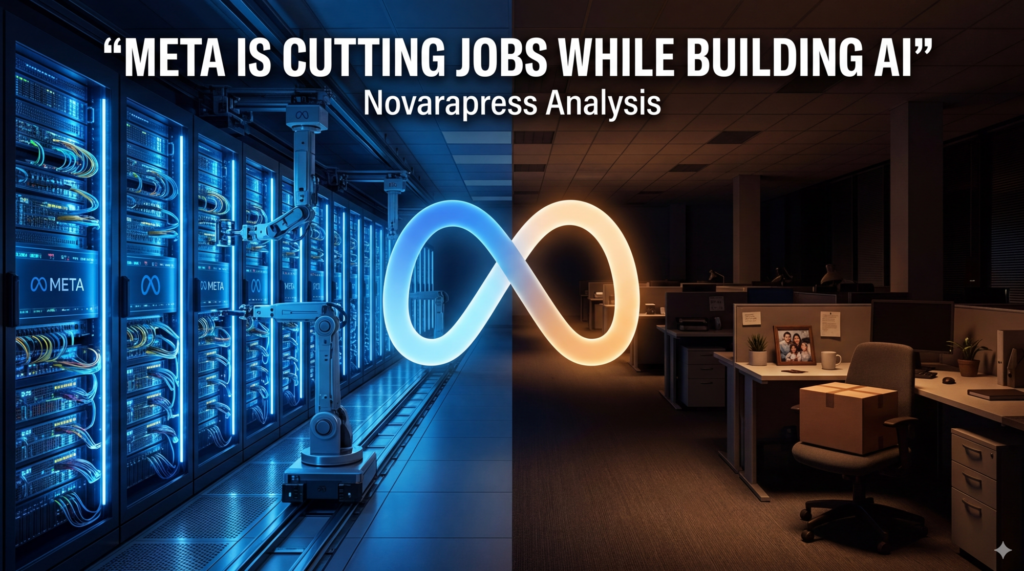
On the morning of March 25, 2026, Meta employees in five divisions received notices that their jobs had been eliminated. By that evening, SEC filings revealed that four of Meta’s senior executives had been granted stock option packages worth up to $921 million each. The same company. The same day. Two completely different experiences of what the AI revolution means for the people inside it.
The 700 jobs cut were in Reality Labs, recruiting, sales, and Facebook operations. The stock options went to CFO Susan Li, technology chief Andrew Bosworth, Chief Product Officer Christopher Cox, and operating chief Javier Olivan. Mark Zuckerberg, whose net worth exceeds $200 billion, was not included in the executive pay plan — presumably because he did not need the retention incentive.
Meta called the layoffs routine restructuring. It called the executive pay plan a retention tool. Both descriptions are accurate. Neither captures what is actually happening — which is that one of the world’s most valuable companies is using artificial intelligence as the organizing principle for a fundamental redistribution of who gets paid, how much, and for what.
The Numbers Behind the Decision
Meta’s financial commitments in 2026 are staggering in scale. The company has guided for capital expenditure of between $115 billion and $135 billion this year — a roughly 75 percent increase from the prior year. Total projected spending runs between $162 billion and $169 billion. The overwhelming majority of this spending is directed at AI infrastructure: data centers, custom chips, training computing capacity, and the researchers and engineers capable of using it.
This is not a marginal investment. It is a strategic reorientation. Meta spent $118 billion in total in 2025. It is preparing to spend $169 billion in 2026. The increase — approximately $50 billion — is larger than the entire annual revenue of most Fortune 500 companies. It represents a decision that the AI race is existential, that losing it is not an option, and that the cost of competing is worth paying regardless of near-term returns.
Meta’s CFO Susan Li was unusually candid about the uncertainty involved when she spoke to analysts in March: “That’s not like, okay, in 2026, the ROI is this, in 2027, the ROI is this — which pains me, to be clear. I really wish that were the world we live in, but it’s not. And we have to be willing to make temporal bets.”
A company spending $169 billion in a single year on a bet whose return on investment its own CFO cannot describe is making an extraordinary wager. The people who lost their jobs on March 25 are part of what that wager costs.
The Metaverse’s Epitaph
The layoffs tell a story about more than AI investment. They tell a story about the spectacular failure of Meta’s previous strategic bet — the metaverse.
Meta changed its name from Facebook to Meta in 2021, signaling that virtual reality and the metaverse were the company’s future. Reality Labs, the division built to pursue that future, has lost more than $80 billion since its creation. The VR headsets it produced — the Quest line — found a niche market but never approached the mass adoption that Zuckerberg’s vision required. The Horizon Worlds social platform became a punchline. The metaverse did not arrive.
The layoffs hitting Reality Labs most heavily are the final acknowledgment that this bet has been called. The division is not being shut down — Meta is still developing AI-powered wearables and next-generation computing interfaces. But the vision of the metaverse as the successor to the smartphone has been quietly abandoned, and the tens of thousands of people who were hired to build it are now, depending on their specific role and skills, either being retrained for AI work, offered relocation packages, or let go.
The transition from metaverse to AI is not a pivot. It is a recognition that the company bet on the wrong thing and is now betting on a different thing with the same urgency and the same certainty it brought to the first bet.
What Zuckerberg Actually Said
In January 2026, Mark Zuckerberg posted a vision statement on Facebook that received less attention than it deserved. He described 2026 as the year Meta would begin “elevating individual contributors and flattening teams.” He said AI was already enabling projects that once required large teams to be accomplished by single talented individuals. He projected that AI agents would be writing significant portions of Meta’s code within the year.
Read carefully, this is not a statement about efficiency. It is a statement about headcount. If AI can do what a team used to do, you need fewer people. The math is straightforward: the same output, divided across fewer salaries, produces higher margins. The strategic rationale for AI investment is not only competitive — it is financial. AI-driven productivity gains reduce labor costs in ways that fall directly to the bottom line.
The 700 jobs cut in March are a small fraction of Meta’s nearly 79,000 employees. But Reuters reported in March that Meta is preparing for a potential workforce reduction of 20 percent — approximately 15,000 to 16,000 jobs — as AI automation reduces the need for human labor across more of the company’s operations. If that number materializes, it would bring Meta’s headcount to its lowest level since 2021, even as the company’s revenue and market value continue to grow.
Growth without hiring. Revenue without headcount. These are the metrics that AI investment promises — and that investors are rewarding Meta for pursuing.
The Pattern Across the Industry
Meta is not an outlier. It is the leading indicator of a pattern that is playing out across the technology industry and beginning to spread beyond it.
Google reduced its workforce by approximately 12,000 employees in 2023. Microsoft cut 10,000 in the same year. Amazon eliminated 27,000 roles between 2022 and 2023. These cuts were attributed at the time to post-pandemic normalization — companies that had over-hired during the COVID boom returning to sustainable headcount levels. The explanation was partially accurate. It was not complete.
The same companies that were cutting jobs were simultaneously making their largest ever investments in AI infrastructure. The correlation between workforce reduction and AI investment is not coincidental. AI is not yet replacing most jobs. But it is changing the calculation of how many people a company needs to hire to grow its revenue — and it is changing it in a direction that consistently points toward fewer people, not more.
The technology industry has historically been a major source of high-wage employment. It attracted talent from around the world, paid salaries that supported expensive urban housing markets, and generated the tax revenues that funded public services in the cities where it concentrated. If AI investment persistently reduces technology industry headcount even as revenues grow, the social contract that made the technology industry politically tolerable — the implicit exchange of economic disruption for job creation — begins to break down.
The Executive Stock Plan as a Signal
The timing of Meta’s executive stock option announcement — hours before layoff notices went out — was either spectacularly poor judgment or a deliberate demonstration of priorities. Either interpretation is revealing.
The stock options are structured around a target that requires Meta’s share price to nearly double within five years — roughly equating to a market capitalization target of $9 trillion. The options have no value unless that target is achieved, which means the incentive is explicitly aligned with maximizing shareholder value over the medium term.
The people whose jobs were eliminated on the same day have no equivalent long-term stake in Meta’s success. They received severance packages, some were offered alternative roles, and some were given relocation options. By any measure, these are better outcomes than many workers facing layoffs receive. They are also structurally different from the outcome available to the executives — who retain a direct financial interest in the company’s performance for the next five years.
This structural difference — between workers who receive compensation for labor and executives who receive equity in outcomes — is not specific to Meta. It is the defining feature of how value is distributed in the AI economy. The people building AI systems, training AI models, and maintaining AI infrastructure are compensated for their time. The people who own the companies deploying AI at scale are compensated for ownership. As AI increases the productivity and value of those companies, the returns flow to ownership, not to labor.
The Future of Work, Told in One Day
The story of March 25, 2026, at Meta is not primarily a story about 700 people losing their jobs. It is a story about what the AI economy looks like when it matures — and who benefits from it.
A company invests $135 billion in AI infrastructure. It eliminates jobs that AI can replace or that are no longer needed in an AI-first organization. It grants its senior leadership compensation packages that align their interests with maximizing the returns from that AI investment. It tells the market that it expects AI to allow it to generate more value with fewer people. The market rewards it with a higher valuation.
This is not a scandal. It is the operating logic of the AI economy, operating transparently and without apology. The question it raises is not whether it is legal or whether any individual decision is unethical. The question is whether the economy this logic produces — one where AI investment concentrates value at the top while reducing the employment that distributed it more broadly — is the economy that democratic societies intended to build.
That question is not being asked loudly enough. Not in boardrooms, not in legislatures, and not in the coverage of AI investment that treats hundred-billion-dollar infrastructure spending as unambiguously good news.
On March 25, 700 people at Meta found out what the AI future means for them. The answer was not what the AI promotional materials promised.
If this analysis interests you, read next: Why the Global South Is Losing the AI Race