
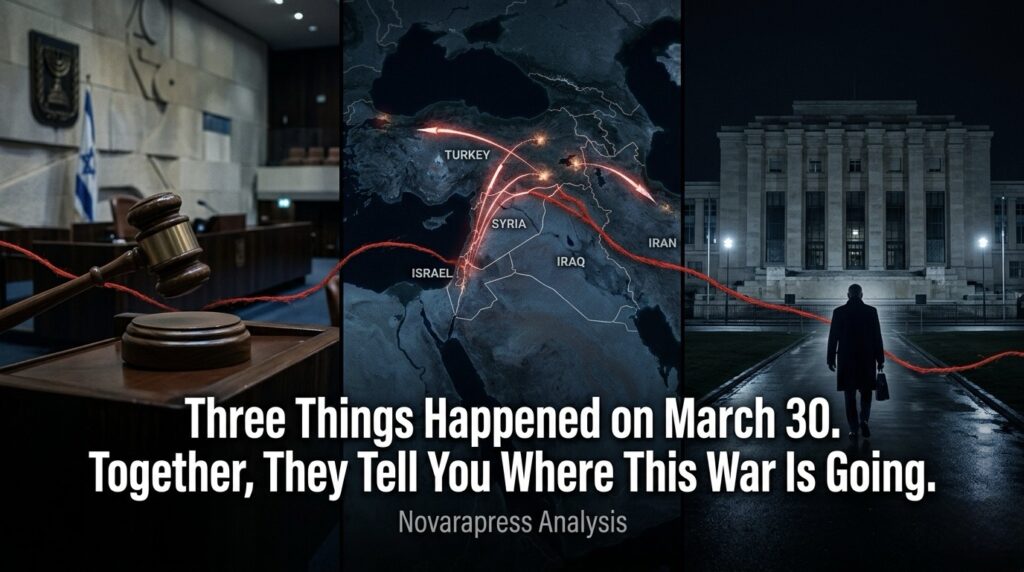
Three things happened on March 30, 2026, that did not make the same headline. They should have.
In Jerusalem, the Israeli Knesset passed a law making death by hanging the default sentence for Palestinians convicted of deadly attacks against Israelis — a law that critics from Germany, France, Britain, and the United Nations said was explicitly designed to apply to Arabs and not to Jewish citizens. In Geneva, a UN-linked diplomat resigned and posted on social media that he was leaving because the United Nations was “preparing for possible nuclear weapon use in Iran.” In Ankara, Turkey’s defense ministry confirmed that NATO air defenses had intercepted an Iranian missile entering Turkish airspace for the fourth time since the war began — and announced that “all necessary measures” were being taken “decisively and without hesitation.”
None of these three events caused the other. Each has its own logic, its own timeline, its own set of actors. But they arrived on the same day, in the same war, and together they describe something that individual headlines do not: the boundaries of this conflict are moving, in multiple directions, simultaneously.
The Death Penalty Law
The vote was 62 to 48. When it passed, Israeli National Security Minister Itamar Ben-Gvir — who was convicted in 2007 of racist incitement against Arabs — brandished a bottle of champagne in the parliamentary chamber. “We made history,” he wrote on social media. Prime Minister Benjamin Netanyahu sat motionless.
The law makes death by hanging the mandatory default sentence for Palestinians convicted in Israeli military courts of deadly nationalistic attacks. It requires executions to be carried out within 90 days of sentencing. It restricts access to legal counsel, limits family visits, and grants immunity to those involved in carrying out executions. It provides judges the option of imposing life imprisonment instead — but only under unspecified “special circumstances.”
The law does not, on its face, mention Palestinians or Arabs. It does not need to. As Human Rights Watch noted in its immediate response, the structure of the legislation makes its application clear: West Bank Palestinians are tried in Israeli military courts. Jewish Israelis are tried in civilian courts, and the civilian provision of the law applies only to attacks aimed at “negating the existence of the State of Israel” — a standard that experts say would not apply to Jewish Israelis. The result, as the legislation’s critics from Jerusalem to Berlin noted, is a death penalty that applies to one population and not the other.
“Make no mistake: this is a death-penalty law for Arabs alone,” said Doron Gitzin of the Association for Civil Rights in Israel. “Its message is unmistakable — Jewish lives matter, Arab lives are cheap.”
The law drew immediate international condemnation. The foreign ministers of Germany, France, Italy, and Britain issued a joint statement before the vote, describing the legislation as having a “de facto discriminatory” character and saying it undermines Israel’s democratic principles. The Council of Europe’s secretary-general called it a “serious regression.” A group of UN human rights experts warned that the bill’s vague definition of terrorism could result in the death penalty being applied to “conduct that is not genuinely terrorist.”
Israel has technically had the death penalty on its books since its founding, but had not used it — with one exception, the 1962 execution of Nazi war criminal Adolf Eichmann. The law passed Monday changed that. Whether it will survive legal challenge, whether Netanyahu will allow it to be implemented, and what it signals about the trajectory of Israeli politics are questions that will unfold over months. What it signals today is already visible in the reaction: a governing coalition that is moving in a direction that its closest European allies are willing to publicly condemn, in writing, before the vote.
The UN Diplomat Who Resigned
Mohamad Safa is not a senior UN official. He was the main representative of the Patriotic Vision Association — a Lebanese human rights organization — at the United Nations Economic and Social Council, a body that allows NGOs to participate in UN consultations. He had held that role for nearly twelve years.
On March 29, he resigned. He announced the decision on X with a photograph of Tehran — a city of nearly ten million people — and a statement that is worth reading in full for what it says and for what it does not prove: “I don’t think people understand the gravity of the situation as the UN is preparing for possible nuclear weapon use in Iran. I gave up my diplomatic career to leak this information. I suspended my duties so as not to be part of or a witness to this crime against humanity, in an attempt to prevent a nuclear winter before it is too late.”
His claim — that the United Nations itself is “preparing for possible nuclear weapon use in Iran” — has not been confirmed by any government, any intelligence service, or any other UN official. The United Nations has not responded to his allegations. There is no corroborating evidence from Reuters, the Associated Press, the BBC, or any other news organization with access to UN deliberations that the institution is doing what Safa claims.
What is true is this: Safa is a real person who held a real position at a real UN body, and he resigned over genuine alarm about the direction of the conflict. His concerns about nuclear escalation are shared, in more measured language, by serious analysts and former officials who have been publicly warning since the war began that the logic of the conflict — Iran’s nuclear program as the stated casus belli, the killing of Iran’s supreme leader, the decimation of its military command — creates conditions in which nuclear considerations become relevant in ways they were not before.
Trump himself warned Iran in March that the United States could target Kharg Island — Iran’s main oil export terminal — and possibly its desalination plants. The scale of destruction being contemplated and, in some cases, executed in this war is unprecedented in the region since 1991. Safa’s alarm, stripped of its unverifiable specifics, reflects a genuine anxiety shared by people with far more institutional credibility than his NGO role conferred.
The story is not that a senior UN official has insider knowledge of an imminent nuclear strike. The story is that the Iran war has reached a point where someone who spent twelve years in proximity to UN deliberations felt compelled to resign publicly rather than remain associated with what he was watching. That is a data point, not a smoking gun — but it is a real one.
Turkey’s Fourth Interception
The military reality is this: since the war began on February 28, Iranian missiles have entered Turkish airspace four times. NATO air defenses, including a US Arleigh Burke-class destroyer equipped with SM-3 interceptor missiles, have shot them down each time. Turkey has protested each incident. Iran has denied responsibility for each one.
Turkey’s position in this war is genuinely precarious. It is a NATO member — the only one in the Middle East — with a 350-mile border with Iran. It has maintained public neutrality, refusing to join the US-led coalition, hosting diplomatic talks between Iranian and regional officials, and repeatedly calling for a ceasefire. President Erdoğan has said clearly that Turkey does not want to be drawn into the conflict.
But the war is drawing Turkey in anyway. Iranian missiles — likely the result of the IRGC’s decentralized command structure, in which local commanders have been making targeting decisions without central approval since the killing of Iran’s supreme leader and senior military leadership — keep entering Turkish airspace. Each interception is a near-miss for a NATO Article 5 invocation. Each one prompts Turkish warnings to Tehran that are becoming less diplomatic in tone.
Turkey has also been watching with alarm as Washington has openly discussed arming Kurdish groups inside Iran to open a second front against Tehran. Trump publicly said he thought it was “wonderful” that Kurds would want to fight Iran. Turkey’s worst strategic nightmare is a Kurdish armed mobilization along its borders — and the Iran war, if it produces a power vacuum inside Iran or a US-Kurdish military partnership, could produce exactly that.
In response, Turkey has strengthened its military presence on its eastern border, deployed F-16s to northern Cyprus, and issued formal warnings to both Kurdish factions and to Washington that any Kurdish military participation against Iran would trigger a Turkish military response. Ankara has established new government directorates for “emergency situations and defense planning” — described as “civil defense” and “war preparedness” in the official Turkish government gazette.
This is not a military buildup aimed at joining the war. It is a military buildup aimed at staying out of it — at deterring the various actors whose decisions could pull Turkey in despite Erdoğan’s intentions. The distinction matters, but so does the scale of the preparation.
What These Three Things Have in Common
The Israel death penalty law, the UN diplomat’s resignation, and Turkey’s fourth missile interception are not connected by conspiracy or by coordination. They are connected by the logic of a war that is now in its second month with no clear endpoint, spreading consequences faster than the diplomatic capacity to contain them.
Israel’s domestic politics are being shaped by a far-right coalition that is using the war’s emotional atmosphere to advance legislation that it could not have passed in calmer times. Ben-Gvir said explicitly that he had been waiting for this moment. The war provided it.
The nuclear anxiety that Mohamad Safa expressed — however imprecisely — reflects a genuine feature of this conflict that serious analysts share: the war was launched partly to destroy Iran’s nuclear program, Iran’s military leadership has been decimated, the command structure is fragmented, and the question of what a cornered and weakened Iran might do or what the US and Israel might feel compelled to do if the war drags on without achieving its objectives is one that no one in a position of authority is discussing publicly with adequate honesty.
And Turkey — a NATO member, a regional power, a country with its own complex relationships with both Iran and the Kurdish groups that Washington is eyeing as potential proxies — is being drawn into a conflict it does not want, by the physics of geography and alliance that operate regardless of Erdoğan’s preferences.
A war that began on February 28 as a targeted US-Israeli operation against Iran’s military and nuclear infrastructure has, in one month, produced a global energy crisis, a humanitarian crisis in the Gulf, a food security emergency in the Northern Hemisphere, a potential nuclear escalation debate, a discriminatory death penalty law in Israel, and the first serious military stress on NATO’s eastern flank since the current conflict began.
None of this was predicted. All of it was predictable. The gap between those two statements is where wars live.
If this analysis interests you, read next: Russia Is Helping Iran Kill Americans. Nobody Is Asking Why Trump Won’t Stop It.