
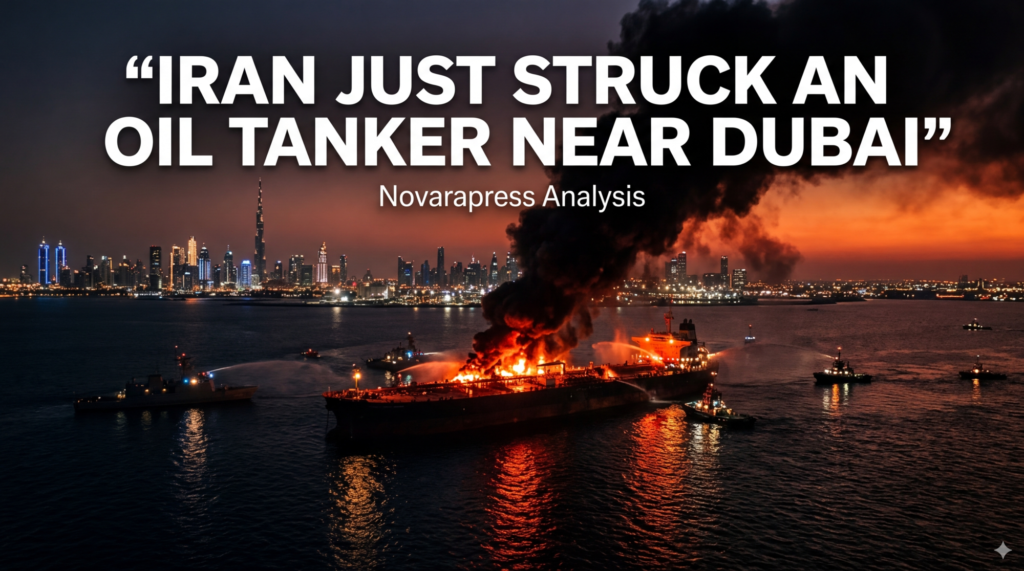
At just after midnight on March 31, 2026, a drone hit the Al-Salmi — a Kuwait-flagged very large crude carrier sitting fully loaded in the anchorage area of Dubai’s port, 31 nautical miles from the city. The tanker was carrying roughly 2 million barrels of oil worth over $200 million. The fire burned for hours. All 24 crew members survived. The global oil market did not absorb the news quietly.
West Texas Intermediate crude jumped nearly 4 percent toward $107 a barrel within hours. Brent crude, the international benchmark, was trading around $115 — up nearly 60 percent since the war began on February 28, when US and Israeli forces launched coordinated strikes against Iran. The Al-Salmi attack was not an isolated incident. It was the latest escalation in a conflict that has been reshaping the Middle East, global energy markets, and the calculations of every government with an interest in what flows through the Strait of Hormuz.
Which is to say: every government on earth.
What Actually Happened on February 28
To understand the tanker strike, you need to understand what triggered the month of war preceding it. On February 28, the United States and Israel launched coordinated air strikes against Iran — targeting its leadership, primary military infrastructure, and air defense systems. The operation had been building for months, driven by escalating tensions, the reimposition of maximum pressure sanctions, and Iranian domestic protests that the US assessed had significantly weakened the regime’s stability.
Iran’s response was immediate and comprehensive. Within days, it launched ballistic missiles and drones against multiple Gulf states — the UAE, Bahrain, Qatar, Kuwait, Saudi Arabia, and Israel. The UAE absorbed the most intense bombardment. Dubai Airport was hit by missile debris. A fire at Jebel Ali port was caused by a drone attack. The Ruwais Industrial Complex in Abu Dhabi — home to the UAE’s largest oil refinery, producing 922,000 barrels per day — was struck by a drone, forcing ADNOC to shut down operations.
By March 28, eleven people had been killed in the UAE alone, including two Emirati military personnel. The UAE’s air defenses had engaged 414 ballistic missiles, 15 cruise missiles, and 1,914 drones. The majority were intercepted — but interception debris and falling projectiles hit populated areas, damaged infrastructure, and created the kind of sustained civilian anxiety that changes a city’s character.
Dubai, which had spent decades building its identity as the Gulf’s safe, stable, cosmopolitan hub, was experiencing something it had not experienced before: sustained military targeting.
The Strait of Hormuz and Why It Changes Everything
Iran’s most consequential strategic move in this conflict has not been its missile strikes on Gulf cities. It has been its effective closure of the Strait of Hormuz.
The Strait of Hormuz is the narrow waterway between Iran and Oman through which approximately 20 percent of the world’s traded oil passes — roughly 20 million barrels per day. It is the single most important chokepoint in global energy supply, and Iran sits on its northern shore. The ability to disrupt or close the Strait is Iran’s most powerful strategic card, and it has been playing it.
Since the war began, Iran has targeted merchant vessels in the Gulf and at the Strait with missiles and explosive drones. Ship traffic through the Strait has slowed to a trickle. Insurance costs for vessels attempting to transit have spiked to levels that make many voyages economically unviable. The Al-Salmi had been sitting in Dubai’s anchorage for days — waiting, like dozens of other vessels, for conditions to change.
The practical effect on global energy supply has been severe. Oil production in the UAE dropped by between 500,000 and 800,000 barrels per day following the conflict’s escalation. Saudi Arabia’s Ras Tanura terminal — one of the world’s largest oil export facilities — has faced repeated incidents. Ongoing strikes on Gulf refineries, pipelines, gas fields, and tanker terminals have created supply disruptions whose full consequences are still unfolding.
Trump’s Ultimatum and Iran’s Answer
Hours before the Al-Salmi was struck, Donald Trump posted a statement on social media that described negotiations with what he called “a new, and more reasonable, regime” in Iran. He said great progress was being made. He then issued a threat: if a deal was not reached shortly, and if the Strait of Hormuz was not immediately reopened, the US would “completely obliterate” Iran’s electric generating plants, oil wells, Kharg Island — the offshore terminal through which 90 percent of Iran’s oil exports flow — and possibly desalination plants.
Iran’s response to this ultimatum was the drone strike on the Al-Salmi.
The message was unambiguous. Iran was not negotiating from weakness. It was demonstrating that it retained the capability and the willingness to escalate, to reach into Dubai’s port, to strike a fully loaded tanker belonging to a country — Kuwait — that had not directly participated in the strikes against Iran. The attack was a signal directed not just at Washington but at every Gulf state that has allowed its territory to be used for US military operations: your commercial infrastructure is within range.
US Secretary of State Marco Rubio, speaking to Al Jazeera, said Trump “always prefers diplomacy” but warned of “real consequences.” Iranian officials denied that any negotiations were taking place even as strikes continued on both sides.
What $107 Oil Means for the World
Oil above $100 a barrel is not merely an energy story. It is an economic event with consequences that extend across every sector of the global economy.
In the United States, the national average retail price of gasoline crossed $4 a gallon for the first time in more than three years on the day before the Al-Salmi attack. The economic and political implications are significant. Trump had campaigned on lowering energy prices and ramping up domestic production. Rising gasoline prices are among the most politically damaging economic indicators for an incumbent party, directly felt by households in ways that abstract economic statistics are not. The jump in oil prices is “starting to weigh on US household finances and become a political headache for Trump and his Republican Party ahead of the November midterm elections,” as Reuters noted.
Globally, the combination of higher energy costs and supply uncertainty is producing the conditions for what economists describe as stagflation — simultaneously rising prices and slowing growth. Countries that import most of their energy — including most of Europe, Japan, South Korea, India, and the developing world — face imported inflation that their central banks cannot address through interest rate policy without deepening economic slowdowns.
The Houthis’ announced entry into the conflict adds another dimension. If they resume targeting vessels in the Bab el-Mandeb Strait off the Red Sea — through which approximately 12 percent of the world’s trade typically passes — the supply chain disruptions extend beyond energy to everything that moves by container ship between Asia and Europe.
The UAE’s Uncomfortable Position
Dubai and Abu Dhabi have spent years building a position as the Gulf’s neutral commercial hub — maintaining relationships with Iran, Israel, the United States, China, and every other power simultaneously, profiting from the connectivity that neutrality enables. The Abraham Accords brought Israel into this network. The Belt and Road Initiative brought China. The US military presence at Al Dhafra Air Base brought Washington’s security guarantee.
The war has made this neutrality structurally impossible to maintain. The UAE is hosting US military forces that are participating in strikes against Iran. Iran is striking UAE territory in retaliation. The UAE is simultaneously calling for diplomacy, deploying its air defenses, and watching the commercial infrastructure that is its economic foundation come under sustained attack.
The costs are already visible. Oil production has dropped. Dubai Airport has been hit. Hotels have slashed prices as bookings collapsed and vacancies rose. Expatriates — who constitute the vast majority of the UAE’s population and workforce — have been fleeing, with private jet costs reaching $250,000 in the early days of the conflict. Pets have been abandoned in the streets as owners departed without them.
The UAE that emerged from this conflict, whenever it ends, will be a different place than the one that entered it.
What Comes Next
The variables shaping this conflict’s trajectory are numerous and moving simultaneously. Trump’s claim that negotiations are progressing may be accurate, may be wishful thinking, or may be a deliberate information operation designed to create domestic political space while military operations continue. Iran’s denial that any negotiations are occurring may reflect genuine policy, internal factional disagreement, or tactical positioning.
What is clear is that neither side has achieved its stated objectives. The US and Israel struck Iran to significantly degrade its military capacity and, some analysts suggest, accelerate regime change. Iran remains operational, continues to strike regional targets, and retains significant leverage through its control of the Strait of Hormuz. Iran struck back to demonstrate resilience and impose costs. The US and Israel continue their operations.
The conflict has already spread to Lebanon, where Israeli forces have suffered casualties. The Houthis have entered. Turkey reported a ballistic missile crossing its airspace. The regional containment that both sides might have preferred has not materialized.
The Al-Salmi burning in Dubai’s port is not the end of something. It is a data point in a conflict whose trajectory is determined by decisions being made in Washington, Tel Aviv, Tehran, and Riyadh — and whose consequences are felt in the price of gasoline at every filling station in the world.
The Strait of Hormuz has always been the world’s most important 21 miles of water. For the first time in decades, the full weight of that fact is being felt by everyone who fills a tank, pays an electricity bill, or moves goods by ship.
If this analysis interests you, read next: The New Proxy War Formula: Drones, Militias, and Deniability