
SHADOWNET ANALYSIS | April 11, 2026 | Intelligence. Analysis. Clarity.
Trump’s Ceasefire Gave Iran Exactly What It Needed — And the Clock Is Already Running
On April 8, 2026, President Trump announced a two-week ceasefire with Iran. Oil markets exhaled. Prices dropped 15 percent. Western headlines declared the worst over.
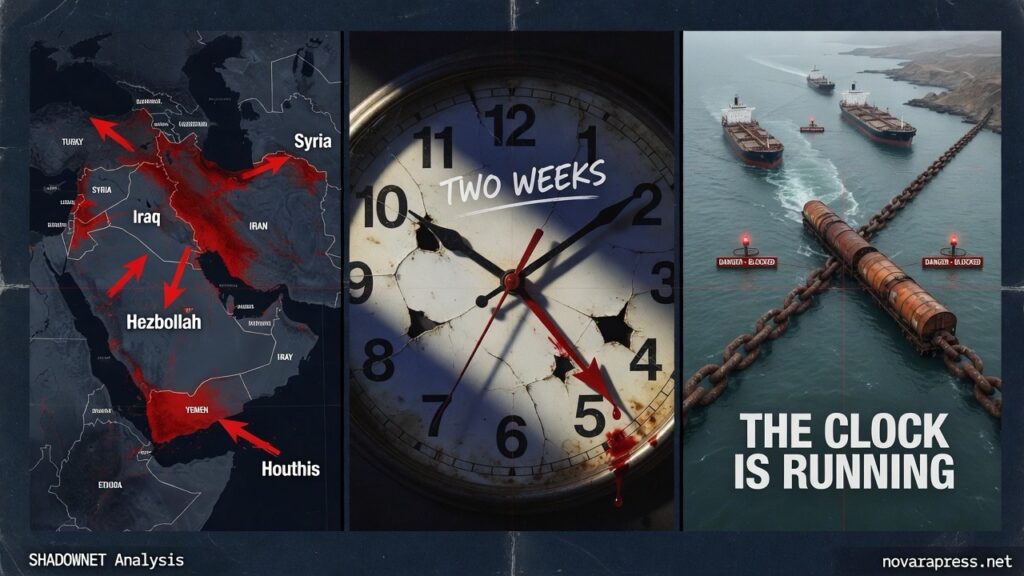
But a ceasefire with Iran is not peace. It is a deadline. And if the history of this regime tells us anything, it is that Tehran uses deadlines better than its enemies do.
How We Got Here: A War Iran Started by Threatening Its Own Region
The conflict that began on February 28 did not emerge from nowhere. It was the culmination of decades of Iranian behavior that systematically destabilized every country on its border.
Iran armed and directed the Houthis in Yemen — a proxy force that has spent years targeting civilian infrastructure in Saudi Arabia and the UAE, closing shipping lanes, and firing on commercial vessels in international waters. Iran funded and equipped Hezbollah, transforming Lebanon from a sovereign state into a forward operating base. Iran supplied weapons to militias across Iraq and Syria, ensuring that no government in the region could stabilize without Tehran’s permission.
The Strait of Hormuz — through which 20 percent of the world’s oil passes — was not a weapon Iran discovered in this conflict. It was a hostage Iran had been holding for years, threatening to execute whenever Washington applied pressure. The difference this time is that Iran actually pulled the trigger.
At peak crisis, daily transits through the strait fell from 150 vessels to six. Brent crude hit $144.42 per barrel — the highest ever recorded. The IEA called it the worst supply shock in the history of the oil market. The IMF warned of permanent global economic damage.
These are not the consequences of American aggression. They are the consequences of a regime that weaponized a global shipping lane shared by over 30 nations — including its own neighbors — to shield itself from accountability.
The Ceasefire: Strategic Pause or Strategic Trap?
Trump set a deadline: reopen Hormuz or face catastrophic consequences. When the deadline arrived, he announced a ceasefire instead. That sequence matters.
Two weeks is an unusually short window for any meaningful diplomatic progress on issues this complex. Iran’s nuclear program, its proxy network, its Hormuz leverage, and the status of ongoing Israeli operations in Lebanon are not questions that resolve in fourteen days. They are structural issues that have resisted resolution for decades.
What two weeks does do — very effectively — is give Iran time. Time to assess damage to its nuclear and military infrastructure. Time to reconstitute degraded units. Time to allow international economic pressure to build on Washington’s allies, whose energy-dependent economies absorbed the Hormuz shock disproportionately. Time to let the IMF’s April 14 forecast downgrade do its quiet political work.
Indirect talks are reportedly underway in Pakistan. Pakistan is a reasonable venue — a nuclear state with relationships on both sides. But proximity to a negotiating table is not the same as willingness to make concessions. And Iran has a documented record of using negotiating periods not to prepare compromises, but to prepare leverage.
Iran’s Neighbors Are Paying the Bill
Lost in the framing of this as a US-Iran bilateral conflict is a simpler truth: the countries that suffered most from Iran’s Hormuz strategy were not the United States and Israel. They were Iran’s neighbors.
Gulf states that depend on oil export revenue saw their markets convulse. Shipping-dependent economies across South and Southeast Asia absorbed the logistics costs of rerouting around a closed strait. Lebanon — already economically shattered — continued to absorb strikes as the Iran-Hezbollah front remained active even after the ceasefire announcement. Yemen’s civilian population remains caught between Houthi control and the consequences of a proxy war Iran funds but does not fight.
Egypt is now reportedly reassessing its strategic posture — not because Washington pressured it, but because Cairo has watched Iranian-backed destabilization consume one neighboring state after another and has concluded that neutrality is no longer a viable position. A new regional alignment involving Egypt, Saudi Arabia, Turkey, Qatar, and Pakistan is being quietly discussed. Its common thread is not ideology. It is the shared experience of living next to a state that treats its neighborhood as a battlefield.
Will the Two-Week Deadline Cause a Setback?
This is the question that matters most right now — and the honest answer is: possibly yes, and the conditions for it are already in place.
Consider what has to happen in fourteen days for the ceasefire to hold: Iran must agree to verifiable constraints on its nuclear program. The United States must offer terms Tehran’s hardliners can accept without framing as surrender. Israel must refrain from operations in Lebanon significant enough to trigger Iranian pressure to respond. The Houthis must stand down. And both negotiating teams must produce a framework with enough substance to be defensible domestically on both sides.
None of those conditions are currently met. Several are moving in the wrong direction.
Israeli strikes on Lebanese infrastructure have continued since the ceasefire announcement. The Houthis conducted coordinated attacks on Israeli targets as recently as April 6 and have not publicly committed to standing down. Iran’s hardline factions have spent the last six weeks positioning domestic resistance to the conflict as a point of national pride — making any compromise politically costly for the government in Tehran.
If the ceasefire collapses, the consequences of a second Hormuz closure would be worse than the first. Markets have partially priced in stability. A resumption of hostilities after a failed peace process would carry a credibility shock on top of the supply shock — and this time, the international community’s appetite for absorbing the cost would be significantly lower.
The IMF’s April 14 forecast will quantify the damage already done. The number will be large. It will increase pressure on all parties. But pressure cuts in multiple directions — and Iran has shown, consistently, that it responds to pressure by escalating rather than conceding, unless the terms on offer are sufficient to satisfy its core survival requirements.
The Structural Problem No Ceasefire Solves
The Strait of Hormuz will exist after this ceasefire ends, whatever the outcome. Iran’s coastline will still run along its northern shore. The geographic leverage that allowed a sanctioned, economically weakened state to inflict the worst supply shock in modern oil market history on the global economy will remain structurally intact.
That is not an argument for Iranian strength. It is an argument for a different kind of problem — one that military campaigns alone cannot solve and that no two-week negotiating window is designed to address.
The real question the ceasefire deadline forces is whether the parties can move from managing Iran’s behavior to resolving the underlying conditions that make that behavior possible. That requires a regional security architecture capable of providing Tehran with credible deterrence against attack without requiring it to hold global shipping hostage as an insurance policy.
That architecture does not exist. Building it takes years, not fourteen days.
The clock is running. And the history of Iran’s relationship with deadlines suggests we should not assume it ends well.
— SHADOWNET Analysis | novarapress.net
RELATED: The Four Scenarios After the Ceasefire Expires | Sudan’s Red Sea Position in the Hormuz Crisis | How Iran’s Proxy Network Survived Six Weeks of Strikes