
SECOND FRONT
The Strait of Hormuz carries 20 percent of the world’s oil. It has been effectively closed since February 28. The global economy has been absorbing that shock for five weeks — rising oil prices, fertilizer shortages, food inflation, energy crises in Asia, and a UN Security Council that cannot agree on how to reopen it.
Now there is a second strait.
The Bab al-Mandab — Arabic for the Gate of Tears — is a 29-kilometer-wide chokepoint at the southern entrance of the Red Sea, between Houthi-controlled Yemen and Djibouti. Approximately 15 percent of global maritime trade passes through it every year. All ships traveling between Asia and Europe through the Suez Canal must pass through Bab al-Mandab. There is no alternative route that does not add two weeks to the voyage and significantly increase fuel costs.
On March 28, Yemen’s Houthi movement fired ballistic missiles at Israel, formally entering the Iran war. They have since conducted multiple additional strikes. And they have made clear, through multiple official statements, that closing Bab al-Mandab is an option they are willing to exercise.
The question is not whether the Houthis can close it. They demonstrated during the 2023-2025 Red Sea crisis that they do not need to physically block the strait to shut down commercial shipping through it. They just need to make it dangerous enough that insurance companies refuse coverage and shipping companies reroute. The question is whether they will — and what happens to the global economy if they do.
The Houthis and Bab al-Mandab: What They Can Do
The Houthis have spent the past two years demonstrating their maritime warfare capabilities in ways that were visible to every shipping company and insurance underwriter on earth. Between 2023 and 2025, they attacked 178 vessels in the Red Sea using drones, anti-ship missiles, and explosive boats. They sank four ships and killed nine sailors. They forced the rerouting of hundreds of commercial vessels around the southern tip of Africa — adding up to two weeks to voyages and costing an estimated $20 billion per year in additional shipping costs.
They did all of this without closing Bab al-Mandab. They achieved commercial closure of the route through the demonstrated threat of attack, not through physical blockade. “The Houthis do not necessarily need to shut down Bab el-Mandab to affect energy markets,” Maged al-Madhaji, chairman of the Sana’a Center for Strategic Studies, told Foreign Policy. “Even limited or intermittent disruptions in the Red Sea could have outsized effects on energy markets, particularly given how sensitive current conditions already are.”
Those conditions are now significantly more sensitive than they were during the 2023-2025 Red Sea crisis. Then, there were large global oil stockpiles and the Strait of Hormuz was open. Now, Hormuz is closed, global emergency stockpiles are being drawn down, and oil is at $109 a barrel. A resumption of Houthi attacks on Red Sea shipping in this environment would not produce a modest price spike. It would compound an already severe energy crisis with a second simultaneous disruption to global commodity flows.
The Saudi Arabia Dimension
The Bab al-Mandab threat carries a specific additional danger that has received insufficient attention: Saudi Arabia’s emergency workaround for the Hormuz closure runs directly through Houthi range.
When Iran closed the Strait of Hormuz, Saudi Arabia activated its east-west pipeline — the Petroline — to reroute oil exports from Gulf fields to the port of Yanbu on the Red Sea, bypassing Hormuz entirely. Saudi Arabia has been routing approximately 5 million barrels per day — half its total production — through this pipeline to Red Sea terminals. The port of Jeddah has also been handling significantly increased container traffic for the same reason.
Both Yanbu and Jeddah sit within range of Houthi drones and missiles. Both have been targets before. If the Houthis choose to escalate and begin attacking Red Sea terminals or the tankers loading at Yanbu, Saudi Arabia’s emergency workaround disappears. The one significant alternative to the Hormuz chokepoint becomes a target rather than a solution.
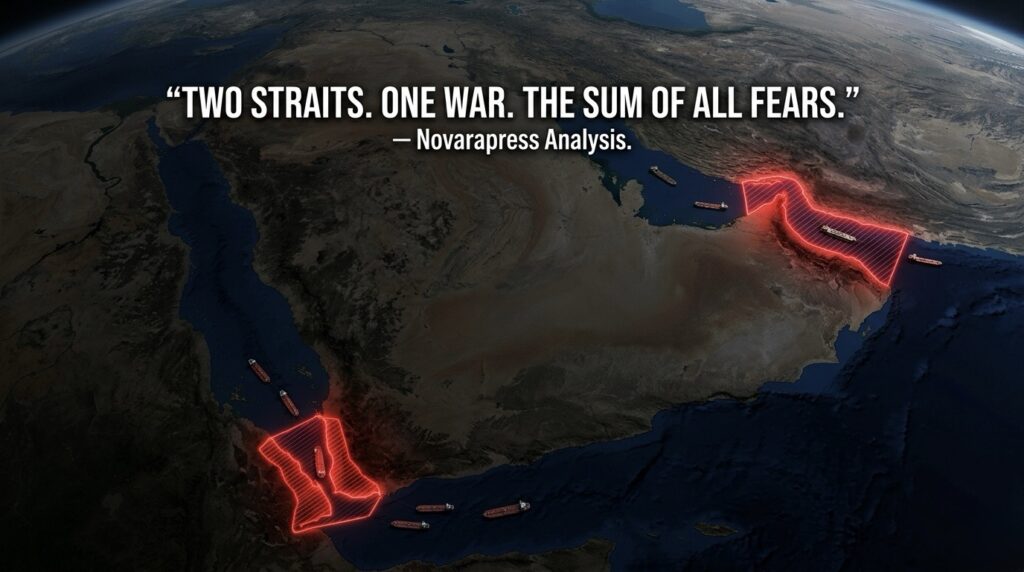
This is what analysts mean when they describe simultaneous closure of both straits as the “sum of all fears” scenario for global energy markets. It is not theoretical. The infrastructure for that scenario exists. The actors capable of triggering it are already in the war.
Why the Houthis Haven’t Closed It Yet
The Houthis entered the war on March 28, more than a month after it began. Their initial involvement has been limited — missile strikes against Israel, coordinated with Iran and Hezbollah, but no attacks on Red Sea shipping and no formal blockade of Bab al-Mandab.
This restraint is deliberate and reflects the Houthis’ strategic calculation. The group has explicitly stated its conditions for escalation: if Gulf countries join the US-Israeli coalition against Iran, or if the war escalates beyond its current scope, the Bab al-Mandab option will be activated. “The option of closing the Bab el-Mandeb Strait is a Yemeni option that can be implemented should the aggression against Iran and Lebanon escalate savagely, or if any Gulf state becomes directly involved in military operations,” Houthi Deputy Information Minister Mohammed Mansour told CNN.
The Houthis are also managing a strategic asset carefully. An unspent threat is more valuable than an expended one. As long as the threat of Bab al-Mandab closure hangs over the war, it constrains the options of every Gulf state, every European country with Red Sea trade interests, and the United States. The moment the Houthis act, the threat becomes a reality that others must respond to — and the Houthis draw into the direct crosshairs of US military response at a time when the US is already heavily committed to Operation Epic Fury.
Analysts at CSIS noted that the Houthis have been making land moves in Yemen during the past month — advancing toward rival-held territory on the southwest coast that would give them higher ground and better launching positions for attacks on Bab al-Mandab. They did not make these moves during the previous Red Sea campaign. The preparation suggests escalation is being planned, not just threatened.
The Bab al-Mandab Threat and the April 6 Deadline
The April 6 deadline — Trump’s ultimatum for Iran to reopen the Strait of Hormuz or face strikes on power plants — creates the precise conditions the Houthis have identified as their trigger for full escalation.
If the US strikes Iranian power plants after April 6, Iran will face the most severe military pressure it has experienced since the war began. Under those circumstances, the Houthis have said they will “significantly intensify their involvement.” The Bab al-Mandab option — held in reserve throughout the war’s first five weeks — would become Iran’s most powerful remaining card to play against the global economy.
The US military’s capacity to respond to a Houthi escalation in the Red Sea simultaneously with ongoing operations in Iran is limited. During the 2023-2025 Red Sea campaign, the US deployed two carrier strike groups to defend against Houthi attacks. Currently, only the USS Abraham Lincoln is in the Middle East after the departure of the USS Gerald R. Ford. Air defense munitions are already under strain from five weeks of intercepting Iranian missiles and drones across the region.
Opening a full second front in the Red Sea, at the moment of maximum pressure on Iran, would stretch US military resources in ways that US military planners have been quietly warning about since the war began.
Why Bab al-Mandab Matters More Than Hormuz in One Specific Way
The Strait of Hormuz carries more oil. But Bab al-Mandab carries something that Hormuz does not: the Suez Canal route between Asia and Europe.
When Hormuz closed, Asian countries lost their primary oil supply. That is devastating. When Bab al-Mandab closes — or becomes effectively impassable — European countries lose their primary trade route to Asia. Container ships carrying manufactured goods from China, electronics from South Korea, and textiles from Bangladesh to European consumers must either pay dramatically higher insurance premiums to transit a route under attack, or reroute around Africa, adding two weeks and significant cost to every voyage.
Europe is already facing a gas crisis from the loss of Qatari LNG through Hormuz. A simultaneous disruption to Red Sea shipping would compound a gas shortage with a manufacturing supply chain disruption and further inflation pressure. The European Central Bank has already postponed planned rate reductions and raised its 2026 inflation forecast. A second strait closure would make an already difficult situation significantly worse.
The Gate of Tears has been quiet for five weeks. It does not need to stay that way. And the conditions that would open it are arriving on schedule.
If this analysis interests you, read next: The Strait of Hormuz Is Closing. Here’s What That Does to the Global Economy.