
In 2022, a Kenyan content moderator named Daniel Motaung filed a lawsuit against Meta. His job — performed in Nairobi for a subcontractor called Sama — was to review videos of beheadings, child sexual abuse, and graphic violence, flagging content that violated Facebook’s community standards. He was paid approximately $2.20 per hour. He developed severe PTSD. When he tried to organize his colleagues, he was fired.
This is what the AI economy looks like from the Global South. Not the glossy promises of leapfrogged development and democratized technology. The unglamorous reality of cheap labor feeding the systems that wealthy countries build, own, and profit from — while the workers who make those systems function are treated as disposable inputs.
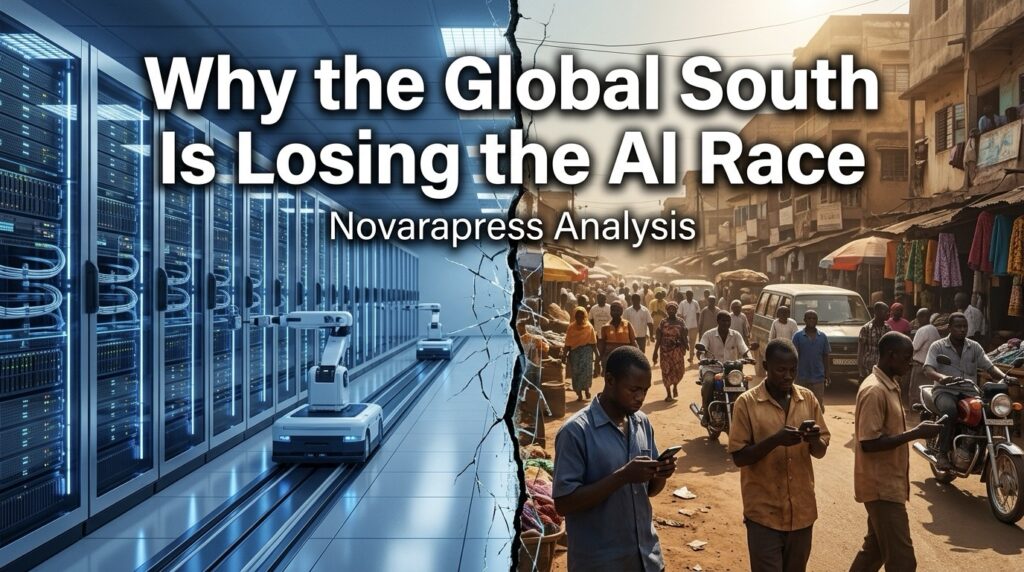
The AI race is real. The United States and China are genuinely competing for dominance in a technology that will reshape economic and military power for decades. But the framing of this race as a two-horse contest obscures a more consequential reality: the rest of the world is not in the race at all. It is the track the race is being run on.
What the AI Economy Actually Requires
The public face of artificial intelligence is large language models, image generators, and autonomous vehicles. The hidden infrastructure that makes these systems possible is less glamorous and more revealing about who benefits from AI development.
Training AI systems requires three things in enormous quantities: data, computing power, and human labor. The data comes from everywhere — scraped from the internet, purchased from data brokers, generated by users of platforms who receive no compensation for their contribution. The computing power is concentrated in a handful of hyperscale data centers, primarily in the United States, owned by a handful of companies — Microsoft, Google, Amazon, Meta — whose market capitalizations exceed the GDP of most countries.
The human labor is the part that gets least attention. AI systems require massive amounts of human annotation — workers who label images, transcribe audio, categorize text, and review content to train and refine the models. This work is systematically outsourced to low-wage workers in Kenya, the Philippines, India, Venezuela, and other countries where the cost of human attention is low enough to make large-scale annotation economically viable.
The Global South provides the labor. The Global North captures the value. This is not a new economic pattern. But it is a pattern that AI is intensifying and extending into new domains.
The Infrastructure Gap
Building AI capability requires infrastructure that most of the world does not have.
Reliable electricity is the starting point. Training large AI models requires sustained, high-density power consumption that is simply unavailable in countries with unreliable grids. Sub-Saharan Africa — home to 1.4 billion people — accounts for less than 1 percent of global data center capacity. The continent that will contribute the largest share of global population growth over the next thirty years has almost no capacity to host the infrastructure that will define the next thirty years of economic development.
Connectivity is the second constraint. AI applications require bandwidth — to access cloud-based models, to transmit training data, to deploy systems at scale. Broadband penetration across much of Africa, South Asia, and Latin America remains far below the levels that make AI-dependent economic activity viable for most businesses and individuals.
Compute access is the third. The specialized chips required for AI development — Nvidia’s H100 and A100 GPUs — cost tens of thousands of dollars each and are primarily allocated to the large cloud providers and well-capitalized research institutions in wealthy countries. A researcher at a university in Lagos or Dhaka cannot access the same computational resources as a researcher at MIT or Tsinghua. The playing field is not level. It is not close to level.
The Language Problem
The most widely used AI systems in the world — ChatGPT, Gemini, Claude, and their competitors — are overwhelmingly trained on English-language data. The result is systems that perform significantly better in English than in any other language, and dramatically worse in the languages spoken by the majority of the world’s population.
A farmer in rural Ethiopia asking an AI system for advice about crop disease in Amharic will receive a response far less reliable than the same question asked in English by a farmer in Iowa. A lawyer in Indonesia drafting a contract in Bahasa Indonesia will find AI assistance significantly less capable than her counterpart in London. A student in Nigeria writing in Yoruba has access to AI tools that are, in practice, less useful than those available to students writing in French or German.
This is not a minor inconvenience. Language is the interface through which AI systems deliver their value. A world in which AI works well for English speakers and poorly for speakers of Swahili, Hausa, Bengali, or Tagalog is a world in which AI amplifies existing inequalities rather than reducing them.
Some efforts are underway to address this. Google’s work on low-resource language models, Meta’s No Language Left Behind project, and various academic initiatives have made real progress. But the progress is incremental against a baseline of severe inequality, and the commercial incentives point in the opposite direction — toward optimizing for the highest-value markets, which are English-speaking markets.
The Regulatory Asymmetry
As the United States and European Union develop regulatory frameworks for AI — the EU AI Act, the US Executive Order on AI, various national strategies — they are creating rules that will shape how AI is developed and deployed globally. The countries that will be most affected by these rules had the least input in writing them.
When the EU decides that certain AI applications require specific transparency measures, or that high-risk AI systems must meet defined safety standards, these rules affect every company that wants to access European markets — including companies based in India, Brazil, and Nigeria that had no seat at the table where the rules were written.
This regulatory asymmetry is not new — it mirrors patterns in pharmaceutical regulation, financial standards, and environmental rules where wealthy country frameworks become de facto global standards. But in AI, the speed of development and the breadth of impact make the asymmetry more consequential than in previous technology cycles.
The Brain Drain Accelerant
The Global South is producing AI talent. Universities in India, Brazil, Egypt, Nigeria, and across Southeast Asia are graduating engineers and researchers with genuine AI capability. The problem is where those graduates go.
The combination of higher salaries, better infrastructure, more advanced research environments, and clearer career trajectories in the United States, Canada, the United Kingdom, and increasingly China, creates a systematic drain of AI talent from the countries that most need it. An engineer who could be building AI applications for Nigerian agriculture or Brazilian healthcare spends her career optimizing recommendation algorithms for a Silicon Valley platform.
This is rational individual behavior and catastrophic collective outcome. The countries that most need AI capability to address their development challenges are systematically losing the people who could build it.
What Would Actually Help
The gap between AI haves and have-nots is not inevitable. It is the product of specific policy choices, investment patterns, and institutional arrangements that could be made differently.
Compute access programs — subsidized or pooled access to high-performance computing for researchers in low-income countries — would reduce one of the most binding constraints on AI development outside the wealthy world. Several initiatives along these lines exist but operate at a fraction of the scale required to make a meaningful difference.
Investment in low-resource language AI — training models on African, South Asian, and Southeast Asian languages with the same intensity applied to English — would make AI systems genuinely useful for the majority of the world’s population rather than a tool that works best for those who already have the most advantages.
Data governance frameworks that give countries control over data generated by their populations — rather than allowing that data to flow freely to foreign platforms that monetize it without returning value to its source — would address the most fundamental asymmetry in the AI economy.
None of these changes are technically difficult. They are politically difficult, because they require wealthy countries and large technology companies to accept constraints on arrangements that currently benefit them.
The Stakes
The AI race between the United States and China will determine which country leads in military capability, economic productivity, and technological influence for the next generation. That competition is real and its outcomes matter.
But the more consequential question for the majority of the world’s population is not who wins the race between Washington and Beijing. It is whether the technology produced by that race will be accessible, useful, and governed in ways that serve people in Nairobi and Dhaka and Lagos — or whether it will be one more technology cycle in which the Global South provides the inputs and receives the externalities while the value concentrates elsewhere.
Daniel Motaung, the content moderator in Nairobi, was doing work that was essential to the functioning of one of the world’s most valuable AI systems. He was paid $2.20 an hour and fired for organizing. The gap between his contribution and his compensation is not an accident. It is a design choice. And it tells you more about who the AI economy is built for than any corporate presentation about democratizing technology ever will.
If this analysis interests you, read next: Surveillance States: The Technology Authoritarian Governments Love