
NOVARAPRESS ANALYSIS | April 1, 2026 | Geopolitics
What Are the Effects of the Strait of Hormuz Closure?
Short answer: The closure of the Strait of Hormuz has triggered the largest energy supply disruption in the history of the global oil market — cutting off 20% of the world’s daily oil supply, spiking Brent crude by over 60% in a single month, halting global shipping, driving up food and fertilizer prices, and pushing multiple economies toward recession. The effects are spreading across energy, food, inflation, shipping, aviation, and financial markets worldwide.
Since the US and Israel launched strikes on Iran on February 28, 2026, the Strait of Hormuz — the narrow waterway between Iran and Oman through which one-fifth of the world’s oil flows — has been effectively closed. What follows is a comprehensive breakdown of every major effect that closure is producing, in real time.
1. Oil Prices: The Biggest Shock Since the 1970s
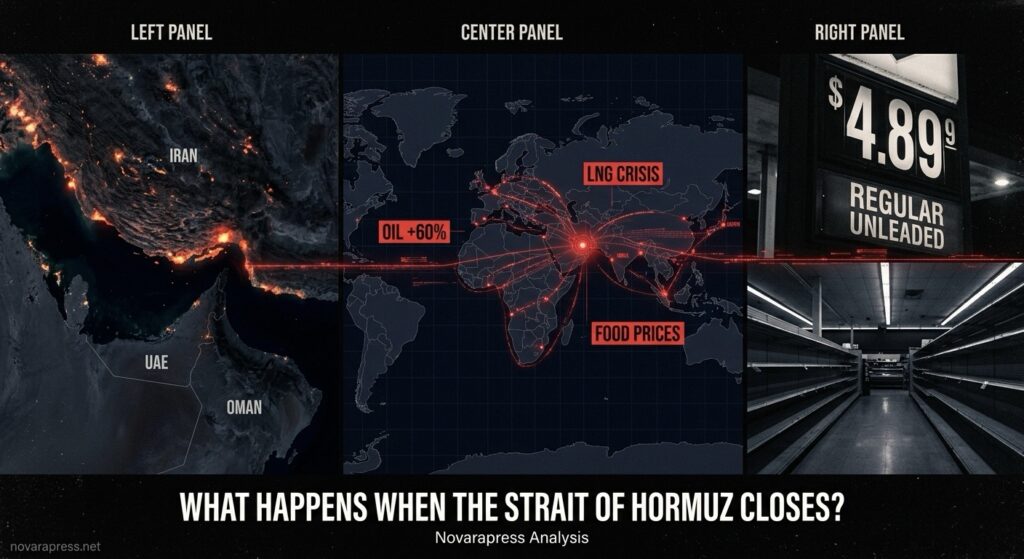
Before the war, Brent crude traded around $70 per barrel. Within days of the first strikes, it surged past $100 for the first time in four years. By late March, it had reached $126 per barrel at its peak — and Brent recorded its largest single-month price gain since records began in the 1980s, surging over 60% in March alone.
Analysts at Bloomberg Economics and Goldman Sachs are now openly modeling a scenario in which oil reaches $170–$200 per barrel if the strait remains closed into the second quarter of 2026. At $200 per barrel, economists describe the consequences as entering “unknown territory” — a level that has never occurred in history.
The IEA called it “the greatest global energy security challenge in history.” Oil flows through Hormuz: 20 million barrels per day — 4x larger than the 1973 oil embargo.
2. Natural Gas: Qatar’s LNG Exports Collapse
Oil is not the only energy product transiting the strait. Approximately 20% of all globally traded liquefied natural gas passes through Hormuz — the vast majority of it coming from Qatar, the world’s largest LNG exporter.
On March 4, QatarEnergy declared force majeure on all LNG shipments after Iranian attacks on its Ras Laffan facilities. Natural gas prices have spiked to levels not seen since the 2022 Russia-Ukraine crisis. Pakistan and Bangladesh — which source over 70-99% of their LNG from Qatar and the UAE — face acute energy shortages with limited storage and almost no alternative suppliers.
3. Global Shipping: Maersk, MSC, and Hapag-Lloyd Suspend Operations
Within 48 hours of the war beginning, the world’s four largest container shipping companies — Maersk, MSC, CMA CGM, and Hapag-Lloyd — suspended all transits through the Strait of Hormuz. Over 150 tankers anchored outside the strait rather than risk attack.
Ships rerouting around the Cape of Good Hope add 10–14 days to transit times and place enormous strain on global shipping capacity. Jebel Ali Port in Dubai — the largest container port in the Middle East and a critical transshipment hub — is experiencing severe congestion from diverted vessels.
For the first time in modern history, both of the Middle East’s major maritime corridors are simultaneously blocked. The Red Sea route — already disrupted by Houthi attacks — is also closed, leaving no viable alternative route through the region.
4. Food and Fertilizer: The Hidden Crisis
The most underreported effect of the Hormuz closure is its impact on food security. Up to 30% of internationally traded fertilizers normally transit the strait. Nitrogen fertilizer prices have already risen sharply — New Orleans urea prices jumped from $475 to $680 per metric ton in a matter of weeks.
The timing could not be worse. The disruption is falling directly on the spring planting season in the US Midwest, when soy and corn farmers need fertilizer deliveries. If those shipments don’t arrive, the impact on food prices will hit grocery shelves within months — in America and globally.
The IMF has specifically warned that low-income economies in Asia and Africa face acute food insecurity risk. Egypt’s president declared his country’s economy in a “state of near-emergency.” Djibouti’s finance minister warned of severe consequences for all of Africa.
5. Inflation and Recession Risk
Bloomberg Economics estimates US inflation running at 3.4% annually in March — up sharply from 2.4% in February — with rising fuel costs as the primary driver. The Federal Reserve’s 2% target has been effectively suspended by events.
For an average American household spending $5,000 per month, the war is already costing an extra $150 per month — $1,800 per year.
The Dallas Federal Reserve has modeled the economic scenarios explicitly:
- 1-quarter closure: WTI oil rises to $98/barrel, global GDP growth falls 2.9 percentage points
- 2-quarter closure: Oil reaches $115/barrel, growth stays negative through most of 2026
- 3-quarter closure: Oil reaches $132/barrel, global GDP falls 1.3 percentage points for the full year
Goldman Sachs and JP Morgan have both raised stagflation warnings — a combination of rising prices and slowing growth that central banks have almost no tools to address simultaneously.
6. Aviation and Tourism: Gulf Airspace Collapses
Iranian missile and drone strikes have forced repeated closure of Gulf airspace — one of the busiest aviation corridors on earth. Oman Air has cancelled flights to numerous regional and European destinations until April 15. Qatar Airways Cargo has suspended operations. Airlines across the region are operating on restricted schedules with sharply elevated costs and capacity constraints.
The tourism and hospitality industries of the UAE, Qatar, and Bahrain — economies that have spent decades diversifying away from oil — are facing an existential disruption. Iraq, Qatar, the UAE, and Saudi Arabia could see up to a 30% contraction in annualized GDP if the closure persists, according to analyst Paul Sankey of Sankey Research.
7. Financial Markets: Volatility and Stagflation Fear
The Iran war has pushed global stock markets into their most volatile period since the 2008 financial crisis. The S&P 500 recorded its fifth consecutive losing week — its longest streak in nearly four years. The Nasdaq fell more than 10% below its all-time high. Asian markets have shed 10–14% since the war began.
Bond markets are also under pressure as investors price in higher-for-longer inflation. The dollar has strengthened sharply as a safe haven, putting additional pressure on emerging market currencies and debt. Countries as geographically distant as Chile and Poland have abandoned expectations for interest rate cuts.
A Financial Times investigation found that $580 million in bets on falling oil prices were placed just 15 minutes before Trump posted on Truth Social about pausing Iran strikes — raising serious questions about insider trading at the highest levels of the US government.
8. Which Countries Are Hardest Hit?
- Japan and South Korea: Source 70–95% of their crude from Gulf states transiting Hormuz. Both have 2–4 weeks of LNG reserves.
- India: More exposed than China, with oil reserves covering only 20–25 days and heavy reliance on Middle Eastern crude.
- Pakistan and Bangladesh: Face acute LNG shortages with almost no alternative supply options.
- China: Has larger strategic reserves (~900 million barrels) but cannot absorb a multi-month disruption.
- Gulf States (Iraq, Kuwait, Qatar, UAE): Face existential economic threat as their export routes are blocked by the very war their infrastructure is being struck in.
- Africa: Food-importing nations facing cascading effects from fertilizer shortages and rising shipping costs.
The Bottom Line
The Strait of Hormuz is not simply an oil chokepoint. It is the physical connection between the Gulf’s energy production and the global economy. When it closes, the effects do not stay in the Gulf. They travel through oil prices, gas prices, fertilizer costs, shipping rates, inflation, currency markets, and food security — touching every country on earth, in roughly that order, over roughly that timeline.
A short closure is an energy shock. A long closure becomes a structural economic crisis. The world is now in week five. The IEA says April will be worse than March. And the April 6 deadline has not yet passed.
— Novarapress Analysis | novarapress.net