
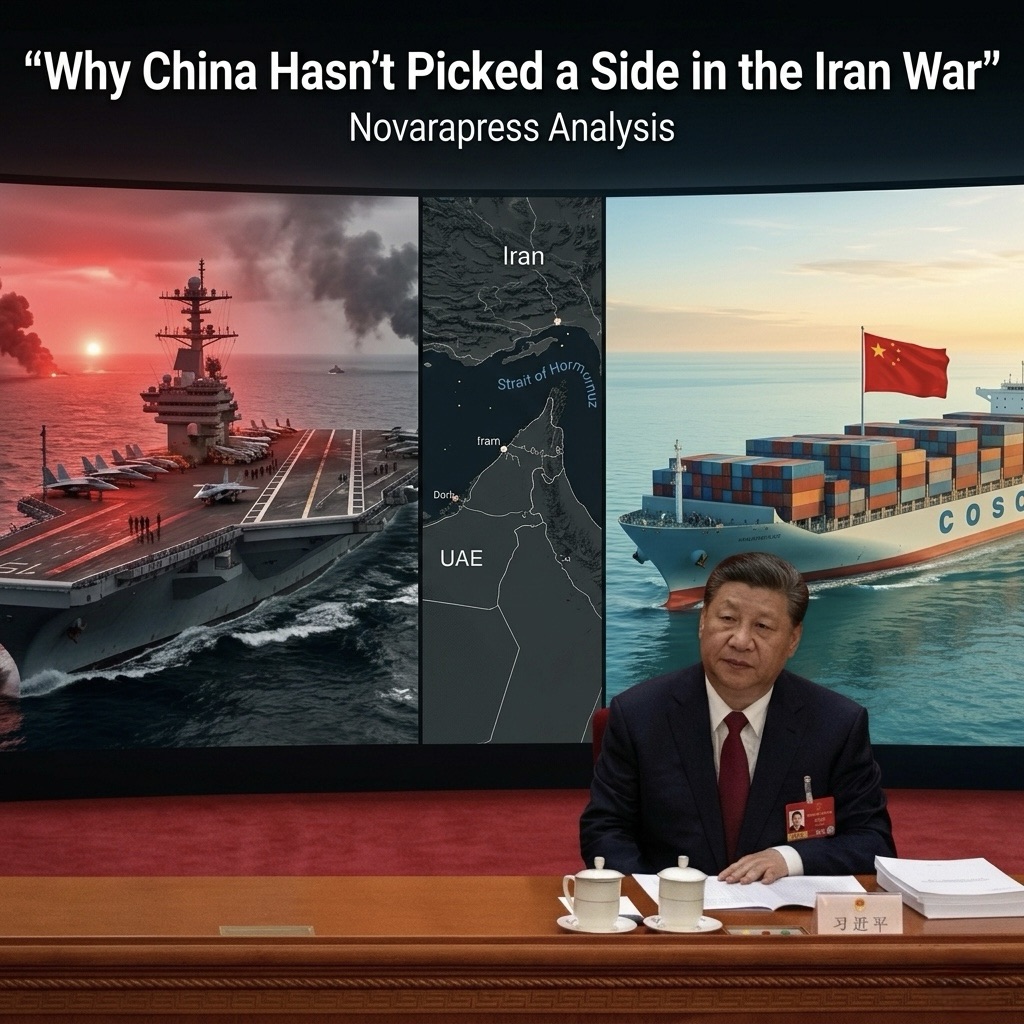
On a Sunday morning in late March 2026, a medium-sized Chinese cargo ship called the Newvoyager slipped through a narrow channel past the red sands of Larak Island, navigated carefully around Iranian-laid naval mines, and emerged safely in the Arabian Sea. It was broadcasting a single message via its tracking system: “ALL CREW CHINA.” A Chinese company had paid Iranian authorities for the vessel’s safe passage. The rest of the world’s ships were waiting.
That single transit tells you almost everything you need to know about China’s position in the Iran war — and why Beijing’s silence has been the most consequential geopolitical calculation of the conflict so far.
While the United States and its allies have been unable to reopen the Strait of Hormuz through military operations now entering their second month, China has managed to keep some of its ships moving through a closed strait by paying Iran directly. It has declined Trump’s request to send warships to a US-led coalition. It has postponed Trump’s visit to Beijing without explanation. And it has watched, with evident satisfaction, as America’s most significant military operation in years has produced the opposite of its intended effect — a stronger Iran, a weakened US position, and a global energy crisis that is damaging Washington’s domestic political standing far more than Beijing’s.
The Strategic Calculation Beijing Made
China’s response to the Iran war has been described by analysts as “strategic neutrality” — a deliberate posture of maximum ambiguity designed to extract maximum benefit from a conflict it did not start and does not want to end too quickly.
The calculation is straightforward. China has extensive economic relationships with both Iran and the Gulf Arab states. It is Iran’s largest trading partner and the primary buyer of Iranian crude oil — much of it purchased at significant discount under sanctions arrangements that give China access to cheap energy that its competitors cannot access. Simultaneously, Chinese companies have invested billions in Saudi ports, Emirati logistics infrastructure, and Gulf energy facilities. The Belt and Road Initiative runs directly through the Middle East.
Picking a side would destroy one relationship or the other. Staying neutral preserves both — and allows China to position itself as the responsible adult in a room set on fire by American and Israeli military action.
“China has very little to lose by staying quiet and a lot to gain by being seen as a neutral party,” said Ben Cavender, managing director at China Market Research Group. The analysis is correct as far as it goes. But it understates the active dimension of China’s neutrality — the ways in which Beijing is not merely passive but is strategically exploiting every aspect of this crisis.
The Special Passage Arrangement
The most concrete evidence of China’s leverage is the passage arrangement. Iran declared the Strait closed to all shipping on March 2. Within days, it had carved out exceptions for Chinese vessels, Russian ships, Indian carriers, and a handful of other nations with which it has active diplomatic relationships.
The logic is transparent. Iran cannot close the Strait to China without cutting off its own primary revenue stream — Chinese purchases of discounted Iranian crude are the financial lifeline sustaining the regime’s ability to fight the war. The arrangement is mutually beneficial in the short term: Iran gets continued income, China gets continued energy supply, and both get to demonstrate that the Strait closure is a selective tool aimed at American-aligned shipping rather than a blanket prohibition on maritime commerce.
Iranian Foreign Minister Araghchi was explicit in a call with Chinese Foreign Minister Wang Yi: “The Strait of Hormuz is open to everyone, and ships can pass through safely. But countries currently at war are not under consideration.” The message was equally explicit in what it did not say: China is not considered to be at war with Iran. The United States is.
This distinction — between countries Iran considers adversaries and countries it considers partners — is the foundation of China’s energy security during the crisis. While Japan has had to draw down strategic reserves, South Korea has faced spot market scrambles, and Europe has watched LNG prices double, China has maintained a degree of supply continuity that none of its competitors have managed.
Trump’s Request and China’s Answer
On March 14, Trump issued a public call for multiple countries — naming China, France, Japan, South Korea, and the UK — to send warships to the Strait of Hormuz to help reopen it. He argued that China, which depends on the Strait for the majority of its energy imports, had a direct interest in ensuring it remained open.
China’s response came through its Embassy in Washington: Beijing wants “an immediate cessation of hostilities” and believes “all parties have the responsibility to ensure stable and unimpeded energy supply.” The statement was a masterpiece of diplomatic non-commitment — expressing concern without making any commitment, calling for peace without doing anything to produce it, and implicitly placing responsibility on the parties doing the fighting rather than on China as a spectator.
Trump then linked China’s cooperation to his planned state visit to Beijing, suggesting the trip could be canceled if China did not help. Beijing signaled willingness to reschedule. The trip was postponed. China clarified that the postponement had nothing to do with Trump’s Hormuz request. Trump told reporters the Chinese “were fine” with the delay and that he had “a very good working relationship with China.”
The episode was, from Beijing’s perspective, a near-perfect outcome. China declined to join a US military operation, declined to assist in reopening a strait that Iran — its primary oil supplier — has closed, watched Trump’s planned Beijing summit collapse without accepting responsibility for its collapse, and maintained the appearance of productive dialogue throughout. Washington received nothing. Beijing lost nothing.
Ali Wyne, senior research and advocacy adviser for US-China relations at the International Crisis Group, described the dynamic with precision: “A show of US force that was meant to intimidate Beijing has instead served to puncture the illusion of US omnipotence. Unable to reopen the Strait of Hormuz alone, Washington now needs its principal strategic competitor to help it manage a crisis of its own making.”
The Narrative Beijing Is Building
China is not merely benefiting passively from American difficulties. It is actively constructing a counter-narrative about what the Iran war reveals about the two superpowers.
Chinese state media and government-aligned think tanks have consistently framed the conflict as evidence of American instability and recklessness. “The US does not provide security to the Middle East anymore,” Henry Huiyao Wang of the Center for China and Globalization told CNBC. “China’s influence and impact is growing daily given this war, while the image of the US is the opposite.” The framing is deliberate: China as the stable, responsible actor; America as the disruptive force that created a crisis it cannot resolve.
This narrative is being delivered directly to the governments most affected by the crisis. Chinese diplomats have been active throughout the Middle East, pledging constructive engagement and positioning Beijing as a potential mediator. Pakistan hosted a meeting on March 29 with Egypt, Saudi Arabia, and Turkey — with Chinese diplomatic presence — to discuss reopening the Strait. The meeting produced no immediate outcome, but the optics were significant: the countries trying to resolve the crisis through diplomacy were meeting in Islamabad, not Washington.
The Limits of Chinese Neutrality
China’s position is not without costs and constraints. The crisis has disrupted Chinese supply chains in ways that Beijing did not entirely anticipate. Chinese state-owned shipping company Cosco suspended all new bookings for routes to and from Middle East ports. A Chinese-owned vessel broadcasting its Chinese affiliation was struck by shrapnel while transiting the Strait on March 12 — demonstrating that Iran’s selective passage arrangements are not a guarantee of safety.
China has also been caught in an uncomfortable position regarding its relationship with Iran. Beijing has a 25-year strategic cooperation agreement with Tehran and is Iran’s most important economic partner. But it has publicly criticized Iranian attacks on Gulf states — countries where China has its own significant investments. Chinese Foreign Minister Wang Yi said “the war should not have happened” — a statement that implicitly criticizes the US and Israel for starting it, but also distances China from Iran’s retaliatory campaign.
The deeper constraint on China’s neutrality is that it is ultimately dependent on a resolution to the conflict that it is not willing to actively facilitate. China benefits from the crisis continuing — it weakens the US position, demonstrates American unreliability to Middle Eastern partners, and allows China to position itself as the responsible alternative. But China also needs the Strait to eventually reopen fully, needs stable Gulf energy supplies, and needs the global economy to not tip into the recession that a prolonged Hormuz closure could produce.
Strategic neutrality is profitable in the short term. In the medium term, China’s interests require the conflict to end — but on terms that do not restore American credibility or strengthen the US security architecture in the Gulf that Chinese strategy has spent years trying to erode.
What the Silence Actually Means
The most revealing aspect of China’s position is not what Beijing has said. It is what it has not said.
China has not condemned Iran’s closure of the Strait. It has not joined any international coalition to reopen it. It has not used its significant leverage with Tehran — as Iran’s primary trading partner, China has more influence over Iranian decision-making than any other country — to push for a ceasefire or a reopening of shipping lanes. It has not provided Washington with any substantive assistance in managing a crisis that is genuinely damaging the global economy.
What China has done is negotiate special passage for its own ships, call for diplomacy in language that commits it to nothing, position itself as the responsible counterpoint to American militarism, and watch the United States spend political capital, military resources, and international credibility on a war whose management it cannot control and whose costs it cannot contain.
The Chinese silence on the Iran war is not a failure to respond. It is the response — carefully calibrated, strategically profitable, and more consequential than any statement Beijing could have made.
A conflict that was supposed to demonstrate American strength has instead demonstrated that the United States needed China’s help to manage its consequences, asked for that help publicly, and did not receive it. That is a data point that every government watching this crisis — in Asia, in the Middle East, in Europe, and in Washington — will factor into its calculations about the relative power of the two superpowers for years to come.
If this analysis interests you, read next: The Strait of Hormuz Is Closing. Here’s What That Does to the Global Economy.