
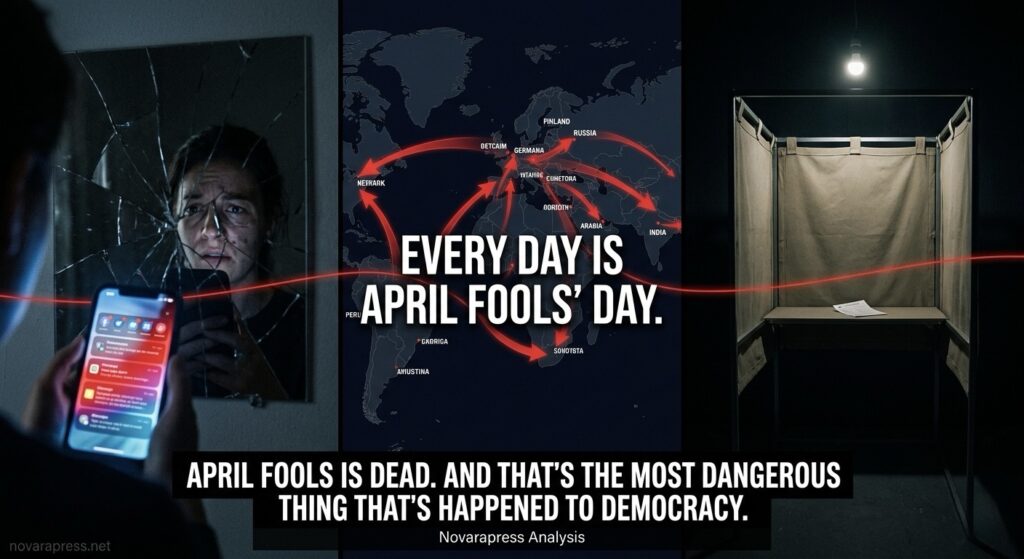
NOVARAPRESS ANALYSIS | April 1, 2026 | AI & Technology
April Fools Is Dead. And That’s the Most Dangerous Thing That’s Happened to Democracy.
Today is April 1. Somewhere right now, a brand is announcing a ridiculous fake product. A politician is posting a prank on X. A news outlet is running a joke story. And almost nobody is laughing — because almost nobody can tell which announcements are jokes and which ones are real.
That confusion is not accidental. It is the defining feature of political life in 2026. And it did not begin with AI, or deepfakes, or social media algorithms. It began with the deliberate weaponization of doubt — the systematic effort by powerful actors to make the truth feel unknowable, so that people stop trying to find it.
April Fools’ Day used to be one day a year. Now every analyst, writer, and expert who covers disinformation says the same thing: every day is April Fools’ Day.
The Prank That Became a Strategy
The tradition of April Fools dates to 16th-century France, when the switch from the Julian to the Gregorian calendar left some people celebrating the new year on the wrong date. They were mocked as fools — sent on false errands, tricked with fake information. The joke relied on a shared understanding: everyone knew, eventually, what was real.
That shared understanding no longer exists.
The BBC’s 1957 “spaghetti harvest” broadcast — a three-minute clip showing Swiss farmers harvesting pasta from trees — is remembered as a masterpiece of harmless deception. Audiences called the station in confusion. The reveal came quickly. Nobody made policy decisions based on it. Nobody went to war over it.
In 2026, the Dutch far-right politician Geert Wilders posted on April 1 that the Dutch Prime Minister had called him to hand over power — with a state of emergency, asylum center closures, and fuel tax cuts. Thousands believed it before the joke was revealed. Not because they were stupid. Because in the current political environment, that scenario was entirely plausible.
That quote is not from a dystopian novel. It appeared in a mainstream sports column published today. The author meant it seriously.
The Architecture of Manufactured Confusion
The collapse of epistemic certainty — the shared ability to agree on basic facts — did not happen by accident. It was engineered. And the engineers had specific goals.
Disinformation researchers have identified three distinct categories of actors who benefit from a world where nobody knows what is true:
Authoritarian governments benefit when their citizens distrust all information equally — including accurate reporting on corruption, atrocities, and failure. When everything is fake, nothing can be held against you.
Populist political movements benefit when institutional credibility collapses — when courts, media, health agencies, and election systems are all perceived as equally suspect. The phrase “fake news” was not a description. It was a tool. Applied systematically to any inconvenient fact, it renders the concept of factual accountability meaningless.
Attention-economy platforms benefit from outrage, confusion, and emotional activation — because these states drive engagement, and engagement drives revenue. The algorithm does not reward truth. It rewards reaction.
The World Economic Forum’s Global Risks Report 2026 placed misinformation and disinformation among the top short-term risks facing humanity — alongside geoeconomic confrontation and societal polarization. Crucially, the report noted it is “one of the few risks that catalyzes or worsens all other risks on the list.”
Disinformation is not just a problem. It is the environment in which all other problems now exist.
AI Changed the Scale. It Did Not Change the Strategy.
The arrival of generative AI has transformed disinformation from a labor-intensive operation into an industrial process. What once required a team of operatives, graphic designers, and social media managers can now be produced by a single person with a laptop and an API key.
Deepfakes have crossed what researchers call “a critical threshold” in 2026. In Ireland’s 2025 presidential election, a deepfake video falsely showed the eventual winner withdrawing his candidacy — with fake footage of national broadcasters confirming the news — released days before polling day. In the Netherlands, roughly 400 AI-generated synthetic images were deployed to attack political opponents in a single campaign cycle.
But the deeper shift is more subtle than deepfakes. AI has made it possible to:
- Generate thousands of slightly different versions of the same false narrative, making fact-checking at scale impossible
- Optimize disinformation for maximum emotional impact — targeting specific audiences with specific fears at the moment they are most susceptible
- Create “liar’s dividend” — the ability to dismiss any true video, document, or recording as potentially AI-generated, destroying its evidentiary value
- Flood information environments with low-quality content until credible sources become indistinguishable from noise
Evidence from the 2024-2025 electoral cycle showed that young voters on TikTok were regularly exposed to misleading political content — including AI-generated videos of political leaders — positioned alongside genuine posts in ways that made distinction impossible.
The April 6 Problem
Consider what is happening today, April 1, 2026, in real time.
The United States has a genuine deadline — April 6 — for a decision that could determine whether the global economy enters the worst energy crisis in history. Iran has issued genuine threats against 17 named American technology companies, with a deadline of tonight. A real war is in its 32nd day. Real missiles are striking real cities.
And today — April Fools’ Day — the information environment surrounding all of it is maximally degraded. Every satirical post about the war competes with real war updates. Every fake “ceasefire announcement” prank circulates alongside actual diplomatic statements. Every joke about oil prices is indistinguishable, at first glance, from a real market alert.
Intelligence services and state actors know this. April 1 is not a day off for information warfare operations. It is an opportunity. The cover of ambient pranksterism allows genuine disinformation to spread with reduced skepticism — because the standard response to suspicious content today is “probably just an April Fools joke,” not “let me verify this.”
One intelligence analyst’s framing cuts to the core: “April Fools’ Day is essentially a civilian-scale deception exercise. For an intelligence mindset, it is not about jokes — it is about controlling perception, testing reactions, and understanding how easily narratives can be manipulated.”
The Political Economy of Unreality
There is a reason the most powerful political actors in the world have invested heavily in degrading the information environment rather than improving it. Confusion serves power.
When citizens cannot agree on basic facts, they cannot coordinate around shared grievances. When every institution is equally suspect, no institution can hold the powerful accountable. When the concept of truth itself becomes partisan — when believing in verifiable facts marks you as belonging to one political tribe rather than another — the entire architecture of democratic accountability collapses.
This is not a side effect of the digital revolution. For many actors, it is the point.
The EU’s AI Act, enforced from August 2026, requires labeling of AI-generated content and disclosure of synthetic media — with fines up to 6% of global revenue for violations. It is the most serious regulatory attempt yet to address the problem at scale. Whether it is sufficient is a different question. The platforms that profit most from disinformation are not headquartered in Brussels. And the state actors who deploy it most aggressively answer to no regulator at all.
What Comes After Certainty
The collapse of shared epistemic ground is not inevitable. It is a choice — made by platforms that optimize for engagement over accuracy, by politicians who found lying profitable, by intelligence agencies that discovered confusion was cheaper than conventional warfare, and by all of us who learned to scroll past things we couldn’t verify rather than stopping to ask whether they were true.
Reversing it requires not just better technology or better regulation. It requires rebuilding the social infrastructure of trust — the institutions, habits, and norms that allow people to disagree about values while still agreeing on facts.
That is a longer project than any algorithm can solve. It is also the most important political project of the 21st century. Because a democracy in which no one knows what is true is not a democracy. It is a performance of one.
Happy April Fools’ Day. Or whatever this is.
— Novarapress Analysis | novarapress.net