
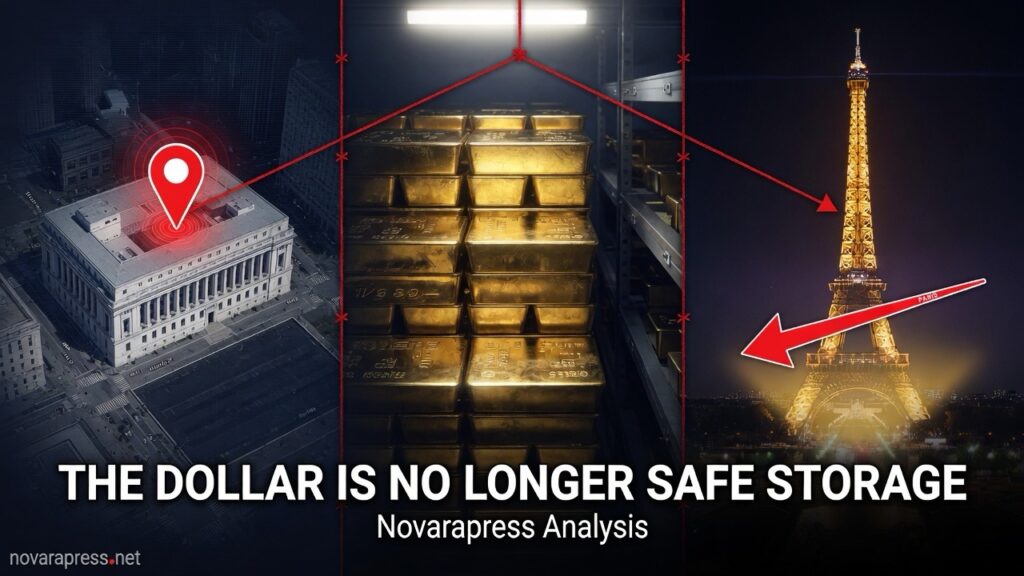
The Dollar Is No Longer Safe Storage: Why Allies Are Quietly Moving Their Gold Home
For most of the postwar era, storing gold in New York was considered the safest thing a central bank could do. The Federal Reserve Bank of New York sat 80 feet below street level in Lower Manhattan, holding metal on behalf of roughly 36 governments — the world’s most trusted vault. That era is ending.
In January 2026, France completed the repatriation of its last gold bar from the New York Fed — the first time in roughly a century that France held none of its reserves on American soil. The Banque de France netted approximately $15 billion in the process, converting old non-standard bars into London Good Delivery gold purchased within Europe. The official reason: technical compliance. The actual story is something else entirely.
The Dominoes Are Already Falling
France isn’t an outlier. It’s the leading edge of a trend that has been building for over a decade and is now accelerating into something that looks less like portfolio management and more like a geopolitical verdict.
Germany repatriated 674 tonnes of gold from New York and Paris between 2013 and 2017 — a multi-year operation that cost 7 million euros and was driven largely by a grassroots citizen movement that began in 2010. Even after that effort, roughly 37% of Germany’s 3,352-tonne reserve — over 1,200 tonnes — remains in Manhattan. As of January 2026, German economists and politicians across the political spectrum are calling for the rest to come home. The argument, put plainly by one senior European official: “Trump wants to control the Fed, which would also mean controlling the German gold reserves in the US.”
Italy faces the same pressure. Approximately 43% of Italy’s gold reserves currently sit in New York — a figure that one Italian economic commentator recently described as “very dangerous for the national interest” under the current American administration. The combined value of German and Italian gold held at the New York Fed now exceeds $245 billion.
The Netherlands, Hungary, Poland, and India have all moved to increase domestic gold holdings. The World Gold Council’s 2025 survey found that 59% of central banks now store at least part of their gold domestically — up sharply from 41% just one year earlier. Only 7% said they planned to increase storage abroad.
The Russian Moment Changed Everything
To understand why this is happening now, you need to go back to February 2022. When the United States and its allies froze roughly $300 billion in Russian sovereign assets following the invasion of Ukraine, every central bank in the world absorbed the same lesson simultaneously: proximity to American financial infrastructure is a liability, not an asset, when Washington decides you’re the enemy.
The logic is simple and brutal. If Russian dollar reserves could be frozen overnight, so could anyone else’s. The question facing every finance ministry on earth became: how do we hold strategic reserves in a form that cannot be seized, sanctioned, or frozen by a foreign government — including our closest partner?
Gold, physically held within national borders, is the answer. You cannot sanction a bar sitting in a Paris vault.
Central bank gold buying accelerated accordingly. The World Gold Council reported that central banks purchased over 1,000 tonnes of gold in both 2023 and 2024 — a pace not seen since the Cold War. China has been the most aggressive buyer, but European institutions have been adding steadily. Gold prices surpassed $3,200 per ounce in 2025.
The Question No One Wants to Answer
Repatriation has also revived an uncomfortable question that officials have spent decades dismissing as conspiratorial: is the gold actually there?
When Germany received its repatriated bars, some arrived with 2013 casting dates — not the original bars deposited in the 1960s. The New York Fed has never been subject to a comprehensive independent audit. House Bill 3795, introduced by Representative Thomas Massie, would mandate the first full audit of US gold holdings in over 60 years — covering Fort Knox, West Point, and the Denver Mint. The bill’s very existence signals that the question is no longer just for conspiracy forums.
For nations weighing whether to leave their gold in New York, the uncertainty doesn’t need to reach the level of proof to matter. Doubt alone is enough to justify bringing the metal home.
What This Means for the Dollar
None of this kills the dollar tomorrow. The US still holds the world’s largest gold reserve. The dollar remains the dominant currency for global trade and debt. But the gold repatriation movement is one of several converging signals that the dollar’s role as an unconditional safe haven is being quietly renegotiated.
A 2023 survey by the Official Monetary and Financial Institutions Forum found that 70% of central banks cited US political instability as a factor discouraging dollar holdings — double the figure from the prior year. When your closest allies are pulling their most irreplaceable assets out of your custody, the message doesn’t require translation.
France called it technical compliance. But it completed the move in January 2026, after years of watching Washington freeze Russian assets, weeks before the Hormuz closure rattled every financial market on earth, and amid a transatlantic relationship that Macron himself has described as requiring European strategic autonomy.
The gold came home. The trust did not go with it.