
SHADOWNET ANALYSIS | April 11, 2026 | Intelligence. Analysis. Clarity.
The Ceasefire Is Real. The Resolution Is Not.
On April 8, 2026, the United States and Iran agreed to a two-week pause in hostilities — the first formal de-escalation since the conflict began on February 28. Oil markets responded immediately, with Brent crude dropping roughly 15 percent from its historic peak of $144.42 per barrel. Airspace over parts of the Gulf began to cautiously reopen. Headlines declared relief.
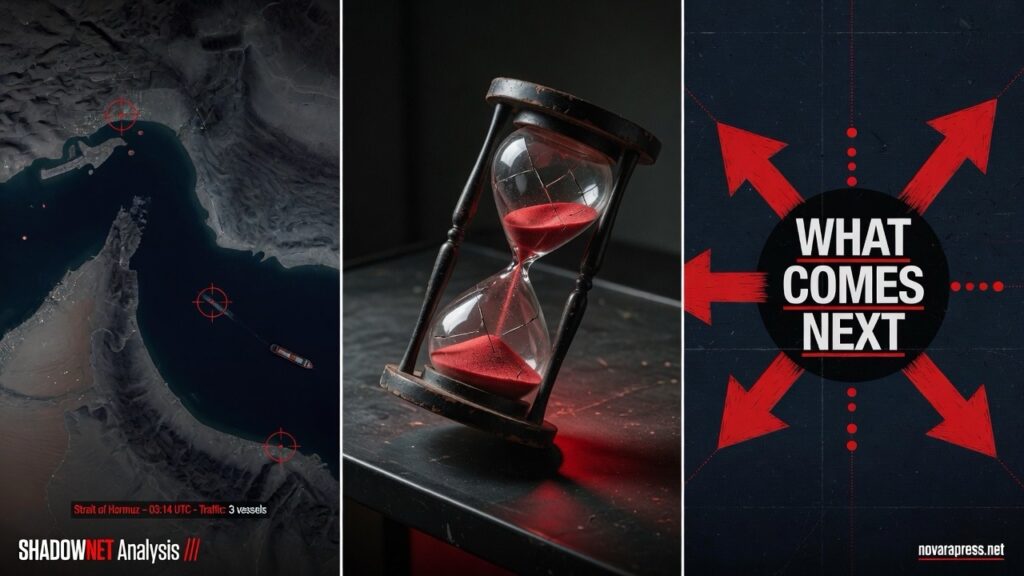
But a ceasefire is not a settlement. It is a clock.
When that clock expires, the world will face a set of decisions that will determine whether the most significant supply shock in modern oil market history becomes a footnote — or a prologue. The International Monetary Fund has already warned of permanent damage to the global economy regardless of outcome. The Strait of Hormuz, through which roughly 20 percent of global oil supply passes, remains effectively closed to most commercial traffic. And the three core questions that triggered this conflict — Iran’s nuclear program, its regional influence, and the future of Gulf shipping security — remain entirely unresolved.
What follows is not prediction. It is a structured assessment of the four most credible scenarios now being gamed out by analysts, intelligence services, and market strategists.
The Strategic Landscape Before the Scenarios
To evaluate what comes next, it is necessary to understand what the past six weeks actually produced — stripped of the rhetorical framing on both sides.
The joint US-Israeli military campaign against Iran entered the conflict with three publicly stated objectives: neutralizing Iran’s nuclear infrastructure, severely degrading its military capability, and — at the more maximalist end — enabling conditions for regime change in Tehran.
Six weeks later, the picture is mixed. Iran’s nuclear facilities sustained significant damage, but no authoritative assessment has concluded that the program was eliminated. The IRGC absorbed serious losses but continues to function as an operational force. The Islamic Republic’s government remains in power. And Iran’s most consequential weapon in this conflict was not a missile — it was geography.
By restricting and ultimately near-closing the Strait of Hormuz, Iran transformed a conventional military confrontation it could not win into an economic confrontation with global consequences. Daily transits through the strait fell from approximately 150 vessels to fewer than six at the crisis peak. The IEA described the resulting disruption as the worst supply shock in the history of the oil market. Brent crude hit $144.42 — a level never before recorded since the benchmark was established in 1987.
Those numbers do not disappear because a ceasefire was announced. They define the leverage architecture within which all four scenarios now operate.
Scenario One: Negotiated Framework — The Managed Exit
Probability: Moderate
Indirect talks between US and Iranian negotiators are currently underway in Pakistan. The choice of venue is not incidental — Pakistan is a nuclear state with relationships on both sides, and its involvement signals that at least some level of serious back-channel engagement is occurring.
In this scenario, the two weeks produce a preliminary framework: Iran agrees to partial Hormuz reopening and verifiable constraints on its nuclear enrichment program in exchange for phased sanctions relief, a halt to military operations, and implicit recognition that regime change is off the table as a US objective.
This outcome would resemble the 2015 JCPOA architecture, though likely with different terms and a different enforcement mechanism. It would satisfy enough of Washington’s stated goals to be politically sellable domestically, while giving Tehran the survival guarantee it has consistently prioritized above all else.
The obstacle: trust. Both governments have domestic constituencies that treat any compromise as betrayal. The Trump administration faces pressure from the Israeli government and segments of the Republican base who view anything short of total Iranian capitulation as failure. Tehran faces pressure from hardliners who see negotiation with Washington as existential surrender. The window for this scenario is narrow — and it closes fast if either government blinks publicly before a deal is signed.
Scenario Two: Ceasefire Collapse — Return to Conflict
Probability: Significant
Two weeks is a very short runway. If the Pakistan talks fail to produce even a framework agreement, or if either side conducts operations that the other interprets as ceasefire violations, the pause ends — and the second round of this conflict begins under worse conditions than the first.
Iran entered the ceasefire having demonstrated the viability of the Hormuz leverage strategy. A second closure would not shock markets in the same way the first did — the infrastructure for disruption is already in place, and insurance, routing, and reserve calculations have already been recalibrated. But it would confirm that the strait cannot be secured through military pressure alone, and it would land on a global economy already weakened by the first shock.
The Houthis remain an active variable. As recently as April 6, Houthi forces conducted coordinated strikes on Israeli targets. A separate closure of the Bab al-Mandeb Strait — the Red Sea chokepoint controlled by Houthi-aligned forces — would compound the Hormuz disruption and cut off two of the world’s most critical shipping lanes simultaneously. That scenario has not occurred. It remains possible.
For the United States, a return to conflict also carries escalation risks that were not fully resolved in round one. Iranian mine-laying operations across Gulf sea lanes — a publicly stated threat from Iran’s Defence Council — would create a maritime crisis of a different order than the traffic restrictions seen in the first phase. Clearing mines from the Persian Gulf is a weeks-long operation that cannot be conducted under fire.
Scenario Three: Frozen Conflict — The Korea Model
Probability: Moderate to High
Neither side achieves its maximum objectives. Neither side is willing to accept the costs of resuming full-scale conflict. The result is a prolonged, ambiguous state of partial hostility — reduced but not eliminated military operations, intermittent shipping disruptions, sustained elevated oil prices, and a diplomatic process that moves slowly enough to be called ongoing without producing binding outcomes.
This scenario is historically common in Middle East conflicts precisely because it allows all parties to avoid the domestic political cost of either clear victory or clear defeat. The US can claim it degraded Iran’s capabilities without admitting it failed to achieve its stated goals. Iran can claim it survived without admitting the cost it paid. Both governments can manage their domestic narratives indefinitely as long as there is no decisive event forcing a reckoning.
The economic cost of this scenario is significant and underappreciated. Oil markets do not need a fully closed Hormuz to remain disrupted — they need uncertainty. A frozen conflict in the Gulf sustains that uncertainty for months, possibly years. Shipping insurance premiums remain elevated. Alternative routing through longer sea lanes remains necessary. The structural cost to global trade is real even when individual dramatic events are absent.
The IMF’s forecast downgrade, scheduled for release on April 14, will begin quantifying what a prolonged partial disruption costs the world economy. The number is expected to be substantial.
Scenario Four: Broader Regional Escalation
Probability: Low but Non-Trivial
The ceasefire covers the US-Iran bilateral. It does not cover Lebanon, Gaza, Yemen, or the Red Sea.
Israeli operations against Hezbollah in Lebanon have continued despite the ceasefire announcement. An Israeli strike on a bridge in southern Lebanon linking the south to the Bekaa Valley prompted Lebanon’s president to describe the action as preparatory for ground invasion. If Israel launches a ground operation into Lebanon during the US-Iran ceasefire window, the pressure on Tehran to respond — from its own hardliners, from Hezbollah, from the broader Iranian-aligned network — becomes severe.
Iran’s strategic calculus in this scenario is acutely difficult. Allowing a major Hezbollah defeat while a ceasefire is nominally in place would damage Tehran’s credibility as a security guarantor across its entire regional network. But responding militarily risks ending the ceasefire and inviting resumed US strikes at a moment when Iran’s military infrastructure has already been degraded.
A broader escalation triggered by the Lebanese front — rather than the direct US-Iran axis — is the wildcard scenario that most formal risk models currently underweight. It requires no decision from Washington or Tehran. It only requires a miscalculation in Beirut, Tel Aviv, or the hills of southern Lebanon.
The Variables That Will Decide Which Scenario Wins
Four pressure points will determine which of the above scenarios materializes within the next two weeks.
The first is the Pakistan talks. Progress, stagnation, or collapse in those negotiations will be the clearest leading indicator of trajectory. Watch for whether the talks expand to include European or Chinese observers — broader participation signals movement toward Scenario One. Bilateral deadlock signals movement toward Scenarios Two or Three.
The second is the Lebanon front. Any significant Israeli ground operation in Lebanon during the ceasefire window fundamentally changes the political geometry for Tehran. It forces a choice that the ceasefire was designed to avoid.
The third is oil pricing. If Brent crude stabilizes below $100 during the ceasefire period, political pressure for a negotiated settlement increases on all sides. If prices rebound above $110 on continued disruption fears, the economic urgency driving diplomacy weakens — and the frozen conflict scenario becomes more attractive to parties who can absorb the cost.
The fourth is the IMF Spring Meetings on April 14. The updated global growth forecasts will publicly quantify the economic cost of continued instability. If the downgrade is severe — and preliminary signals suggest it will be — allied governments whose economies are absorbing the damage will significantly increase pressure on Washington for a durable settlement. That external pressure is a variable the Trump administration cannot fully control.
The One Thing All Four Scenarios Share
Across all four scenarios, one structural reality persists: the Strait of Hormuz cannot be secured through military superiority alone. It is a geographic constant. As long as any Iranian state or military presence exists on its northern shore, the potential to restrict transit exists. That is not an intelligence assessment — it is a map.
The conflict that began on February 28 did not resolve that reality. The ceasefire did not resolve it. Whatever comes after the ceasefire will not resolve it either, unless the diplomatic process produces binding arrangements that both parties have sufficient incentive to honor over the long term.
Whether that is achievable — given the accumulated distrust, the domestic political constraints on both sides, and the number of non-bilateral actors with the capacity to trigger escalation — is the central question of the next fourteen days.
The clock is running.
— SHADOWNET Analysis | novarapress.net
RELATED: The Proxy Network That Survived | Sudan’s Red Sea Position in the Hormuz Crisis | How China Wins Every Middle East War Without Firing a Shot