
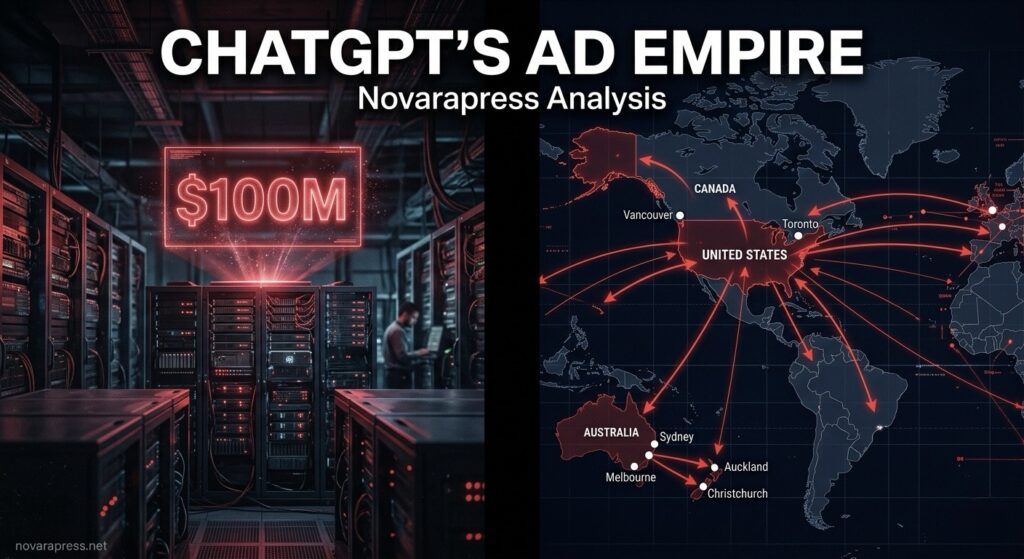
Six weeks. That’s all it took for OpenAI to cross the $100 million annualized revenue threshold from advertising alone. The milestone, disclosed on March 26, 2026, isn’t just a business headline — it’s a signal that the architecture of digital advertising is shifting beneath our feet, and the old guards of Silicon Valley are watching nervously.
The Numbers Behind the Hype
OpenAI’s ChatGPT advertising pilot launched quietly in early February 2026, targeting free-tier and Go-plan subscribers in the United States. The format is deliberately unobtrusive: sponsored messages appear at the bottom of ChatGPT’s responses, clearly labeled, and with one firm guarantee — they do not influence the AI’s answers. User conversations remain private and are never shared with advertisers.
The results came fast. More than 600 advertisers joined the pilot within weeks, including household names like Target, Ford, Adobe, and Mrs. Meyer’s. Holding company giants WPP Media, Omnicom, and Dentsu signed on as launch partners. By the six-week mark, the annualized revenue figure had crossed $100 million — and that number was generated from fewer than 20% of eligible users seeing ads on any given day.
Read that again: fewer than one in five eligible users saw an ad daily, yet the revenue clock was already ticking at nine figures annually. The implication is straightforward — the ceiling here is enormous.
The Irony of Sam Altman’s Pivot
Perhaps the most striking part of this story is how it contradicts OpenAI’s own stated philosophy. As recently as 2024, CEO Sam Altman described advertising as “a last resort” for the company’s business model. The shift is not lost on industry observers. What changed? The brutal economics of running frontier AI at scale.
OpenAI burns through approximately $10 billion annually in operational costs. Subscriptions alone — even at scale — don’t close that gap fast enough. Advertising, with its proven ability to monetize free users at massive volume, represents the same logic that built Google and Meta into trillion-dollar companies. OpenAI is following a well-worn path, but with one crucial difference: it’s arriving with a product that commands attention in a way search ads never fully achieved. ChatGPT’s 94.7 million U.S. users average nearly 80 minutes of engagement per month — a figure that makes advertisers salivate.
The Anthropic Jab
The competitive dimension of this story carries its own drama. When OpenAI announced its ad intentions in January 2026, rival Anthropic — maker of the Claude AI assistant — responded by making OpenAI’s ad push the centerpiece of its first-ever Super Bowl campaign. The message was pointed: Anthropic positioned itself as the ad-free alternative, the AI that exists to think, not to sell.
That positioning may resonate with enterprise clients and privacy-conscious users. But if OpenAI’s ad revenue continues to compound, Anthropic’s principled stance may prove costly in the long run. Money funds model development. Model development drives capability. Capability drives market share. The loop is unforgiving.
What the Critics Are Getting Right
The $100 million figure deserves scrutiny. Several agency executives have pointed out that ChatGPT ads are currently delivering clickthrough rates as low as 0.91% — a fraction of the 6.4% benchmark Google Search achieves. Measurement tools are still immature. Some advertisers report that the ads aren’t displayed frequently enough to assess their actual business impact. The self-serve advertising infrastructure, which will open the platform to smaller budgets beyond the current $200,000 minimums, isn’t even live yet — that’s scheduled for April 2026.
In other words: OpenAI crossed $100 million in annualized revenue during what is effectively the beta phase of a product that most advertisers haven’t even been able to access yet. The pilot is barely warmed up.
Global Expansion and the Road Ahead
OpenAI has already announced the next phase. International pilots are being launched in Canada, Australia, and New Zealand — the same cautious geographic expansion strategy Google once used to test AdWords beyond American borders before unleashing it globally. Former Meta ads executive David Dugan has been brought in to lead OpenAI’s global advertising solutions team, a hire that signals the company is treating this as a core business function, not an experiment.
The financial context underscores why this matters. OpenAI executives have told investors the company expects to generate more than $17 billion in revenue from ChatGPT consumers in 2026 alone. Advertising is designed to be a meaningful slice of that figure — specifically, the slice generated by the hundreds of millions of users who will never pay for a subscription.
The Bigger Picture: Who Controls the Conversation Controls the Commerce
For two decades, Google’s dominance in advertising rested on a single insight: people signal intent through search queries, and intent is the most valuable commodity in commerce. ChatGPT has something Google never fully had — conversational context. Users don’t just type keywords; they explain their situations, ask for advice, describe their problems in detail. That level of contextual richness, applied to advertising without compromising privacy, could represent a step-change in ad targeting sophistication.
Whether OpenAI can convert that potential into sustained, scalable revenue — while preserving the user trust that makes the platform valuable in the first place — remains the defining challenge. The $100 million milestone is a proof of concept. The real test begins when self-serve tools launch in April, when international markets come online, and when the ad frequency dial gets turned up beyond its current, deliberately conservative setting.
The AI chatbot that was supposed to replace search may be on its way to replacing something else entirely: the ad network that made search rich.
Related Analysis: As AI platforms like ChatGPT pivot toward advertising revenue, the ability to extract maximum value from these tools — before they become fully commercialized — becomes a strategic advantage. If you want to stay ahead of the curve, read our complete guide to crafting AI prompts that deliver expert-level results: The Prompt Is the Product: A Complete Guide to Writing AI Commands That Actually Work →
Analysis by SHADOWNET | novarapress.net | April 2026