
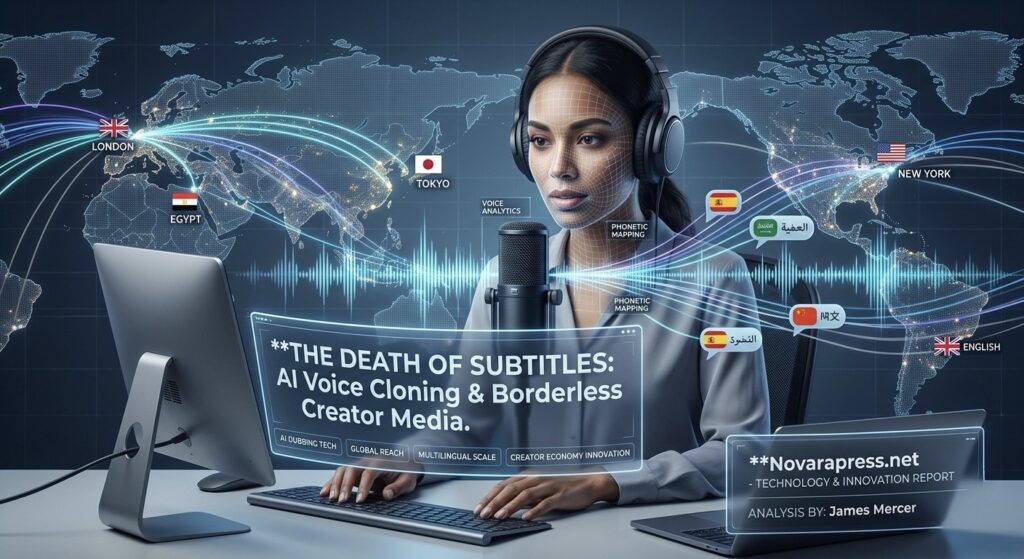
Introduction: The New Era of Borderless Content Creation
In the rapidly evolving landscape of the digital creator economy, producing high-quality content is merely the baseline. Today, the true battleground for content creators, digital marketers, and media brands is global distribution. For years, the ultimate ceiling for independent creators has been the language barrier. You could produce the most insightful tech review, the funniest comedy sketch, or the most profound educational video, but if it was only available in English, you were automatically excluding over 80% of the global population.
Historically, solving this problem required massive budgets. Top-tier creators like MrBeast pioneered the multi-language channel approach, hiring expensive teams of translators, voice actors, and audio engineers. However, as we navigate through 2026, the paradigm has completely shifted. Artificial Intelligence has democratized global reach. AI voice cloning, hyper-realistic lip-syncing, and automated dubbing have transformed from experimental beta tools into essential, everyday utilities for content creators.
At Novarapress, we continuously analyze the technologies reshaping digital media. In this comprehensive guide, we will dissect how AI dubbing works, explore the most authoritative tools available, and provide a step-by-step roadmap to scaling your audience globally—all while strictly adhering to platform policies and maintaining the authenticity your audience demands.
Why Subtitles Are No Longer Enough
Before diving into the technology, it is crucial to understand why we are moving past traditional localization methods. Subtitles (Closed Captions) have been the gold standard for accessibility and silent mobile viewing. However, relying solely on text to translate your content introduces significant friction:
- Visual Distraction: Viewers are forced to split their attention between reading text and watching the visual elements of your video. In fast-paced edits, this leads to a poor user experience.
- Emotional Disconnect: Reading a translation does not convey the tonal shifts, excitement, or nuance of the original speaker’s voice.
- Algorithm Preferences: Platforms like YouTube and TikTok are increasingly prioritizing fully dubbed, native-sounding audio tracks, as their internal metrics show significantly higher viewer retention rates for dubbed videos compared to subtitled ones.
The Mechanics of AI Voice Cloning and Lip-Syncing
To fully leverage these tools, it helps to understand the underlying technology. Modern AI dubbing relies on several advanced neural network architectures working in tandem:
1. Text-to-Speech (TTS) Evolution
We have moved far beyond the robotic, monotone voices of the early 2010s. Today’s AI models utilize deep learning to analyze thousands of hours of human speech. When you upload your voice for cloning, the AI maps your unique vocal characteristics—your pitch, cadence, breath patterns, and emotional inflections.
2. Cross-Lingual Style Transfer
The true magic happens during translation. If you speak English, the AI translates your script into Spanish. But instead of generating a generic Spanish voice, it uses Cross-Lingual Style Transfer to make the Spanish audio sound exactly like you. It preserves your unique vocal identity across linguistic borders.
3. Generative Adversarial Networks (GANs) for Lip-Syncing
Having a matching voice is only half the battle. If your audio is in French but your lips are moving in English, the “uncanny valley” effect will alienate viewers. AI video generation tools now use GANs to subtly manipulate the pixels around your mouth and lower face. The AI matches the visual phonemes (mouth shapes) to the newly generated foreign language audio, making it look as though you natively shot the video in that language.
Top Authoritative AI Tools for Creators in 2026
The market is flooded with AI applications, but for professional creators looking to monetize through Google AdSense, YouTube Partner Programs, and brand deals, quality and reliability are non-negotiable. Here are the industry-standard tools:
ElevenLabs: The King of Voice Cloning
ElevenLabs remains the undisputed leader in generative voice AI. Their “Dubbing” feature is specifically designed for creators. You can upload an entire video, and ElevenLabs will automatically transcribe, translate, and dub the audio while keeping your original voice. Their AI understands context, ensuring that a joke delivered in English retains its comedic timing in German.
HeyGen: Master of Visual Translation
HeyGen went viral for a reason. While ElevenLabs excels in audio, HeyGen offers an incredible end-to-end video translation service. You upload your talking-head video, select a target language, and HeyGen not only translates and clones your voice but also seamlessly adjusts your lip movements to match the new language perfectly. This tool is invaluable for educational channels, podcasters, and news analysts.
YouTube’s Native “Aloud” Integration
Google has aggressively integrated AI into the YouTube creator studio. Stemming from their Area 120 incubator, the “Aloud” tool is now deeply embedded in the platform. It allows creators to automatically generate high-quality dubs directly within YouTube Studio. While it may not offer the hyper-customized lip-syncing of dedicated third-party apps, it provides a seamless, zero-cost entry point for creators wanting to upload multi-language audio tracks to a single video.
A Step-by-Step Workflow for Global Content Domination
Integrating these tools into your production pipeline requires strategy. Here is a proven workflow to maximize efficiency without sacrificing quality:
- Script and Record Natively: Do not change your initial recording process. Speak naturally in your native language. High-quality original audio results in the best AI clones. Use a good microphone and a tool like Adobe Podcast AI to remove background noise.
- Generate the Transcript: Use an AI transcriber to get a highly accurate text version of your video. Review this text carefully. AI is smart, but it can still misunderstand industry-specific jargon or slang.
- Translate and Localize: Don’t just translate word-for-word. Localize the context. A cultural reference that works in the US might make no sense in Japan. Use tools like ChatGPT or Claude to adapt the script culturally before feeding it to the dubbing AI.
- Generate the Dub and Lip-Sync: Process the localized script and original video through HeyGen or ElevenLabs.
- Optimize Meta-Data for SEO: This is a crucial step for AdSense and algorithm discovery. When uploading a multi-language video (or creating separate regional channels), ensure your titles, descriptions, and tags are meticulously translated and keyword-optimized for the target region.
SEO and AdSense Compliance: Best Practices
When implementing AI, it is vital to adhere to Google’s Search and AdSense policies to maintain your monetization status and search rankings.
- Prioritize High-Quality Content: Google’s Helpful Content Update guidelines state that AI-generated content is not inherently penalized, provided it demonstrates E-E-A-T (Experience, Expertise, Authoritativeness, Trustworthiness). Use AI for translation, but ensure the core ideas and analysis are your own original work.
- Avoid Spammy Behavior: Do not auto-generate thousands of low-quality videos in 50 languages hoping to game the algorithm. Focus on 2 or 3 high-impact languages where your analytics show potential growth.
- Transparency is Key: Platforms are cracking down on undisclosed AI content. Always use the built-in platform labels (like YouTube’s “Altered or synthetic content” toggle) to declare that the video uses AI translation or voice cloning. Honesty builds trust with your audience and keeps your account in good standing.
The Ethical Considerations of Voice Cloning
As authoritative publishers at Novarapress, we must address the ethical landscape. Voice cloning technology carries inherent risks regarding deepfakes, misinformation, and copyright infringement. As a creator, you must ensure you are only cloning your own voice or voices for which you have explicit, documented commercial rights. Leading platforms now require voice verification (e.g., reading a specific prompt on camera) before allowing you to create a custom voice model, safeguarding against malicious use.
Conclusion: The Time to Scale is Now
The barrier to entry for global audience building has never been lower, yet the potential upside has never been higher. AI lip-syncing and voice cloning are not just flashy gimmicks; they are robust business tools that fundamentally alter the ROI of your content. By adopting these technologies responsibly, optimizing your SEO metadata for multiple regions, and maintaining your commitment to high-quality analysis, you can multiply your reach, unlock new revenue streams, and future-proof your brand in the creator economy.
What language will you conquer first? Let us know in the comments below, and stay tuned to Novarapress.net for more deep-dives into the technologies shaping the future of digital media.
🔗 Related Read from Novarapress:
While AI can help you dub your videos for a global audience, it is also fundamentally changing how search engines index your written work. Discover the new strategies content creators must adopt to survive the AI search era.
You Wrote the Content. AI Got the Traffic. Here’s What Content Creators Need to Know. →