
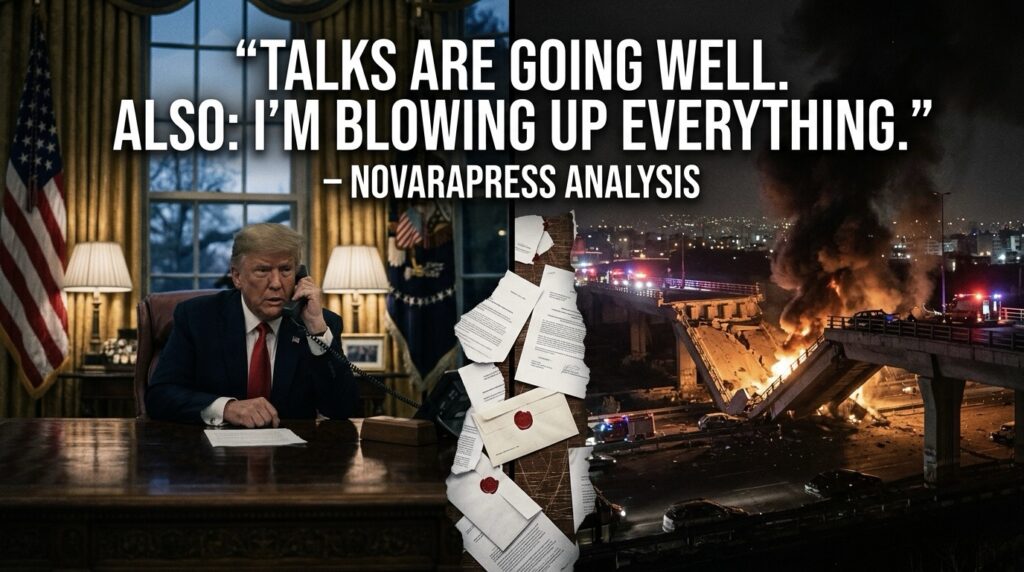
BOTH THINGS
In a single eight-minute phone call with Axios on Sunday morning, April 5, Donald Trump said all of the following:
That Steve Witkoff and Jared Kushner are holding “intense negotiations” with the Iranians. That negotiations are going well but “you can never reach the finish line” with the Iranians. That several days ago the US and Iran were close to agreeing to hold direct talks. That he bombed a bridge near Tehran because he felt the Iranians weren’t being serious. And that if no deal is reached by Tuesday, “I am blowing up everything over there.”
Then, separately, he told ABC News: “If we don’t make a deal with Iran, I am going to blow the whole country up.”
These statements were not made over weeks. They were not made by different officials with competing views. They were made by the same person, in the same interview, within minutes of each other. And they represent the clearest window yet into what the diplomacy of the Iran war actually is — and why it has produced, after 36 days of war, no agreement and no clear path to one.
The Iran War Contradictions: A Timeline of What Trump Said vs. What Happened
To understand Sunday’s statements, they need to be placed in the context of what came before them.
On February 25, three days before the war began, Iranian Foreign Minister Araghchi said a “historic” agreement with the United States was “within reach” in Geneva. Negotiations were ongoing. Witkoff and Kushner were at the table. The Omani foreign minister flew to Washington urgently after the talks ended to warn the White House that a deal was possible — and that Iran was not bluffing about its willingness to negotiate.
On February 28, the US and Israel launched Operation Epic Fury. The supreme leader of Iran was killed. The war began.
Witkoff’s explanation for why the talks failed has shifted repeatedly. He told Fox News on the first day of the war that Iran was “using talks to buy time.” He told reporters a week later that Iranian negotiators had “bragged” about having enriched uranium for eleven bombs and said they wouldn’t give diplomatically what the US couldn’t take militarily. Both claims have been disputed by third parties present at the negotiations, including Omani Foreign Minister Al Busaidi, who said Witkoff’s account was “inaccurate.”
The Arms Control Association published an analysis this week concluding that “by the time the third round of talks ended in Geneva, Trump had likely already made the choice to go to war” — and that “it is unlikely that any outcome short of complete Iranian capitulation to U.S. demands at the negotiating table would have averted the military strikes.”
The war began. And then the negotiations, remarkably, began again.
The Negotiation Cycle That Keeps Repeating
What has happened since February 28 is a pattern that has repeated itself five times in 36 days:
Trump claims negotiations are ongoing and going well. Iran denies negotiations are happening. Trump extends a deadline. Trump claims Iran requested the extension. Iran denies requesting anything. Strikes continue. Trump threatens escalation. Iran rejects the ultimatum. New deadline. New claims of progress. New denials from Tehran.
The specifics of each cycle are worth documenting because they reveal a structural problem at the center of the diplomatic effort.
In mid-March, Trump said he was in talks with “a very respected” Iranian official and that the US and Iran were “aligned on many key issues.” An Israeli official told Axios this was a reference to Iranian Parliament Speaker Ghalibaf. Ghalibaf denied any negotiations had taken place and called Trump’s claims an effort to “manipulate the financial and oil markets.” A source familiar with the discussions said no direct contact with Ghalibaf had actually occurred.
On March 26, Trump paused strikes on Iranian power plants for ten days, claiming Iran had “requested” the extension and that talks were “going very well.” Iran denied requesting anything. On March 30, Trump threatened to blow up desalination plants. On April 1, Trump addressed the nation and said the war was “nearing completion” and that a deal was preferred. On April 1, the home of Kamal Kharazi — the man arranging the back-channel for a Vance-Iran meeting — was struck. His wife was killed. On April 3, Trump posted that the military “hasn’t even started” destroying Iran. On April 5, in an eight-minute interview, Trump said negotiations were intense and going well and that he bombed a bridge because the Iranians weren’t being serious.
Each statement is real. Together, they do not form a coherent diplomatic strategy. They form something else.
What the Contradictions Actually Reveal
There are two possible frameworks for understanding Trump’s contradictory statements about the Iran war, and the truth may involve elements of both.
The first framework is strategic ambiguity. Trump has used contradictory public statements deliberately throughout his political career — saying multiple incompatible things simultaneously in order to preserve maximum flexibility, keep adversaries uncertain, and avoid being held to any specific commitment. Under this framework, the simultaneous claims of “negotiations are going well” and “I will blow up the whole country” are features rather than bugs. They keep oil markets uncertain, keep Iran guessing, and keep Trump’s domestic audience hearing what each segment of it wants to hear.
The second framework is genuine incoherence — a decision-making process in which Trump’s statements reflect his mood, his most recent conversation, and his immediate political calculations rather than a coordinated strategy with clear objectives. Under this framework, the contradictions are not designed; they are the product of a negotiating team (Witkoff and Kushner) that the Arms Control Association says lacked the technical expertise to understand what Iran was offering, operating under a president who had likely already decided to go to war before the final round of talks concluded.
The evidence supports the second framework more than the first. The specific claim that Iran requested the ten-day deadline extension — later denied by Iran — is not strategic ambiguity. It is either a lie told to calm oil markets (which it briefly did, before snapping back) or a genuine misunderstanding between the parties about what was being communicated through Pakistani, Egyptian, and Turkish intermediaries. The claim that the US was “close to a deal” days before bombing the bridge is not strategic ambiguity. It is Trump describing a negotiating process that was producing apparent progress and simultaneously revealing that he interpreted that progress as insufficiently fast and responded by escalating militarily.
The Negotiator Problem
Any honest assessment of the Iran war’s diplomatic trajectory has to reckon with Witkoff and Kushner’s role in it.
Witkoff is a real estate developer with no background in nuclear nonproliferation, Iranian politics, or Middle Eastern diplomacy. Kushner is a real estate developer and Trump’s son-in-law whose previous Middle Eastern diplomatic experience consisted of the Abraham Accords — normalization agreements between Israel and Arab states that notably did not include Iran. Both men have strong ties to Israel and to pro-Israel donors who have long advocated for military action against Iran.
The Arms Control Association analysis found that Witkoff made specific technical claims about Iran’s nuclear program in public briefings that were directly contradicted by US intelligence assessments published weeks later. He claimed Iran’s enriched uranium stockpile was “only” useful for weapons — a characterization that third parties present at the talks said misrepresented what the Iranians had actually said. He claimed Iran’s reactor was not producing medical isotopes — a claim the intelligence community did not support.
The Omani foreign minister — a professional diplomat from a country that had successfully mediated previous US-Iran nuclear talks — flew urgently to Washington after the final Geneva round to make the case that a deal was achievable. His warnings were not heeded.
Now Witkoff and Kushner are conducting “intense negotiations” with Iran through Pakistani, Egyptian, and Turkish intermediaries, with a deadline of Tuesday, to produce an agreement that ends a war they may have helped start by mischaracterizing what Iran was offering before it began.
What a Deal Would Actually Require
Trump told Axios on Sunday that “you can never reach the finish line” with the Iranians. That framing deserves examination, because it obscures what “the finish line” actually requires both sides to do.
The US 15-point framework demands that Iran reopen the Strait of Hormuz immediately, permanently abandon uranium enrichment, dismantle its nuclear facilities, remove its enriched uranium stockpile from the country, end support for regional proxies, and limit its ballistic missile program — all before any sanctions relief and with no guarantee that the US will not resume military pressure in the future.
Iran’s counterproposal demands a permanent ceasefire, guarantees that the US will not resume attacks, war reparations, and recognized sovereignty over the Strait of Hormuz — conditions the US has publicly called non-starters.
The gap between these positions is not the product of bad faith negotiating on either side. It is the product of two countries with fundamentally incompatible visions of what an agreement should accomplish. The US wants Iranian capitulation formalized as a treaty. Iran wants survival guaranteed before it concedes anything. These positions have not moved significantly in 36 days.
Trump said Sunday that “there is a good chance” of a deal before Tuesday’s deadline. The mediators — Pakistan, Egypt, Turkey — told Axios they are “less optimistic” but will work to the last minute. The most they are hoping for is a partial agreement that delays the ultimatum further, not a comprehensive deal that ends the war.
The pattern that has repeated five times in 36 days is likely to repeat a sixth time. The deadline will be extended, or something will be struck, or both. The war will continue. The negotiations will continue. And Trump will continue to say, in the same interview, that talks are going well and that he’s going to blow up the whole country — because in the logic of this war, both things are simultaneously true, and neither one is a strategy.
If this analysis interests you, read next: Iran’s 48-Hour Ultimatum: What Happens If Nobody Blinks