
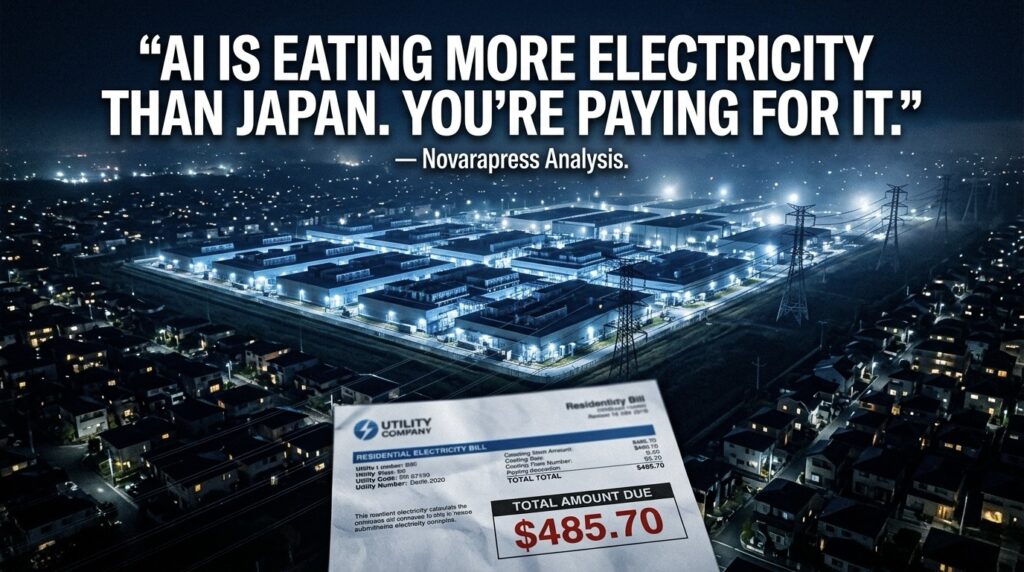
YOU’RE PAYING
In a suburb of Columbus, Ohio, a retired couple named Ken and Carol Apacki opened their electricity bill last month and found it had gone up again. They are not sure exactly why. Their usage has not changed. Their appliances are the same. But the bill is higher than it was last year, and higher than it was the year before that.
About forty miles away, outside the city of New Albany, a data center the size of several football fields runs continuously, twenty-four hours a day, seven days a week, drawing enough electricity to power tens of thousands of homes. It was built in less than two years. It will never stop running. And the cost of the power it consumes is, by design of the regulatory system that governs American electricity markets, partially distributed across every ratepayer in its region.
The Apackis are subsidizing artificial intelligence. They did not agree to this. Nobody asked them.
The AI Energy Crisis Nobody Is Discussing Honestly
The AI energy crisis is not a future problem. It is a present one, measurable in kilowatt-hours and electricity bills and grid operator warnings, and it is accelerating faster than either the energy system or the political system was designed to handle.
The International Energy Agency now projects that global data center electricity consumption will reach 1,100 terawatt-hours in 2026 — equivalent to Japan’s entire national electricity consumption, and an 18 percent upward revision from estimates made just six months ago. In the United States alone, data center electricity consumption has surpassed 25 gigawatts of continuous demand, driven primarily by the artificial intelligence infrastructure buildout that has transformed Google, Microsoft, Amazon, and Meta into some of the largest electricity consumers in the country.
Retail electricity prices in the United States have risen 42 percent since 2019, outpacing the 29 percent increase in the Consumer Price Index over the same period. Goldman Sachs projects that data center power consumption will boost core inflation by 0.1 percent in both 2026 and 2027. PJM Interconnection — the grid operator serving 65 million people from New Jersey to Illinois — has issued formal capacity warnings through 2028 and projects a six-gigawatt shortfall by 2027. Northern Virginia, which hosts the world’s largest concentration of data centers, has effectively halted new data center permits because the grid cannot accommodate more demand.
AI Data Center Energy Consumption: The Scale of the Problem
The scale of investment is almost impossible to comprehend. Google’s 2025 data center investment plan totaled $75 billion — more than doubling from $33 billion in 2024. Microsoft signed a 2 gigawatt nuclear commitment with Constellation Energy through 2040, described as the largest corporate nuclear agreement in history. Amazon secured 1.5 gigawatts of dedicated solar in Texas. Meta has announced multiple multi-billion dollar data center campuses across the United States and Europe.
Despite these commitments, over 60 percent of the power feeding US data centers still comes from fossil fuels. The renewable energy construction pipeline cannot match the pace at which AI data centers are being built and activated. Google, Microsoft, and Meta have quietly walked back near-term climate commitments as their absolute emissions rose in 2024 sustainability reports, even as they publicly committed to net-zero targets in future years.
Oracle’s situation illustrates the broader dynamic. The company disclosed this week a $20 billion funding shortfall for AI data center construction — a gap between the infrastructure it has committed to building and the capital it has available to build it. Oracle is not an outlier. The entire hyperscaler industry is in a race to build AI infrastructure at a pace that strains not just electricity grids but financing, construction labor, cooling water, and semiconductor supply chains simultaneously.
The IEA’s base case projection is that data center electricity consumption will double by 2030, reaching approximately 945 terawatt-hours globally. In all scenarios, AI data center energy consumption grows four times faster than total electricity consumption from all other sectors combined.
Who Is Actually Paying for the AI Energy Crisis
The regulatory structure of American electricity markets was not designed for loads of this scale, speed, or geographic concentration. When a data center company selects a site and begins drawing hundreds of megawatts of continuous load, the cost of the grid upgrades required to serve that load is typically socialized — distributed across all ratepayers in the utility’s service territory through rate increases.
Cathy Kunkel, an energy researcher at the Institute for Energy Economics and Financial Analysis, described the dynamic directly: “I think it’s almost inevitable, the way that these structures are set up, that ordinary people are going to end up subsidizing the wealthiest industry in the world.”
This is not theoretical. It is happening now, in Ohio and Virginia and Georgia and Indiana and Arizona. The capacity market prices in PJM have spiked nearly tenfold, driving retail electricity increases above 15 percent in some service areas. Dominion Energy in Virginia filed for its first base-rate increase since 1992, adding approximately $8.51 per month to a typical household bill in 2026.
The political response is bipartisan in an unusual way. Senators Josh Hawley, a conservative Republican, and Elizabeth Warren, a progressive Democrat, sent a joint letter demanding mandatory annual reporting of data center power usage. The GRID Act, introduced in February 2026, would require new data centers drawing more than 20 megawatts to generate their own electricity from off-grid sources, with civil penalties of up to $1 million per day for non-compliance. Virginia, Georgia, Indiana, and Washington have all enacted or proposed similar legislation.
The Iran War Connection to the AI Energy Crisis
The AI energy crisis and the Iran war are not separate stories. They are connected by the basic physics of energy production.
The Iran war has disrupted approximately 20 percent of the world’s oil supply through the Strait of Hormuz closure. Oil prices have risen from below $70 a barrel before the war to above $109 this week. Natural gas prices have followed. Data centers that run on fossil fuels — which is most of them — are now paying more for that energy. Those costs are passed to customers, which raises the prices of cloud computing, AI services, and every product that depends on them.
More broadly, the AI industry’s dependence on cheap, abundant electricity is being exposed at precisely the moment when cheap, abundant electricity is becoming harder to guarantee. The Iran war is an extreme version of a structural vulnerability that exists regardless of the conflict: a technology industry that requires ever-increasing quantities of power, in a world where the energy system is neither stable enough nor fast enough to provide it without significant cost to ordinary people.
What the AI Energy Crisis Requires
The AI energy crisis has solutions. They are not simple or fast, but they are not mysterious.
Data centers need to pay for the grid infrastructure their demand requires, rather than socializing those costs across all ratepayers. The GRID Act represents a reasonable starting point. The renewable energy construction pipeline needs to accelerate, which requires reforming permitting processes that currently add years to solar, wind, and transmission projects. AI hardware needs to become more energy efficient — and this is already happening, but efficiency improvements are not outpacing demand growth at current trajectories.
And ordinary electricity ratepayers need to understand what is happening to their bills and why. Ken and Carol Apacki in Ohio do not know that the price increase in their electricity bill is partly attributable to the infrastructure of companies worth trillions of dollars. That information is available. It is not being communicated.
The AI revolution is real. Its benefits are real. And the costs of building it — in electricity, in grid strain, in ratepayer bills, in carbon emissions — are real, measurable, and currently being paid by people who did not choose to pay them and were not asked.
If this analysis interests you, read next: You Wrote the Content. AI Got the Traffic. Here’s What Content Creators Need to Know.