
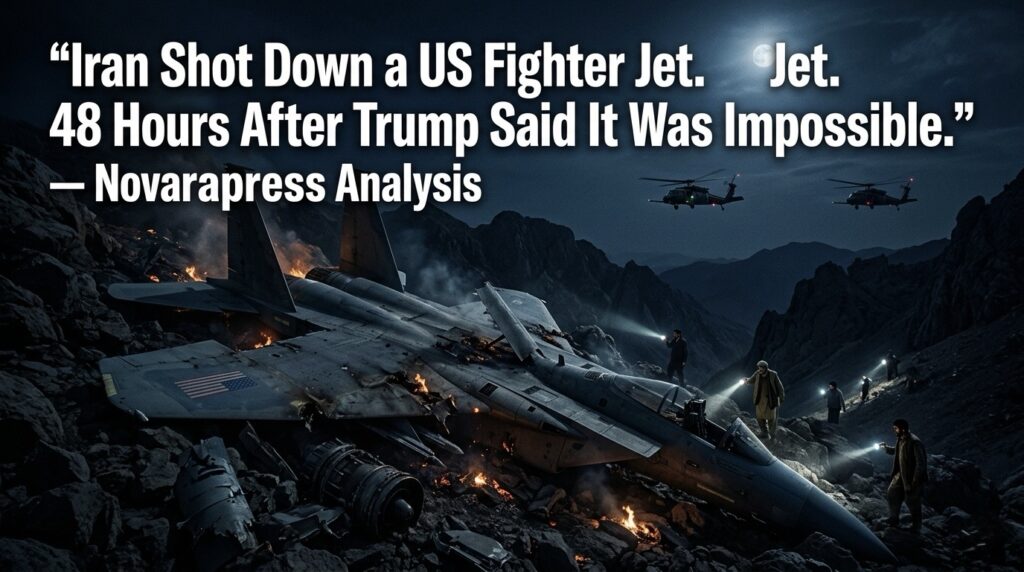
PROVEN WRONG
On Wednesday night, Donald Trump stood in the Cross Hall of the White House and told the American people this: “They have no anti-aircraft equipment. Their radar is 100% annihilated. We are unstoppable as a military force.”
Less than 48 hours later, Iran shot down a US F-15E Strike Eagle.
The jet went down over southwestern Iran on Friday. One crew member — the pilot — was rescued by US special forces in what Trump later described as a “miraculous” operation involving dozens of aircraft. The weapons systems officer, the second crew member, remained missing for more than 24 hours before being recovered on Saturday. Iran had offered a reward to any civilian who found them. Armed Iranian tribesmen shot at the US helicopters conducting the search and rescue operation. Two of those helicopters were hit. A US A-10 Thunderbolt attack aircraft, sent to assist the rescue, was also struck and crashed in Kuwait. Its pilot ejected safely.
In a single day, Iran caused two US military aircraft to crash and damaged two more — less than 48 hours after the president of the United States told the nation that Iran could not stop anything the American military chose to do.
What the US Fighter Jet Shot Down Over Iran Actually Reveals
The downing of the US fighter jet shot down over Iran is not, in itself, a strategic turning point. Losing aircraft in combat is a reality of air war, and the US military’s ability to conduct thousands of strikes over 36 days with only one confirmed aerial loss represents a significant operational achievement relative to the scale of the campaign.
But the incident reveals something important that the official narrative of Operation Epic Fury has been obscuring: Iran retains meaningful air defense capabilities, and the claims made by US officials about the state of those capabilities have been significantly overstated.
Defense Secretary Pete Hegseth has repeatedly stated that the US achieved air dominance over Iran early in the conflict. Trump said Wednesday that Iran’s radar was “100% annihilated.” The F-15E is one of the most capable multirole fighter jets in the US inventory — a sophisticated aircraft designed specifically to fight its way through defended airspace. Its loss means that something in Iran’s air defense network — a missile system, a man-portable launcher, an anti-aircraft gun — functioned well enough to bring it down.
Iran’s military spokesperson addressed this directly on Saturday, with notable confidence: “The enemy should know that we possess advanced air defense systems developed by the talented and distinguished youth of this country, which are being unveiled one after another in real operational conditions. We will certainly achieve full control over our skies and further demonstrate the weakness and humiliation of the enemy to the world.”
That statement may be partially propaganda. But it is not entirely false. The wreckage is real. The missing crew member was real. The civilians shooting at US rescue helicopters with automatic rifles while Iranian state TV broadcast a reward offer for captured American pilots — that was real, and it was visible in verified video footage circulating globally within hours of the incident.
The Gap Between the Narrative and the Reality
The US fighter jet shot down over Iran is significant not primarily because of what it means militarily, but because of what it reveals about the credibility gap at the center of the American war effort.
Trump’s narrative of the war has been built on a consistent set of claims: Iran is decimated, its military is destroyed, its air defenses are annihilated, the regime is begging for a deal, the war will be over shortly. These claims have been contradicted repeatedly by events — by Iran’s continued missile strikes on Gulf states, by the Strait of Hormuz remaining closed, by Iranian drones hitting Kuwaiti refineries, by the failure of multiple diplomatic deadlines to produce results — and now by an F-15E lying in pieces in southwestern Iran.
The contradiction has political consequences. Only one-third of Americans believe Trump has a clear plan for the war, according to CNN polling. Protests have broken out in Tel Aviv demanding an end to the conflict. Approval ratings have hit first-term lows. The gap between “we are unstoppable” and “Iran just shot down our fighter jet” is large enough that it is visible to ordinary Americans who are not following the detailed military situation.
NBC News put the contradiction directly: “The harrowing incidents have put in stark relief a growing challenge facing the president as the war enters its second month: Despite a daily bombing campaign and his triumphant wartime narrative, Iran retains enough military capabilities to inflict considerable damage to U.S. service members and America’s allies and assets in the Middle East.”
The Search and Rescue Operation as a Window Into the War
The rescue of the missing crew member deserves attention not just as a relief but as a data point about what this war actually looks like on the ground.
US special forces conducted a combat rescue operation inside Iranian territory, under fire, while armed Iranian civilians and military forces were actively hunting for the downed crew members with a state-sponsored reward for their capture. Iranian state television ran a crawler urging civilians to “shoot them if you see them” — referring to any US helicopter that appeared. Videos circulated of men with automatic weapons firing at low-flying US aircraft.
This is not the picture of a country whose military has been “completely decimated.” It is the picture of a country that has lost most of its conventional military infrastructure but retains significant irregular capacity — motivated civilians, dispersed forces, man-portable weapons — that makes the operational environment dangerous in ways that are difficult to quantify and even more difficult to eliminate from the air.
The rescue took more than 24 hours of continuous operations, involved dozens of aircraft, and required US special forces to operate in a hostile environment where the local population was actively hostile rather than passive or sympathetic. If Iran’s military has genuinely been degraded to the degree Trump claims, the rescue operation should have been straightforward. It was not.
What This Means for the April 6 Deadline
The US fighter jet shot down over Iran changes the political and psychological context of the April 6 deadline in ways that cut in both directions.
For Trump, the incident creates pressure to demonstrate resolve. A president who just lost a fighter jet over enemy territory and is facing doubts about his wartime narrative has stronger political incentives to follow through on threats than to extend deadlines again. Senator Lindsey Graham’s statement Saturday — that he is “completely convinced” Trump will use “overwhelming military force” — may reflect genuine confidence, or it may reflect an understanding that the political cost of another extension has risen significantly after the F-15 incident.
For Iran, the incident creates the opposite dynamic. Successfully shooting down a US fighter jet, striking the rescue helicopters, and maintaining active civilian resistance demonstrates that Iran retains the capacity to impose costs on the US military even after 36 days of intensive bombing. That demonstration of capability makes unconditional capitulation harder to sell domestically, regardless of what Iran’s leadership might privately prefer.
The last time a US fighter jet was shot down in combat was an A-10 Thunderbolt during the 2003 invasion of Iraq. Before that, it had not happened since the Gulf War. The loss of the F-15E over Iran is the first confirmed aerial loss in enemy territory in decades. It is a data point that Iran’s leadership will use — however quietly — in whatever negotiations are or are not happening through Pakistani and Turkish intermediaries before Monday evening.
If this analysis interests you, read next: Iran’s 48-Hour Ultimatum: What Happens If Nobody Blinks