
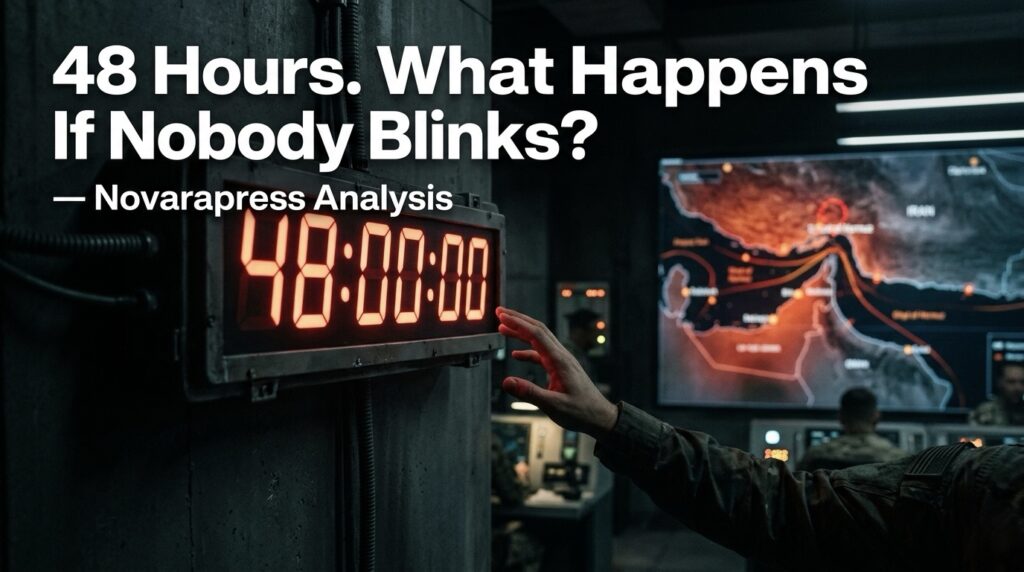
TIME IS UP
On Saturday morning, April 5, 2026, Donald Trump posted this on Truth Social:
“Remember when I gave Iran ten days to MAKE A DEAL or OPEN UP THE HORMUZ STRAIT. Time is running out — 48 hours before all Hell will reign down on them. Glory be to GOD! President DONALD J. TRUMP.”
Iran’s central military command responded within hours. A senior Iranian general called the ultimatum “a helpless, nervous, unbalanced and stupid action.” Tehran’s foreign ministry said the country “will not surrender to threats.”
The clock is running. The deadline expires Monday, April 6, at 8 PM Eastern Time. And the question that nobody in either capital seems able to answer clearly is: what actually happens when the clock hits zero?
Understanding the Iran War Ultimatum: A Pattern, Not a Plan
This is not the first ultimatum. It is the third.
On March 21, Trump gave Iran 48 hours to reopen the Strait of Hormuz or face strikes on its power plants. The deadline passed. Nothing happened immediately. On March 26, Trump extended the deadline by ten days — to April 6 — claiming Iran had requested the extension and that negotiations were “going very well.” Iran denied requesting anything. On April 5, with fewer than 48 hours remaining before the April 6 deadline, Trump issued a new 48-hour warning with the same language as the first one.
The pattern is visible: deadline, extension, new deadline. Each cycle produces intense market volatility — oil jumped past $109 on Friday before the latest ultimatum was posted — and each cycle ends without the stated consequences being fully implemented. The question this raises is not whether Trump is serious, but whether the deadlines themselves are the strategy rather than the precondition for one.
Senator Lindsey Graham, after speaking directly with Trump on Saturday, said he was “completely convinced that he will use overwhelming military force against the regime if they continue to impede the Strait of Hormuz.” He called it a clear choice: deal, or a “massive military operation.” That is the clearest signal yet from someone with direct access to the president that this deadline is intended to be real.
What the Iran War Ultimatum Actually Demands
The core demand is straightforward: Iran must reopen the Strait of Hormuz. But the diplomatic complexity beneath that demand is anything but simple.
Iran’s parliament passed a law in early March formalizing the government’s right to charge tolls for ships transiting the strait. The IRGC has been operating the closure as both a military weapon and a revenue mechanism, charging $2 million per tanker for ships from nations it designates as friendly. Reopening the strait — fully, unconditionally, without the toll system — would require Iran to publicly reverse a law passed by its parliament, abandon its primary remaining source of economic leverage, and accept terms that its military command has repeatedly and publicly rejected.
Iran’s own five-point counterproposal — which includes war reparations, recognized sovereignty over the strait, and inclusion of Lebanon in any ceasefire framework — is so far from what the US has proposed that direct negotiation has not even begun. The back-channel process, led by Pakistani Field Marshal Asim Munir with the involvement of VP Vance and Iranian Parliament Speaker Ghalibaf, has not yet produced a direct meeting between the parties. The man who was arranging that meeting, Kamal Kharazi, was struck in his home four days ago. His wife was killed.
The ultimatum is demanding something that Iran’s political and military leadership has no obvious domestic path to delivering — at least not within 48 hours.
Three Scenarios for What Happens at 8 PM Monday
The Iran war ultimatum resolves into three possible outcomes, and each carries consequences that extend well beyond the immediate military situation.
Scenario One: Iran partially complies. Tehran announces some gesture — allowing a limited number of neutral-flagged ships to transit, or suspending the toll collection temporarily — that falls short of full reopening but gives Trump enough to claim progress and extend the deadline again. This is the most likely scenario based on the pattern of the previous two cycles. It preserves the war’s basic dynamic without forcing either side into its most extreme position. Oil prices would fall sharply on any such announcement, providing Trump with a political win regardless of what actually changed on the water.
Scenario Two: The US strikes power plants. If Iran offers nothing and Trump follows through, the consequences are severe and cascading. Strikes on Iran’s electric generating capacity would affect hospitals, water treatment, heating, food storage, and the basic infrastructure of a country of 85 million people. International law experts have stated clearly that such strikes would constitute collective punishment — a war crime under the Geneva Conventions. The international condemnation would be immediate and overwhelming, including from European allies who have already broken with Washington over the Hormuz resolution at the UN Security Council. Iran has threatened to respond to infrastructure strikes with attacks on Gulf desalination plants — the water supply for Saudi Arabia, the UAE, Kuwait, and Bahrain. Oil would likely spike past $130.
Scenario Three: A deal is announced. The back-channel involving Pakistan, Turkey, and Egypt produces something both sides can claim as a win. The precise terms matter enormously — whether Iran retains any role in strait management, whether sanctions are lifted, whether the nuclear question is resolved or deferred — but the existence of a deal, any deal, would end the immediate military pressure and allow markets to stabilize. This scenario requires both sides to move significantly from their stated positions in the next 36 hours. Nothing in the public record suggests either side is close to doing that.
Why Iran Is Not Complying — And May Not
The instinct in Western analysis is to assume that Iran’s rejection of the ultimatum reflects the stubbornness of its leadership rather than a rational calculation. That assumption deserves examination.
Iran’s strategic position, while severely degraded militarily, has not collapsed entirely. The strait closure is its last significant point of leverage — the one tool that turns a losing military position into a negotiating asset of global significance. Every barrel of oil that doesn’t flow through Hormuz keeps oil prices elevated, keeps the global economy under pressure, and keeps the political cost of the war high for Trump domestically. US approval of the war has been declining steadily. The new CNN poll shows only one-third of Americans believe Trump has a clear plan.
From Tehran’s perspective, the question is not whether to comply with the ultimatum. It is whether the costs of non-compliance — further strikes, including potentially on power plants — are higher than the costs of compliance, which would involve surrendering the last meaningful leverage Iran possesses without any guarantee of what comes after.
Iran has also seen Trump extend deadlines before. The first 48-hour ultimatum produced a ten-day extension. The ten-day extension is now producing another 48-hour ultimatum. Iranian leadership may be calculating that non-compliance again produces another extension — that Trump’s domestic political constraints make full escalation more costly than continued negotiation, and that time favors whoever can sustain the current situation longest.
What 48 Hours Actually Looks Like
Between now and 8 PM Monday, several things are happening simultaneously.
US Special Operations Forces are still searching for the weapons systems officer of the F-15E shot down over Iran on Friday — the first confirmed loss of a US aircraft in Iranian territory during the war. The search operation is ongoing and affects the operational picture regardless of what Trump posts on Truth Social.
The UN Security Council vote on the Hormuz resolution — blocked by Russia, China, and France — is still technically pending, with a revised version possible. The diplomatic track involving Pakistan, Turkey, and Egypt continues. The mediators are still trying to get the parties to meet directly, according to two sources cited by Axios.
And oil markets, which closed Friday above $109 per barrel, will open Sunday evening in Asia with the ultimatum fully public. The 48-hour window is also a market window — and the financial consequences of whatever happens Monday evening will begin to price in before the deadline expires.
The Iran war ultimatum is real in the sense that Trump has issued it, the deadline is specific, and at least one senior senator with direct presidential access believes it will be enforced. It is uncertain in the sense that two previous deadlines produced extensions rather than the stated consequences.
What is not uncertain is what the next 48 hours look like regardless of the outcome: tense, volatile, and consequential for oil prices, diplomatic relationships, and the lives of people in Iran, the Gulf states, and beyond who did not choose this war and have no vote in how it ends.
If this analysis interests you, read next: Russia, China, and France Just Blocked the UN Resolution to Reopen the Strait of Hormuz. Here’s What Happens Next.