
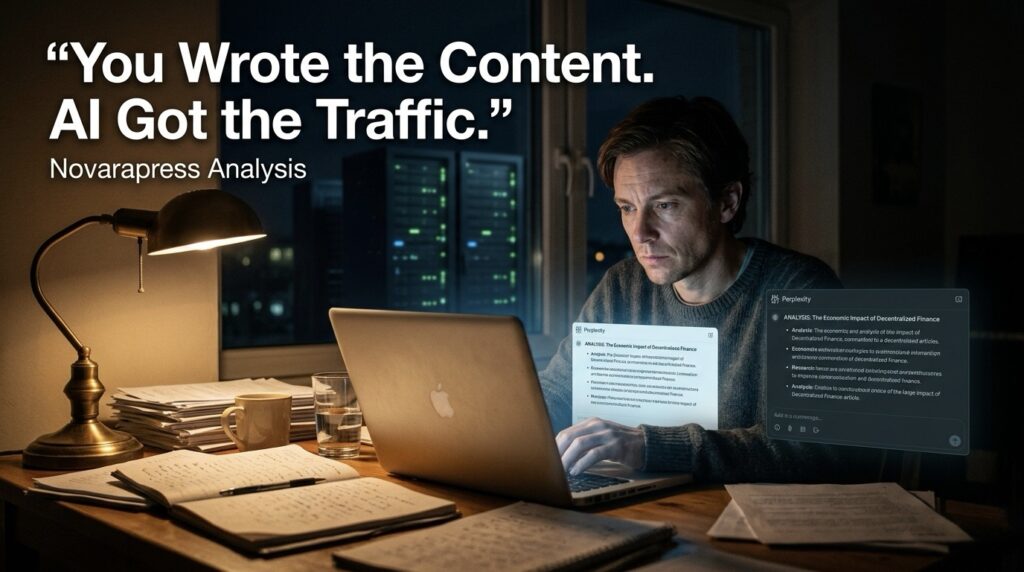
There is a writer somewhere right now who has spent three months building a blog. Good content. Original research. Careful SEO. Real hours. And somewhere else, an AI system with an index of more than 200 billion URLs just answered the exact question that writer’s best article was supposed to answer — without sending a single visitor to the site.
This is the new reality of content on the internet. And most people creating content have not fully processed what it means.
What Perplexity Actually Is
Perplexity is not a search engine in the traditional sense. It does not return a list of links and ask you to click through them. It reads across hundreds of sources, synthesizes an answer, and presents it directly — with citations attached. As of 2026, the platform processes approximately 780 million queries per month, has over 45 million active users, and carries a valuation of $20 billion.
Its index contains more than 200 billion URLs. It has integrated with Snapchat, Mozilla Firefox, and SK Telecom, giving it access to enormous existing user bases. Its annual recurring revenue exceeded $150 million at the end of 2025 and is projected to reach $656 million by the end of 2026. Jeff Bezos, NVIDIA, and SoftBank are among its investors.
When users ask Perplexity a question, they get an answer. They do not necessarily visit the websites that informed that answer. According to research by SEOmator, only 1 percent of users click on sources cited within AI-generated answers. The traffic that does come through AI systems like Perplexity converts at 23 times the rate of traditional organic search traffic — but there is far less of it, and it goes to far fewer destinations.
The Game Has Changed
For the past two decades, the content creation game had a consistent logic: produce good material, optimize it for search engines, build authority over time, accumulate traffic. The game rewarded patience, quality, and technical SEO competence. It was not easy, but the rules were legible.
The rules are no longer the same. The question is not simply whether your content ranks on Google — Google now generates its own AI Overviews for 30 percent of US desktop searches, presenting synthesized answers before any links. The question is whether AI systems treat your content as a source worth citing. And the criteria for that selection are different from traditional SEO in ways that most content creators have not yet adapted to.
Google’s March 2026 core algorithm update reinforced this shift. SEO professionals noted that the update prioritizes content that AI systems can easily parse — structured, authoritative, citation-ready material. As one analysis put it, AI search systems “don’t just rank pages. They read across sources, extract tight answers, and cite what they trust.” The update aligns traditional Google rankings with what AI answer engines need, compressing two optimization problems into one.
Research by Position Digital found that branded web mentions have a correlation of 0.664 with AI Overview appearances — far stronger than the correlation for backlinks, which sits at 0.218. The implication is significant: building a brand that gets mentioned across the web matters more than accumulating links, which is the inverse of what most SEO strategies have prioritized.
Three Strategies — and What Each One Gets Right
The practical question for content creators is what to do about this. Three approaches have emerged in the professional conversation, and each captures something real.
The first is building deep authority in a specialized niche. The logic is that AI systems, when asked specific questions, prefer sources with demonstrated expertise over generalist coverage. A site that covers a narrow topic comprehensively — providing definitions, comparisons, step-by-step explanations, case studies, and updates — becomes the kind of source that AI systems cite repeatedly because it handles the full range of questions within its domain. Research by Texta found that a SaaS analytics company achieved a 340 percent increase in Perplexity referrals after restructuring its documentation with question-based headings and comprehensive FAQ sections. A medical education site that focused on author credentials and research-backed content became the most-cited source in its specialty within six months. Niche authority is defensible in the AI era in ways that broad content farms are not.
The second strategy is shifting focus from SEO to distribution. The argument is that if AI systems are extracting value from content without delivering proportional traffic, the platforms where direct audience relationships exist — newsletters, podcasts, communities, social media — become relatively more valuable. Traffic from search was always rented from Google. Direct audience relationships are owned. If the rent is going up and the landlord is extracting more value, the rational response is to own more of your distribution. This does not mean abandoning SEO. It means not depending on it as the primary discovery mechanism.
The third position is the hardest to hear but worth taking seriously: the platforms will win. Not because creators cannot adapt, but because the structural advantages of scale are decisive. Perplexity has 200 billion indexed URLs and $1.5 billion in funding. Google has two billion monthly AI Overview users and decades of infrastructure. The question of whether an individual content creator can compete for AI citations against institutional publishers, major media organizations, and enterprise content teams is a question about resource asymmetry as much as quality. The platforms that aggregate and synthesize content will capture most of the value. The creators who produce it will capture less.
What the Data Suggests
The honest answer is that all three strategies are partially correct — and which one matters most depends on what you are trying to build.
If you are a business with a specific audience and a specific set of questions that audience asks regularly, niche authority is the most defensible position. AI systems reward completeness and specificity. A site that answers every relevant question in a domain, with clear structure and credible sourcing, has a real path to consistent AI citations regardless of what happens to Google’s algorithm.
If you are a creator whose primary asset is a relationship with an audience — trust, voice, community — distribution is the answer. That relationship does not live in search rankings, and AI systems cannot replicate it. The newsletter that 50,000 people open every week because they trust the writer is not threatened by Perplexity in the same way that a generic SEO blog is.
And if you are producing undifferentiated content designed to capture search traffic on topics where scale and resources determine the outcome, the third position — that platforms will win — is probably accurate. The content farm model worked when Google’s algorithm could be gamed with volume and links. It does not work as well when AI systems evaluate source quality, topical authority, and brand reputation.
The Deeper Shift
Behind all three strategies is a more fundamental change in how information value gets distributed on the internet. Traditional SEO was a system where quality content, properly optimized, could reach readers directly. The writer and the reader were connected through a relatively transparent mechanism, with Google as the intermediary.
AI answer engines change the intermediation. They read the content, extract its value, synthesize it into an answer, and present that answer to the user. The original source may or may not be cited. The user may or may not click through. The writer’s investment in producing the content is real. The return on that investment, in terms of audience and revenue, is increasingly uncertain.
This is not a critique of AI search systems, which genuinely improve the experience of finding information for many users. It is an observation about where value flows. The companies building AI answer engines are capturing enormous value — Perplexity’s $20 billion valuation reflects the market’s assessment of that. The question of how much value flows back to the creators whose work trains and informs those systems remains one of the defining unresolved questions of the current moment in digital media.
The writers building blogs, the journalists producing investigations, the analysts writing research — they are the input. The AI systems are the product. The gap between those two positions is where the real strategic question lives.
If this analysis interests you, read next: How AI Is Reshaping Global Media in 2026