
Weeks before the airstrike that nearly killed him, Kamal Kharazi gave an interview to CNN from Tehran. He was asked about the possibility of negotiations with Washington. His answer was a warning that turned out to be a prophecy.
“Trump had been deceiving others and not keeping with his promises,” Kharazi said. “We experienced this in two times of negotiations — that while we were engaged in negotiations, they struck us.”
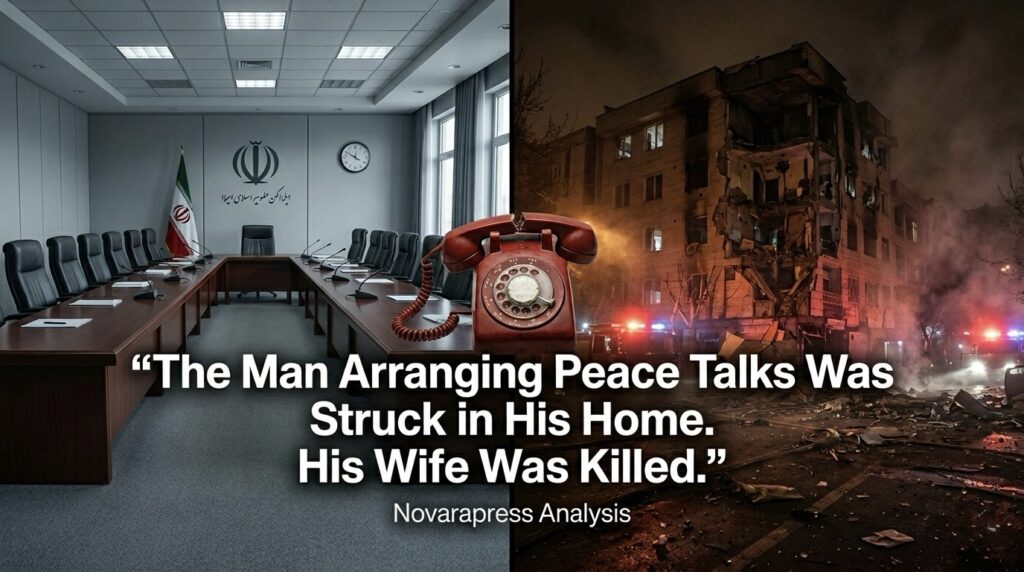
On April 1, 2026, a US-Israeli airstrike hit Kharazi’s home in western Tehran. His wife was killed. The 81-year-old former foreign minister and current head of Iran’s Strategic Council on Foreign Relations was hospitalized with severe injuries. At the time of the strike, according to reporting by The New York Times and The Telegraph, Kharazi was the senior Iranian official coordinating back-channel talks through Pakistani intermediaries to arrange a face-to-face meeting between Iranian officials and US Vice President JD Vance. Vance had been in contact with those intermediaries as recently as Tuesday — the day before the strike.
The man arranging the meeting to end the war was struck in his home the following day. His wife did not survive.
Who Kamal Kharazi Is
Kharazi is not a peripheral figure in Iranian diplomacy. He served as Iran’s foreign minister from 1997 to 2005 under reformist President Mohammad Khatami — the period of Iran’s most sustained engagement with the international community before the nuclear negotiations collapsed. He was later appointed foreign policy adviser to Supreme Leader Ali Khamenei, a position that gave him direct access to Iran’s most sensitive diplomatic deliberations. After Khamenei was killed on the first day of the current war on February 28, Kharazi continued advising the new supreme leadership under Mojtaba Khamenei.
As head of the Strategic Council on Foreign Relations, Kharazi occupied the institutional space where Iran’s official diplomatic positions are developed and where back-channel contacts with foreign governments are managed. He was not a freelancer or a retired official offering personal commentary. He was the operational center of whatever diplomatic capacity Iran retained after its supreme leader and most of its senior military command were killed in the war’s opening days.
In the weeks before the strike, multiple media reports cited Kharazi as saying that Iran had not entirely closed avenues for negotiation and was open to possible indirect talks — a signal that carried weight precisely because of his institutional position. He was simultaneously, and apparently sincerely, warning that the pattern of being struck during negotiations made any such talks extraordinarily difficult to pursue.
The Diplomatic Channel That Was Hit
The back-channel that Kharazi was managing was the most concrete diplomatic process the war had produced. Pakistan had been serving as intermediary between Washington and Tehran since early March, conveying the US 15-point ceasefire proposal to Iranian officials and relaying Iran’s responses. The framework being discussed involved a potential direct meeting between Vance and Iranian authorities — the first such contact at that level since the war began.
According to Reuters, Vance had been in contact with Pakistani intermediaries connected to this process as recently as Tuesday, April 1 — the day before the strike on Kharazi’s home. The New York Times reported, citing officials, that Kharazi was specifically helping coordinate the logistics of that potential meeting.
Neither Washington nor Jerusalem has acknowledged the strike, has confirmed Kharazi’s diplomatic role, or has explained whether the targeting was intentional. That silence is itself informative. If the strike was accidental — if Kharazi’s home happened to be hit during a broader wave of strikes on Tehran — the obvious response would be a statement expressing regret and clarifying that a diplomatic figure was not targeted. No such statement has been issued.
If the strike was intentional — if Kharazi was on a targeting list — then the US and Israel destroyed the diplomatic channel they were simultaneously claiming to be pursuing, on the same day Trump delivered a national address declaring the war “nearing completion” and expressing preference for a negotiated end.
The Daily Caller reported the core contradiction directly: “The strike landed just as that diplomatic channel appeared to be gaining traction.”
The Pattern Kharazi Described
Kharazi’s CNN interview is worth returning to, because it described the exact situation that then materialized around him personally.
He said Iran had experienced twice being struck while negotiations were underway — that Washington had used the cover of diplomatic engagement to continue military operations while Iran’s guard was lowered. He said this made future negotiations nearly impossible to pursue in good faith, because the pattern suggested that Iranian willingness to talk was being exploited rather than reciprocated.
This characterization aligns with what happened at the very beginning of the war. The US-Israeli strikes on February 28 came during active nuclear negotiations in Geneva. Iran had been engaged in a diplomatic process that, from Tehran’s perspective, was moving toward a possible agreement. The strikes began without warning, killed the supreme leader, and eliminated most of the senior military and political leadership that would have conducted any negotiated settlement.
Now the man who was arranging the back-channel to end that war — the man who had described the pattern of being struck during talks — was struck during talks. The pattern he warned about described his own fate.
The Consequences
Iran’s response to the strike was immediate and explicit. The IRGC announced that American technology companies operating in the Middle East should “expect the destruction of their relevant units” in response to assassinations of Iranian figures. The warning specifically targeted tech and AI companies — a reference to the belief, widely held in Tehran, that US technology firms are providing targeting intelligence that enables precision strikes on Iranian officials.
Beyond the specific threat, the strategic consequences of the Kharazi strike are significant. Every Iranian official who might have been willing to participate in back-channel diplomacy now has direct, personal evidence that participation in such contacts does not provide protection. The man arranging a meeting with the US Vice President was hit in his home. His wife was killed. The lesson that Iranian officials will draw from this — regardless of whether the strike was intentional — is that diplomatic engagement is dangerous.
Pakistani intermediaries, who had been the functional backbone of the only diplomatic channel the war had produced, must now determine whether they can continue facilitating contacts between parties where one side has just struck the principal contact of the other side. That calculation is not simple.
Trump’s self-imposed deadline — Iran must reopen the Strait of Hormuz or face strikes on its power plants by April 6 — remains active. The diplomatic process that might have produced an agreement before that deadline has just had its Iranian coordinator hospitalized and his wife killed. The White House has said nothing about Kharazi. Iran’s Foreign Ministry said Tehran “will not tolerate this vicious cycle of war, negotiations, ceasefire, and then repeating the same pattern.”
That phrase — “the same pattern” — is what Kharazi spent weeks warning about. He is now its most recent example.
If this analysis interests you, read next: Trump Just Addressed the Nation on the Iran War. Here’s What He Said — And What He Didn’t.