
NOVARAPRESS ANALYSIS | April 1, 2026 | Geopolitics
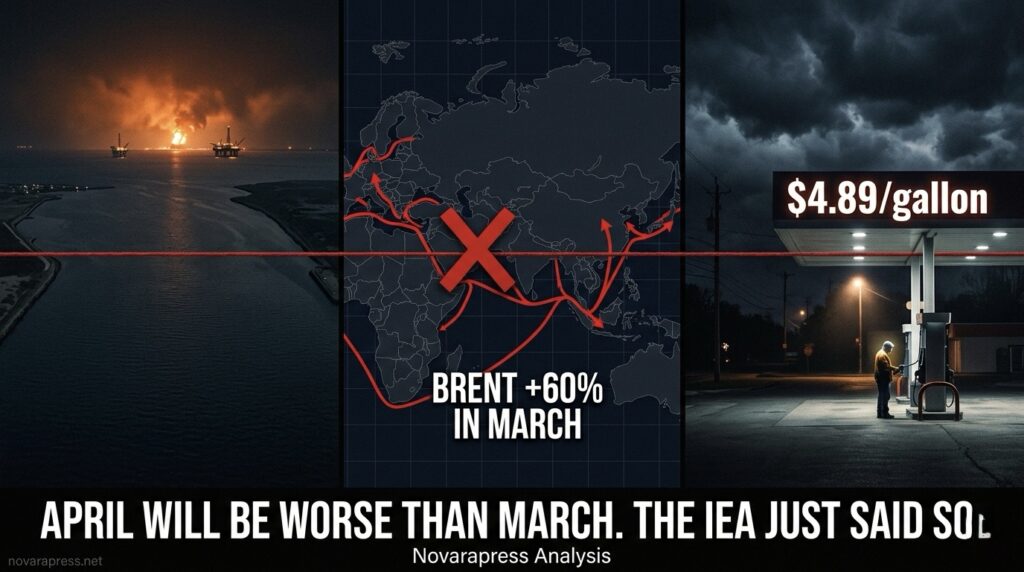
April Will Be Worse Than March. The IEA Just Said So.
The head of the International Energy Agency delivered a warning today that no government wants to hear. The oil supply crisis triggered by the Iran war — already the worst in history — is about to get significantly worse. Not because of a new escalation. Simply because the calendar flipped to April.
“In April, there is nothing,” IEA Executive Director Fatih Birol said. “The loss of oil in April will be twice the loss of oil in March.”
Why April Is the Breaking Point
Throughout March, the global economy was protected by a buffer that most people didn’t know existed: cargo ships that had already loaded oil and gas before the war began on February 28 were still completing their journeys. Those shipments were still arriving at ports in Asia, Europe, and beyond — keeping supply lines alive even as the Strait of Hormuz ground to a halt.
That buffer is now gone.
Before the war, more than 100 vessels per day transited the strait. Today, according to IMF data, that number has fallen to fewer than five. The ships that were already at sea have now docked and unloaded. What comes next is the real supply shock — and it arrives this month.
Birol was explicit about the consequences: “It will come through to inflation. I think it will cut economic growth in many countries, especially emerging economies. In many countries the rationing of energy may be coming soon.”
The Numbers Behind the Warning
To understand the scale of what is happening, consider the context Birol provided. The 1973 Arab oil embargo and the 1979 Iranian revolution each removed approximately 5 million barrels per day from global markets. Both triggered global recessions.
The current closure of the Strait of Hormuz is cutting off 20 million barrels per day of crude oil and oil products — four times the scale of either previous crisis. The IEA’s 32 member countries have already authorized the release of a record 400 million barrels from emergency stockpiles. It has not been enough.
Brent crude surged more than 60% in March alone — the biggest single-month price gain since records began in the 1980s. US gas prices have crossed $4 a gallon. Jet fuel prices have surged $200 per barrel. Diesel is up $160 per barrel.
And according to the IEA, the worst has not yet arrived.
The Domino Effect No One Is Talking About
The conversation about the Iran war’s economic impact has focused almost entirely on oil. The real story is broader and more damaging.
China has banned oil product exports. Thailand is rationing gasoline. Iraq, Qatar, and the UAE are facing potential GDP contractions of up to 30% as their export routes remain blocked. Egypt’s president has declared his country’s economy is in a “state of near-emergency.” Djibouti’s finance minister warned of severe consequences for the entire African continent.
The supply chain effects extend far beyond fuel pumps. Fertilizer prices — with up to 30% of global supply transiting the Strait of Hormuz — are already up 15-20%. That increase will reach grocery shelves within weeks, in countries that can least afford it. Bloomberg Economics now estimates US inflation running at 3.4% annually in March — up sharply from 2.4% in February — with rising fuel costs as the primary driver. The Federal Reserve’s 2% target has effectively been abandoned by events.
For an average American household spending $5,000 per month, analysts estimate the war is already costing an extra $150 per month — $1,800 per year.
The Stopgap Measures Are Running Out
Governments have deployed every available tool to cushion the shock. Saudi Arabia and the UAE have rerouted some oil through pipelines that bypass the strait. The IEA coordinated an emergency stockpile release. The US waived the Jones Act to free up domestic shipping. Trump repeatedly sent oil prices falling with Truth Social posts hinting the war would end soon.
None of it has solved the underlying problem. And according to oil industry executives who gathered this week at CERAWeek in Houston, the market is still not fully pricing in what is coming.
ConocoPhillips CEO Ryan Lance put it plainly: “You just can’t take 8 to 10 million barrels a day of oil and 20 percent of the LNG market off the world stage without having some significant repercussions.”
Chevron CEO Mike Wirth added: “There are very real, physical manifestations of the closure of the Strait of Hormuz that are working their way around the world.”
The consensus among analysts: if the strait is not reopened in the next one to three weeks, there will be little any government can do to prevent energy prices from rising dramatically — and staying there.
What $200 Oil Would Actually Mean
US government officials and Wall Street analysts are now openly modeling a scenario in which Brent crude reaches $200 per barrel — a price level that has never occurred in history.
At $170 per barrel, Bloomberg Economics estimates the inflation impact roughly doubles from current levels — a stagflationary shock that would likely force central banks to raise interest rates at the exact moment their economies are slowing. Stock markets, corporate debt, consumer spending, and political stability would all come under simultaneous pressure.
At $200, the consequences extend into territory that economists describe simply as “unknown.”
The Bottom Line
March was painful. April is when the bill arrives.
The emergency stockpiles that cushioned March’s shock are depleting. The pipeline diversions that softened the Hormuz closure are at capacity. The cargo ships that were already at sea have docked. And the strait remains closed.
The IEA director’s message today was not a prediction. It was a description of arithmetic. The oil that was supposed to flow through the Strait of Hormuz in April does not exist anywhere else on earth. There is no substitute. There is no workaround. There is only one solution: the strait reopens, or the world pays a price it has never paid before.
The deadline is April 6. The clock is running.
— Novarapress Analysis | novarapress.net