
NOVARAPRESS ANALYSIS | April 1, 2026 | Iran & Middle East
The IRGC Just Threatened Apple, Google, and Microsoft. This Changes Everything.
For 32 days, Iran has been fighting a conventional war. Missiles at Israel. Drones at US bases. A chokehold on the Strait of Hormuz. But on the morning of April 1, 2026, the Islamic Revolutionary Guard Corps crossed a line that no one fully anticipated — and the global economy is now facing a threat it has no playbook for.
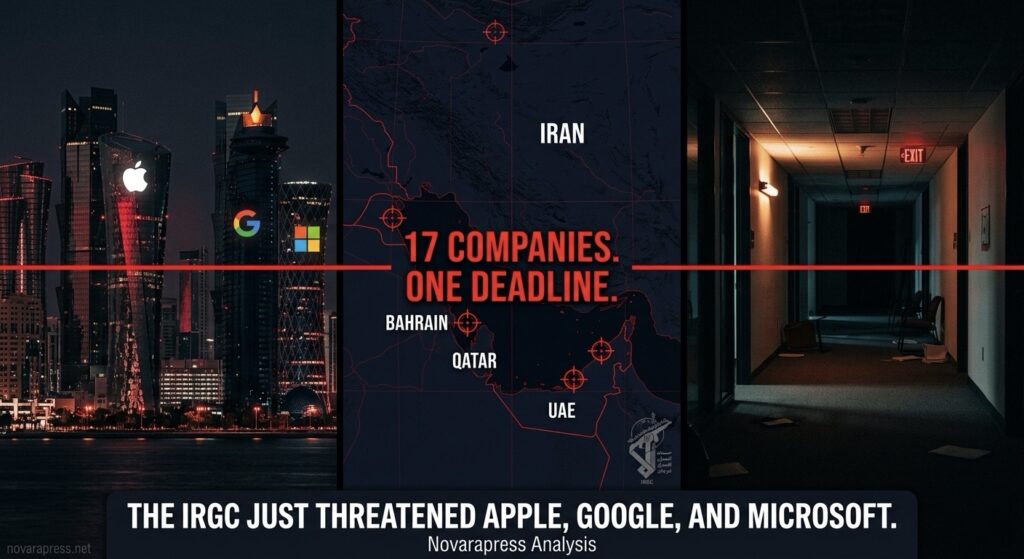
The IRGC issued a direct warning to 17 of the world’s largest technology companies — threatening to destroy their regional offices and facilities before 8 PM Tehran time tonight.
The list includes: Apple, Microsoft, Google, Meta, IBM, HP, Intel, Tesla, Boeing, and JP Morgan.
What the IRGC Actually Said
The statement, carried by Iran’s Fars News Agency, was unambiguous. The IRGC declared that American technology and intelligence companies are “the main element in designing and tracking assassination targets” — a direct reference to US and Israeli strikes that have killed Iranian military commanders and nuclear scientists throughout the war.
The Guards called on employees of American tech firms across the region to “immediately distance themselves from their workplaces” and urged residents living near those offices to evacuate. The deadline: 8 PM Tehran time, Wednesday April 1.
This is not a vague geopolitical threat. It is a named list with a specific time.
Why This Matters Beyond the Obvious
The IRGC’s statement reflects something that analysts have warned about for years but that Western governments have been slow to fully reckon with: the line between military infrastructure and commercial technology no longer exists.
GPS navigation used to guide precision strikes runs on technology built by American companies. Satellite imagery analyzed by AI systems built by those same companies helps identify targets. Communications infrastructure that enables military coordination often runs on hardware and software produced in Silicon Valley. The IRGC has decided to name this publicly — and to make tech companies pay the price for it.
The implications stretch far beyond the Middle East. If Iran follows through on even a fraction of this threat, the consequences include:
- Immediate evacuation of tech company staff from Gulf offices — including major hubs in Dubai, Riyadh, and Doha
- Insurance and liability crises for companies operating anywhere near the conflict zone
- Stock market shock — Apple, Microsoft, Google, and Meta collectively represent trillions in market capitalization
- A precedent that civilian commercial infrastructure is a legitimate military target — a doctrine that no international legal framework is currently equipped to handle
The Wider Picture: Day 32
The IRGC threat arrives on the most volatile day of the war so far. Iran fired three waves of ballistic missiles at Israel within a single hour on Wednesday morning — timed, deliberately, to coincide with the start of Passover preparations, one of the busiest travel days of the Israeli calendar year.
An Iranian missile struck an oil tanker off Qatar’s coast. Bahrain reported a drone attack on a company facility, with fires still burning. And Iran’s Foreign Minister Abbas Araghchi flatly rejected Trump’s claim that the two sides are negotiating.
“Negotiation is when two countries engage in talks to reach an agreement,” Araghchi told Al Jazeera. “Such a thing does not exist between us and the United States.”
Meanwhile, Trump — facing average US gas prices that have now crossed $4 a gallon for the first time since 2022 — shifted his position dramatically. He told reporters that Iran “doesn’t have to make a deal” for the US to wind down the conflict, and suggested the war could end within two to three weeks regardless of negotiations.
Markets rallied briefly on the news. The Wall Street Journal reported Trump told White House staff he’d be open to ending the war even without reopening the Strait of Hormuz — a statement that, if true, would represent a complete reversal of his stated war objectives.
Trump’s Retreat — or Repositioning?
Three weeks ago, Trump said the war would be over in four days. Then he said three weeks. Now he is saying two to three weeks again — while the conflict spreads to new fronts and Iran demonstrates it can sustain military pressure indefinitely.
Foreign policy analyst Trita Parsi put it plainly to Al Jazeera: “The United States is no longer in control of this war.”
Iran’s Foreign Minister has said Tehran is prepared to fight for at least six months. The IMF has warned that countries in Asia and Africa cannot access energy supplies “even at inflated prices.” The world is losing up to 20 million barrels of oil per day from Middle East producers due to the Hormuz blockade.
And now, 17 of the world’s most powerful companies have been told to clear their staff from the region before nightfall.
The Bottom Line
The IRGC’s threat against American tech companies is not just an escalation. It is a signal that Iran has made a strategic decision to expand the definition of what counts as a legitimate target — and to force a confrontation between Washington and the corporate sector that funds, builds, and profits from American military power.
Whether or not the IRGC follows through tonight, the threat alone has already done its work. Every American company with offices in the Gulf is now doing the same calculation: how long before being present in the region becomes a liability no boardroom can justify?
That calculation — not the missile count — may ultimately determine how this war ends.
— Novarapress Analysis | novarapress.net