
NOVARAPRESS ANALYSIS | April 1, 2026 | Iran & Middle East
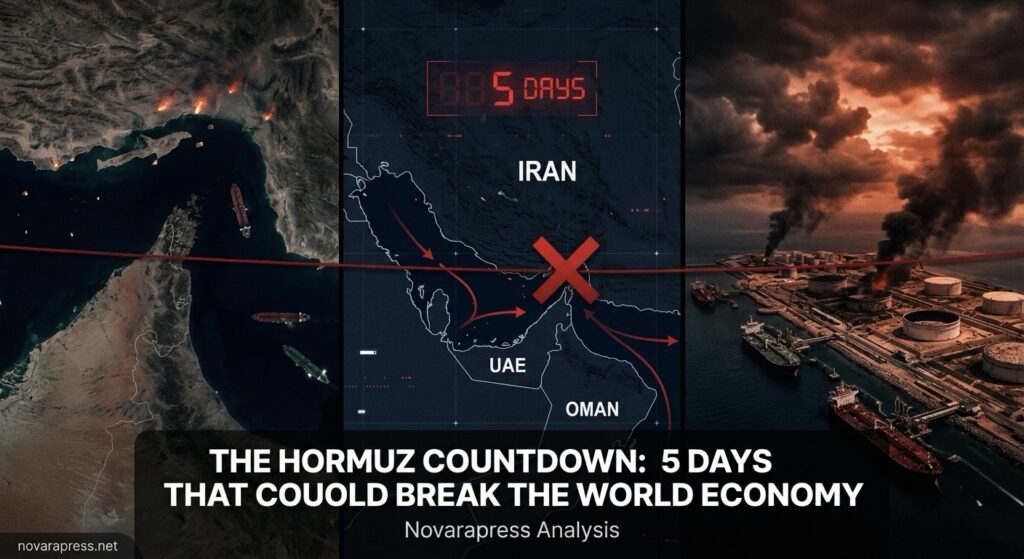
In 5 days, one of two things will happen. Either Iran reopens the Strait of Hormuz — and the world exhales. Or Donald Trump follows through on his threat to destroy Iran’s power plants, oil wells, and Kharg Island — and the world economy enters territory it has never seen before.
There is no third option on the table. Not yet.
How We Got Here
The war began on February 28, when the United States and Israel launched coordinated strikes against Iran, killing Supreme Leader Ali Khamenei on the first day and targeting the country’s nuclear infrastructure. Iran’s response was immediate: the Islamic Revolutionary Guard Corps effectively shut down the Strait of Hormuz — the narrow waterway through which 20% of the world’s seaborne oil and natural gas passes every single day.
Since then, Trump has issued, extended, and re-extended a series of ultimatums. The pattern is now familiar:
- March 22: Trump threatens to obliterate Iran’s power plants within 48 hours.
- March 23: Deadline passes. No strike.
- March 26: Trump announces a 10-day extension until April 6 — citing Iranian “good faith” in allowing eight oil tankers through the strait.
- March 30: Trump escalates again, warning he will “completely obliterate” Iran’s electric plants, oil wells, and Kharg Island if a deal is not reached “shortly.”
Today is April 1. The clock expires in 5 days.
What Iran Is Actually Doing
Tehran’s public position is that there are no negotiations with Washington. Privately, the picture is different.
Iran sent its official response to the US 15-point peace plan through Pakistani intermediaries — calling for an end to all US and Israeli strikes, war reparations, and explicit recognition of Iranian “sovereignty” over the Strait of Hormuz. These are demands that go far beyond anything in the American proposal, and both sides know it.
At the same time, Iran’s parliament is moving to formalize transit fees for ships passing through the strait — a legal mechanism that would institutionalize what is currently a military blockade. If passed, it transforms an act of war into a permanent policy.
Israel, meanwhile, struck back hard. Israeli forces killed IRGC Navy Commander Alireza Tangsiri — the man directly responsible for the mining operations blocking the strait — along with the naval intelligence chief Behnam Rezaei. Iran has not publicly acknowledged the deaths.
The Economic Damage Is Already Historic
The financial markets are not waiting for April 6 to render their verdict.
Brent crude oil has surged from roughly $70 before the war began to $101.89 per barrel — a 45% increase in five weeks. The S&P 500 is on its fifth consecutive losing week, its longest streak in nearly four years. The Nasdaq has fallen more than 10% below its all-time high.
The damage extends far beyond energy markets. Up to 30% of internationally traded fertilizers transit the Strait of Hormuz. Global fertilizer prices are estimated to average 15–20% higher in the first half of 2026 if the crisis continues — a cost that will eventually land on every grocery shelf in America and Britain.
This is not a distant geopolitical abstraction. It is already reshaping what families pay for food, fuel, and heating.
The Allies Are Not Coming
Trump has repeatedly called on allies to send warships to help reopen the strait. The response has been polite refusal.
Australia confirmed it was not consulted before the war began and declined to send ships. Britain, Germany, and Italy are participating in Operation Aspides — a “purely defensive” escort mission — but have stopped well short of the military commitment Washington is demanding. France sent two frigates. The G7 agreed to “look into” options.
The UAE, which stands to lose catastrophically from a prolonged closure, published a Wall Street Journal op-ed stating that a ceasefire alone is “not enough” — demanding a “conclusive outcome” that dismantles Iran’s full military infrastructure. But diplomatic statements are not aircraft carriers.
Washington is carrying this war largely alone.
What Happens on April 6
Three scenarios are now in play:
Scenario 1 — The Deal: Iran makes sufficient concessions — likely around nuclear dismantlement and partial strait reopening — allowing Trump to declare victory and pause military operations. Oil prices fall sharply. Markets rally. The underlying conflict is frozen, not resolved.
Scenario 2 — Another Extension: Trump again pulls back from his deadline, citing “progress” in talks. Markets interpret this as weakness. Oil stays elevated. Iran reads the pattern and holds firmer.
Scenario 3 — Escalation: Trump strikes Kharg Island and Iran’s power grid. Tehran retaliates against Gulf desalination plants and regional US bases. The strait closes completely. Brent crude crosses $130. The global economy enters a supply shock with no historical precedent in the modern era.
As of today, Scenario 3 carries a higher probability than at any point since the war began.
The Bottom Line
Trump’s repeated extensions have not produced a deal. They have produced an emboldened Iran, a rattled stock market, and a global energy system running on borrowed time.
The April 6 deadline is not just a date on a calendar. It is the moment the world finds out whether American ultimatums still mean anything — and whether the price of finding out is one the global economy can afford to pay.
— Novarapress Analysis | novarapress.net