
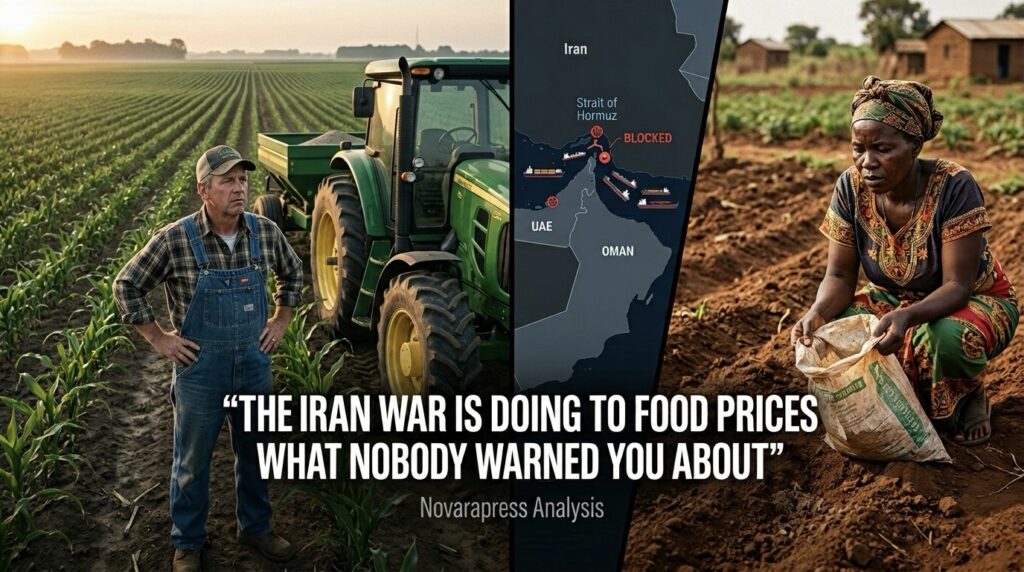
Jason Lewis did not start his morning thinking about the Strait of Hormuz. He started it the way he starts most mornings in late March — checking the weather, checking soil temperature, and calculating how much nitrogen fertilizer he has left before spring planting begins on his family farm in south central Nebraska.
Then he checked the price.
It had gone up again. Urea — the solid nitrogen fertilizer that corn farmers across the American heartland depend on — had spiked close to 30 percent since Iran shut down shipping through the Strait of Hormuz at the start of March. Three years of record-high production costs and weak crop prices had already pushed Lewis Family Farms to the edge of viable margins. Now a war he had no voice in, fought over a waterway he couldn’t find on a map a year ago, was threatening the spring crop he needed to stay in business.
“It’s coming in at a really rough time for us,” Lewis said. “It’s rough just seeing those prices go up.”
Thousands of miles from the Persian Gulf, on a farm in Kansas, in a rice paddy in Punjab, in a maize field in Kenya, the same story is playing out in different languages. The Iran war has a food problem that nobody in the televised debate about oil prices, naval coalitions, and diplomatic ultimatums is talking about with the urgency it deserves.
The Third of Global Fertilizer Nobody Mentioned
The Strait of Hormuz carries approximately one-fifth of the world’s oil. That figure has dominated every headline since the war began. What the headlines have not emphasized with equal force is that the same narrow passage also carries roughly one-third of the world’s seaborne fertilizer trade — and that this matters more to the price of food in 2027 than the price of oil does right now.
Gulf countries west of the strait — Saudi Arabia, the UAE, Qatar, Kuwait — account for exports of approximately 43 percent of global urea, the most widely used nitrogen fertilizer in the world. Saudi Arabia alone exports about one-fifth of the world’s phosphate fertilizer. The region also exports more than 40 percent of the world’s sulfur, a critical input in phosphate fertilizer production. All of it normally moves through the Strait of Hormuz to the global market.
Since the war began on February 28 and Iran effectively closed the strait, that flow has stopped. Urea prices have risen from between $400 and $490 per metric ton before the war to approximately $700 per metric ton as of late March — a jump of between 43 and 75 percent depending on the market. The Fertilizer Institute estimates that US farmers will be short some 2 million tons of urea this spring, the precise moment when demand peaks for the corn planting season that feeds American beef, poultry, and dairy production.
The Timing Could Not Be Worse
Agricultural crises have seasons. The Iran war arrived at the worst possible moment in the agricultural calendar for the Northern Hemisphere.
Spring planting season for corn and wheat in the United States runs from late March through May. Farmers apply nitrogen fertilizer before or at planting — the timing is not negotiable. Corn that does not receive adequate nitrogen at the right time produces lower yields regardless of what happens later in the growing season. A farmer who cannot afford nitrogen, or cannot find it, cannot simply apply twice as much in June.
Matt Ubel, a farmer near Wheaton, Kansas, described the trap: many row crop farmers had been waiting for spring prices to fall after a brutal 2025, holding off on forward purchases in hopes of buying fertilizer cheaper. Then Iran closed the strait. The price spiked 30 percent almost immediately. Farmers who had been trying to save money by waiting were suddenly paying more than they would have paid if they had bought months earlier, in a market with no good options and no timeline for recovery.
“We don’t quite know how it’s going to shake out,” said Nancy Martinez, director of public policy for the National Corn Growers Association.
The uncertainty is its own problem. Farmers making planting decisions in March and April are making financial commitments that will determine their economic survival for the next eighteen months. They are doing so without reliable information about when the strait will reopen, what fertilizer will cost when it does, or whether the yields they are counting on will materialize.
From Nebraska to Punjab to Kenya
The food security implications of the Iran war’s fertilizer disruption are not evenly distributed. American farmers are stressed. Farmers in the developing world are in crisis.
In Punjab, India, Baldev Singh has been farming rice for thirty-five years. He is fifty-five years old, and he has seen bad seasons. This one is different, he said, because the problem is not weather or pests — it is the cost of an input he cannot produce himself and cannot do without. India is the world’s second-largest urea producer, but its production depends heavily on imported natural gas from the Persian Gulf. With gas shipments disrupted, Indian fertilizer plants are running below capacity. The government has prioritized domestic urea for local use, but output is falling. Singh’s government subsidy — India allocates $12.7 billion per year to urea subsidies alone — may not be enough if the shortage deepens into June, when rice planting demand peaks.
“Right now, we are waiting and hoping,” he said.
In Kenya, Stephen Muchiri represents 25 million smallholder farmers through the Eastern African Farmers Federation. East Africa has had heavy early rains, leaving farmers a narrow window of dry weather in which they must prepare fields and apply fertilizer. The window is measured in days. The fertilizer is not arriving. Research from Zambia suggests that even short delays in fertilizer application reduce maize yields by approximately four percent per season — a figure that translates, at scale, into food insecurity for populations with no buffer.
“The poorest farmers in the Northern Hemisphere rely on fertilizer imports from the Gulf, and the shortage comes just as planting season begins,” said Carl Skau, deputy executive director of the World Food Program. “In the worst case, this means lower yields and crop failures next season. In the best case, higher input costs will be included in food prices next year.”
Why Other Suppliers Cannot Fill the Gap
The obvious question is whether other countries can replace Gulf fertilizer exports. The answer is: not quickly, not fully, and not without their own complications.
China is the world’s largest producer of nitrogen and phosphate fertilizers. It has restricted exports to protect its domestic market — a rational response to a global shortage that would otherwise drain Chinese stocks. Chinese urea shipments are not expected to resume until May at the earliest, well after the critical American and South Asian planting windows have closed or been compromised.
Russia is another major fertilizer producer. Russian plants are already running near full capacity. There is no meaningful spare production to redirect to global markets in the short term.
The United States has a substantial domestic fertilizer industry, supported by its position as the world’s largest natural gas producer. Domestic production provides some insulation — but only some. The US imports approximately 18 percent of the nitrogen fertilizer sold domestically, drawing heavily on imports to cover the spring surge. Even domestically produced fertilizer depends on natural gas as a feedstock, and gas prices are rising as global supply tightens. Higher input costs for American fertilizer producers translate into higher prices for American farmers regardless of where the fertilizer is made.
The Political Silence
Fifty-four American agricultural groups wrote to President Trump in late March, calling for “much-needed market relief for America’s farmers.” The letter was direct: “As planting season began in earnest across much of the U.S., the closure of the Strait of Hormuz sent fuel and fertilizer prices skyrocketing.” They warned of consequences for food security both domestically and internationally.
The letter received modest coverage. The war’s energy dimensions — oil prices, the Hormuz toll booth, naval coalitions — continued to dominate the headlines.
This reflects a structural bias in how wars are covered. Energy prices are immediate, visible, and politically salient. Gasoline at $4 a gallon is a story every day. Fertilizer at $700 per metric ton is a story for agricultural reporters and commodity traders. The downstream effect on food prices — which arrives six to eighteen months after the planting disruption, when reduced yields translate into higher grocery bills — is not a story at all yet. It will be, in 2027, by which point the decisions that determined it will be long past.
What the Food System Actually Depends On
Modern agricultural production is a petrochemical system. That is not a metaphor or an exaggeration — it is a description of how food is grown at the scale required to feed eight billion people.
Nitrogen fertilizer is manufactured through the Haber-Bosch process, which combines atmospheric nitrogen with hydrogen derived from natural gas. There is no substitute for this process at industrial scale that does not require natural gas. The natural gas that feeds the largest fertilizer-producing countries in Asia flows, in significant part, from the Persian Gulf through the Strait of Hormuz.
Phosphate fertilizer requires sulfur as a processing input. The Gulf region produces more than 40 percent of the world’s sulfur, most of it as a byproduct of oil and gas refining. When Gulf oil and gas production slows — as it has since the war began — sulfur production falls with it. When sulfur supply tightens, phosphate fertilizer production costs rise everywhere.
Diesel fuel, which powers every tractor and grain truck in the world, is derived from crude oil. When oil prices rise — as they have, from below $70 a barrel in late February to above $107 as of March 31 — the cost of operating every piece of farming equipment rises with them.
The food system’s dependence on the Strait of Hormuz is therefore not only about the fertilizer that ships through it. It runs through the entire agricultural supply chain, from field preparation through planting through harvest through transport. Every step that uses energy — which is every step — becomes more expensive when the waterway that supplies a significant portion of the world’s energy is effectively closed.
The Timeline That Nobody Is Discussing
Wars have a tendency to be covered in real time, with diminishing attention paid to consequences that materialize slowly. The food consequences of the Iran war will not be fully visible for months. By the time they are — when reduced corn yields push up beef and poultry prices, when lower wheat harvests in South Asia raise bread prices in cities that can least afford it, when African maize crops come in short because the fertilizer that should have gone into the soil in March never arrived — the media cycle will have moved on to whatever comes next.
Joseph Glauber of the International Food Policy Research Institute offered a comparison that captures the danger: fertilizer prices today are below the peaks seen after Russia’s invasion of Ukraine in 2022. But in 2022, grain prices were high, giving farmers the margins to absorb the input cost increase. Today, grain prices are low. Margins are already thin. The same percentage increase in fertilizer cost lands much harder on a farmer with no room to absorb it.
The world entered 2026 with adequate food commodity stocks — buffer stocks, as analysts call them. Those buffers will absorb some of the shock. They will not absorb all of it. And they cannot be replenished until the fields that normally produce the food the world depends on are back in full production — which requires the fertilizer that is currently sitting in tankers anchored outside the Strait of Hormuz, waiting for a war to end.
Jason Lewis is still farming in Nebraska. He is conserving his nitrogen, calculating his options, and hoping the prices come back down before he runs out of what he has stored. He did not vote for this war. He did not vote against it. He farms corn in the American heartland, and the Strait of Hormuz just became the most important piece of geography in his life.
If this analysis interests you, read next: Why Food Has Become a Weapon of War