
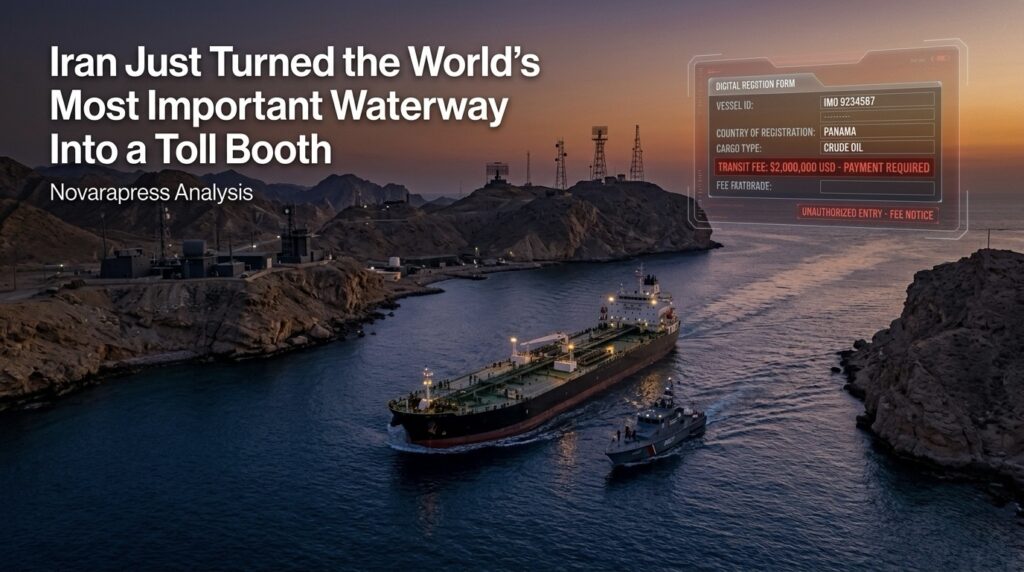
The tanker captain got a message he had never received before in thirty years at sea. It came through an intermediary — a trading company based on Kish Island, a Iranian resort island in the Persian Gulf. The message was simple: if he wanted to bring his ship out of the Gulf, he would need to submit his vessel’s IMO registration number, a complete cargo manifest, the names of every crew member, his ship’s ownership details, and his destination. Then he would wait for a decision.
If approved, he would receive an authorization code and coordinates. An Iranian Revolutionary Guard vessel would escort him through a narrow channel between the islands of Qeshm and Larak — less than twenty miles from Iran’s main naval base at Bandar Abbas. And he would pay two million dollars for the privilege, settled in Chinese yuan, through accounts at a Chinese bank that has processed Iran transactions for years outside the SWIFT system.
If he refused, or tried the normal shipping lane through the middle of the strait, the message was clear: ships attempting unauthorized passage would be targeted.
This is the Tehran toll booth. And it is not a temporary wartime measure. Iran is building it into law.
How It Works, In Detail
Before the war began on February 28, approximately 110 ships passed through the Strait of Hormuz every day. In the week of March 15 to 22, just 16 ships with their Automatic Identification Systems switched on crossed the strait. Traffic has fallen by ninety percent. Nearly two thousand vessels are anchored on both sides, waiting.
The ships that are moving are not using the normal route. They are taking a detour into Iranian territorial waters, threading through the passage between Qeshm and Larak islands, where the Revolutionary Guard’s Navy controls every movement. According to Lloyd’s List Intelligence — the authoritative maritime data firm that has been tracking this since mid-March — at least 26 vessels have used this route since March 13. At least two paid the reported $2 million fee, settled in yuan. Others, like Indian tankers carrying cooking gas, were waved through as diplomatic gestures. Iranian oil tankers pass freely.
Tomer Raanan, a maritime risk analyst at Lloyd’s List, described the mechanics to NBC News from Doha: “Whatever we can detect going out of the strait right now is going through this narrow channel in Iranian territorial waters, where the Islamic Revolutionary Guard Corps essentially verifies the ship’s information and acts almost like a toll booth.”
The vetting process is geopolitical, not just commercial. Ships linked to the United States, Israel, or their allies are systematically excluded. The approved list — China, Russia, India, Iraq, Pakistan, and select others — maps almost exactly onto the countries that have either opposed the war, maintained relations with Tehran, or from which Iran needs continued economic engagement to survive the conflict financially.
The Lawmaker Who Said It Out Loud
Iranian officials have a habit of confirming things on state television that their foreign ministry simultaneously denies. The toll booth was confirmed this way.
Alaeddin Boroujerdi, a member of Iran’s parliamentary national security committee, appeared on state broadcaster IRIB and said what no one had yet said publicly: “Collecting $2 million as transit fees from some vessels crossing the strait reflects Iran’s strength. Now, because war has costs, naturally we must do this and take transit fees from ships passing through the Strait of Hormuz.”
A second lawmaker, Mohammadreza Rezaei Kouchi, told Fortune magazine that parliament was actively pursuing legislation to formalize this arrangement — to codify Iran’s “sovereignty, control and oversight over the Strait of Hormuz” while creating “a source of revenue through the collection of fees.” The bill, being prepared by the Majlis Civil Affairs Committee, would formally recognize Tehran’s sovereign authority over the waterway. A vote was expected in late March or early April.
Iran’s parliament has now passed that legislation. The Tehran toll booth is no longer an improvised wartime shakedown. It is Iranian law.
What International Law Says, and Why Iran Doesn’t Care
The legal case against Iran’s toll system is airtight, by the standards of the international legal order that Iran helped build.
The United Nations Convention on the Law of the Sea — UNCLOS — is explicit. Article 38 guarantees all ships and aircraft “the right of transit passage” through international straits. That right “cannot be suspended.” Article 26 states that no charges may be levied on foreign ships passing through territorial waters “solely by reason of passage.” The right of transit passage was specifically designed for straits like Hormuz, where the narrowness of the waterway means that ships must pass through the territorial waters of coastal states whether they want to or not.
James Kraska, a professor of international maritime law at the US Naval War College, was direct: there is “no legal basis under international law for a coastal state to charge fees in an international strait.”
Iran’s response to this is that it signed UNCLOS in 1982 but never ratified it. Tehran argues that without ratification, it is not bound by the treaty’s transit passage provisions. Iranian officials contend they are applying their own domestic sovereignty over waters that border their coast. “The Strait of Hormuz is also a corridor,” one lawmaker said. “We ensure its security, and it is natural for ships and tankers to pay us duties.”
The legal argument is thin. But the practical reality is that Iran controls the waterway at this moment, and the countries with the legal and military power to challenge that control are either at war with Iran, unwilling to escalate, or quietly paying the toll in yuan and saying nothing publicly.
The Suez Comparison Iran Is Making
Iranian officials and lawmakers have repeatedly invoked the Suez Canal when explaining the toll system. The comparison is politically convenient and legally misleading — but it reveals exactly what Tehran is trying to build.
Egypt earns between $700 million and $800 million per month from the Suez Canal in normal times. The canal is an artificial waterway, dug through Egyptian territory, over which Egypt has unambiguous sovereign authority. International law is clear that Egypt can charge fees — and has done so since nationalization in 1956.
The Strait of Hormuz is a natural international strait. The legal distinction is decisive. But if Iran could establish, through practice rather than law, a functioning system in which ships pay for passage, receive codes, and transit safely — with this arrangement becoming normalized over months or years — the practical distinction between Hormuz and Suez begins to erode, regardless of what international law says about the legal distinction.
That is the ambition. Tasnim news agency — close to the Revolutionary Guard — calculated that if fees of around $2 million per vessel were applied to the roughly 140 ships that transited daily before the war, annual toll revenues could exceed $100 billion. That figure is roughly equivalent to 20 to 25 percent of Iran’s GDP. It would transform the Strait of Hormuz from a geopolitical pressure point into a permanent revenue stream — and transform Iran from a sanctioned pariah struggling to export its oil into the de facto toll collector of the global energy market.
The Sanctions Trap
There is a problem for Western shipping companies that the Iranian toll booth creates beyond the military risk: paying Iran may violate US sanctions.
The Islamic Revolutionary Guard Corps is designated as a foreign terrorist organization by the United States. Providing material support to a designated terrorist organization — which paying a toll controlled by the IRGC might constitute — is a federal crime under US law. UK and EU sanctions create similar restrictions for European operators.
This puts Western shipping companies in an impossible position. They cannot pay the toll legally. They cannot transit without paying. They cannot use the normal channel without risking attack. They cannot reroute around the Strait of Hormuz because there is no viable alternative route for most Gulf shipments. The result is that Western-affiliated carriers are effectively locked out of the Gulf entirely, ceding the shipping lanes to Chinese, Indian, and Russian operators who face no equivalent legal constraints on paying Iran.
The toll booth does not just generate revenue for Iran. It accelerates the de-dollarization of Gulf energy trade, strengthens the yuan’s role in international maritime commerce, and pushes Western shipping companies out of a market they have operated in for decades.
The Man Who Built It Is Dead
On March 26, Israeli Defense Minister Israel Katz announced that Alireza Tangsiri — the commander of the IRGC Navy since 2018 and the officer directly responsible for designing and implementing the Hormuz closure — had been killed in an airstrike on Bandar Abbas.
Katz described Tangsiri as “the man directly responsible for the terrorist operation of mining and blocking the Strait of Hormuz.” Maritime analysts assessed that Tangsiri’s death removed the architect of the toll booth system. His intelligence chief and other senior IRGC Navy leaders were killed in the same strike.
But the system he built survived him. The legislation is advancing. The toll collection is continuing. The IRGC Navy has other officers. What Tangsiri created was not a personal project — it was an institutional capability that Iran has now incorporated into its formal legal structure and its peace negotiation demands.
The Demand That Changes Everything
Iran’s five conditions for ending the war, presented to US negotiators through Pakistani intermediaries, included a demand that had never appeared in any previous round of negotiations: formal international recognition of Iranian sovereignty over the Strait of Hormuz.
US Secretary of State Marco Rubio said after the G7 meeting in France: “Not only is this illegal, it’s unacceptable, it’s dangerous to the world, and it’s important that the world have a plan to confront it.” G7 foreign ministers pledged to restore “safe and toll-free freedom of navigation” — but specified this commitment would take effect after the war ends, and offered no force composition, ship numbers, or deployment timeline for enforcing it.
Iran’s new supreme leader Mojtaba Khamenei, in his first public address, said the leverage of blocking the Strait “must continue to be used.” An adviser to the supreme leader has described what is coming as a “new regime for the Strait of Hormuz” — one in which Iran’s control over the waterway is permanent, formalized, and financially productive.
The war will end. Negotiations are ongoing. Some form of agreement will eventually be reached. The question that nobody in Washington, Brussels, or the Gulf capitals has publicly answered is what happens on the morning after the ceasefire, when the first Western tanker tries to transit the Strait of Hormuz and Iran presents it with an authorization form and a $2 million invoice.
The toll booth is built. The law has passed. The man who built it is dead, but the system runs without him. What the world does about it — if it does anything — will define the future of global energy trade for a generation.
If this analysis interests you, read next: The Strait of Hormuz Is Closing. Here’s What That Does to the Global Economy.