
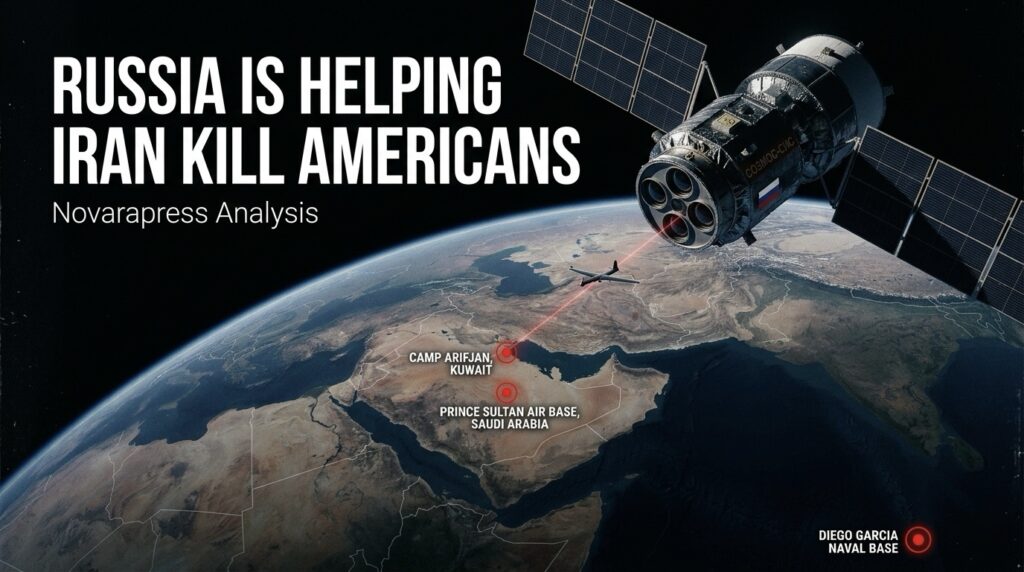
On the morning of March 7, the families of six American soldiers killed in Kuwait the previous Sunday were still making arrangements to receive the bodies. The military had confirmed the deaths — an Iranian drone struck a makeshift facility housing US troops outside Kuwait City. What the Pentagon had not confirmed, and what Washington Post reporters were at that moment preparing to publish, was the detail that would change the entire character of the Iran war.
Russia had told Iran where the Americans were.
The satellite imagery came from Russian reconnaissance assets orbiting over the Gulf region. The coordinates were passed to Iranian military planners. The drone flew to the location. Six soldiers died. The connection between the first two facts and the last two is what US officials described to the Washington Post as a “fairly extensive and systematic” Russian intelligence operation running in parallel with Iran’s military campaign — and it had been going on since the first day of the war.
The story broke on a Friday. By Monday, it had largely been absorbed into the noise of daily war coverage and moved off the front pages. That is worth pausing on. The revelation that a major nuclear power was feeding targeting intelligence to an enemy actively killing American troops — in the middle of a war — lasted about 72 hours as a top story. Then the next missile strike happened, and everyone moved on.
What the Satellites Were Watching
The mechanics of what Russia was doing matter, because they reveal how deliberate this was.
Russia operates one of the world’s most capable military satellite constellations. Its reconnaissance satellites can photograph military installations with sufficient resolution to identify aircraft types, count vehicles, and track the movement of naval vessels. This is not technology Russia developed quietly — it has been demonstrating these capabilities for decades, most recently in Ukraine, where satellite imagery has been used to direct strikes on Ukrainian positions.
In the weeks before the US-Israeli strikes on Iran began on February 28, Russian satellites were already photographing American military facilities in the region. Ukrainian President Volodymyr Zelenskyy, who receives daily intelligence briefings and has spent four years watching Russia’s intelligence apparatus operate against his own country, shared the specifics: Russian satellites captured images of the US-UK joint military facility on Diego Garcia in the Indian Ocean. Kuwait International Airport, where US forces were stationed. Prince Sultan Air Base in Saudi Arabia — photographed on March 20, March 23, and March 25, in the days before Iran struck the base and wounded American soldiers there.
“Everyone knows that repeated reconnaissance indicates preparations for strikes,” Zelenskyy said in Qatar. “I don’t believe — I know — that they share information. Do they help Iranians? Of course. How many percent? One-hundred percent.”
Zelenskyy knows what Russian pre-strike reconnaissance looks like. He has been on the receiving end of it for four years.
The British Said It Out Loud
American officials tend to calibrate their public statements carefully, threading a line between acknowledging what they know and managing the diplomatic and political implications of saying it. The British were less restrained.
UK Defense Secretary John Healey told BBC News in mid-March that he saw the “hidden hand of Putin” behind Iran’s war effort. He used the phrase “axis of aggression” to describe the Russia-Iran relationship. And he added a detail that had not previously been reported publicly: Russia had provided not only intelligence during the war, but also training to Iranian forces in the weeks before it began.
Pre-war training. That means the satellite imagery was not an improvised response to an opportunity. It was part of a prepared collaboration. Russia knew the war was coming — or knew it was likely — and helped Iran get ready for it.
The EU’s foreign policy chief Kaja Kallas went further at the G7 summit in France, telling assembled foreign ministers directly: “We see that Russia is helping Iran with intelligence to target Americans, to kill Americans, and Russia is also supporting Iran now with the drones so that they can attack neighboring countries and US military bases.”
That is not diplomatic language. That is an accusation of complicity in the killing of American soldiers, made by a senior European official at a G7 meeting, on the record, with attribution.
What Trump Said About All of This
A president’s response to the revelation that a foreign power is helping kill American soldiers tends to define a moment. Here is what Donald Trump said when asked by Fox News’s Brian Kilmeade whether he thought Putin was helping Iran.
“I think he might be helping them a little bit, yeah. And he probably thinks we’re helping Ukraine, right? Yeah, we’re helping them also, and so he says that, and China would say the same thing. It’s like, hey, they do it and we do it.”
They do it and we do it.
In subsequent interviews, Trump went further, telling the Financial Times: “You could also make the case that we helped Ukraine to an extent. It’s hard to say, ‘You’re targeting us, but we’ve been helping Ukraine.'”
The incumbent American president, during a war in which American soldiers are dying, responded to evidence that Russia was providing targeting intelligence for the strikes killing those soldiers by suggesting the United States had it coming because of Ukraine. He offered Russia a moral equivalence it had not even asked for. He echoed, without prompting, the Kremlin’s own talking points about Western culpability for Russian behavior.
The White House simultaneously announced sanctions relief on Russian oil shipments — a policy Trump had been pursuing on unrelated grounds, but one that landed, in this context, as something close to a reward for what Russia was doing.
What Putin Is Getting Out of This
Russia’s motivations are not difficult to understand, once you set aside the assumption that Moscow would avoid escalation in a conflict involving the United States.
The Iran war has been, from Russia’s perspective, a windfall. It has diverted American military resources, political attention, and diplomatic capital away from Ukraine. It has driven up oil prices, boosting revenues from Russian exports at a moment when sanctions had been constraining them. It has consumed US munitions stockpiles — partner forces fired more than 800 Patriot missiles in just the first three days of the conflict, more than Ukraine had received in total since Russia invaded in 2022. It has strained US relationships with Gulf allies. And it has produced the spectacle, deeply satisfying to Moscow, of America asking China and Russia for help managing a crisis of its own creation.
A senior Russian source told Reuters, with notable candor: “The escalation in and around Iran and the Gulf is already diverting attention from the war in Ukraine. That’s just a fact. Everything else is just emotion about a ‘fallen ally.'”
Russia is not helping Iran because it loves Iran. It is helping Iran because doing so costs almost nothing and damages the United States significantly. The Wall Street Journal reported that Putin “can barely conceal a smirk” as the war continues. That is a credible characterization of a man watching his strategic environment improve while doing very little except sharing some satellite data.
The Drones That Come Back
There is a detail in this story that rarely gets mentioned, but which explains the depth of the Russia-Iran military relationship better than any diplomatic statement.
The drones Iran has been firing at American bases, Gulf cities, and shipping in the Strait of Hormuz are, in significant part, the same drone design that Russia has been using to attack Ukrainian cities for two years. The Shahed kamikaze drone — slow, cheap, and easy to manufacture in large numbers — was an Iranian design that Iran provided to Russia after the 2022 invasion of Ukraine. Russia built factories inside its own territory to produce the Iranian design at scale. Iran and Russia have been, in effect, running a shared weapons program, with each country benefiting from the other’s production capacity and operational experience.
When those drones now fly toward American positions in Kuwait or Saudi Arabia, they carry within them a development history that runs from Iranian engineering through Russian manufacturing through Russian satellite targeting to Iranian launch. The weapons technology flows in one direction. The intelligence flows in the other. The Americans and their allies absorb the results.
The Conversation Nobody Is Having
Six American soldiers died in Kuwait. Russian satellites had photographed the base where they were stationed in the days before the strike. Russia had been feeding Iran targeting coordinates since the war began. The UK defense secretary called it Putin’s “hidden hand.” The EU foreign policy chief said Russia was helping “kill Americans.” Ukraine’s president said he was “100 percent” certain of what was happening and had the satellite reconnaissance records to prove it.
And the American president said: they do it, we do it.
There are questions that this story demands and that are not being asked with the urgency they deserve. What is the United States doing to disrupt Russian intelligence sharing with Iran? Has Trump raised this directly with Putin, and if so, what was said? What are the consequences for Russia — beyond none — for helping an enemy kill American soldiers during an active war? Why did the administration announce sanctions relief on Russian oil in the same period that Russia was providing Iran with targeting data?
These are not rhetorical questions. They are the questions that would define any other war, in any other administration, with any other set of relationships in play.
The families in Kuwait are burying their dead. The satellites keep orbiting. The drones keep flying. And in Moscow, the smirk remains.
If this analysis interests you, read next: Iran Just Struck an Oil Tanker Near Dubai. Here’s What That Actually Means.