
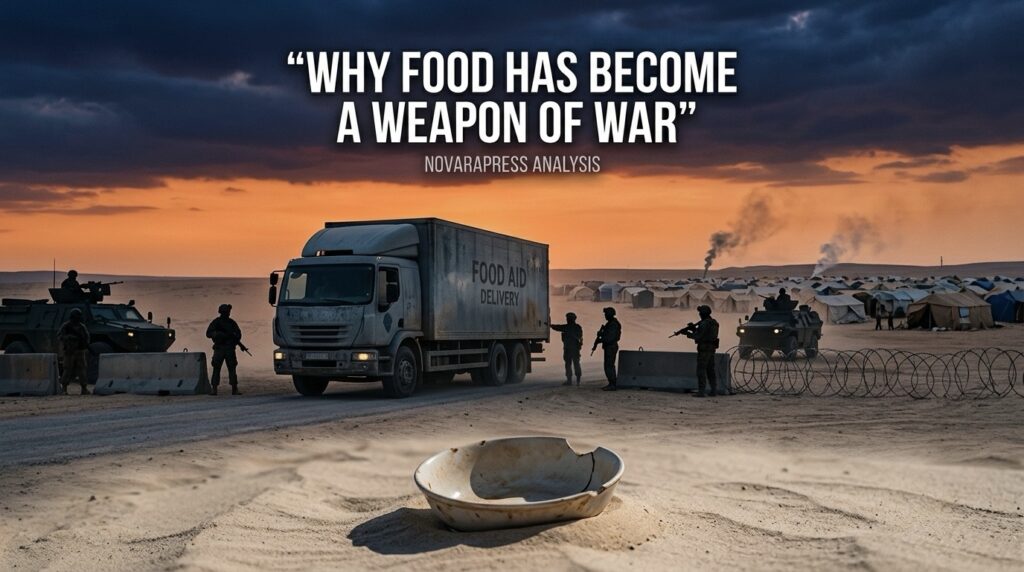
In the summer of 2023, a UN World Food Programme convoy carrying emergency supplies to civilians in Sudan’s North Darfur region was stopped at an RSF checkpoint. The aid workers were turned back. The food did not reach its destination. In the weeks that followed, reports from Darfur described children dying of starvation in a region that had not seen famine in decades.
This was not a logistical failure. It was not a bureaucratic delay. It was a military decision — the deliberate use of hunger as a tool of war. And it was not unique to Sudan. The same pattern was playing out simultaneously in Gaza, in Yemen, in Ethiopia’s Tigray region, and in pockets of the Sahel where armed groups controlled the roads that food aid must travel to reach the people who need it.
Hunger has always accompanied war. What has changed is the degree to which hunger is now deliberately engineered — used as a weapon with the same intentionality as artillery, with the advantage that it kills slowly enough that the perpetrators can maintain deniability while the dying happens.
The Laws That Exist and the Reality That Doesn’t Match Them
The use of starvation as a method of warfare is prohibited under international humanitarian law. Article 54 of Additional Protocol I to the Geneva Conventions explicitly prohibits attacking objects indispensable to the survival of the civilian population — food, crops, livestock, drinking water. The Rome Statute, which established the International Criminal Court, includes the intentional use of starvation as a war crime when committed in international armed conflict.
In 2018, UN Security Council Resolution 2417 specifically condemned the use of starvation as a method of warfare and called for unrestricted humanitarian access in conflict zones. It passed unanimously.
Since that resolution passed, documented cases of deliberate food deprivation in conflict — in Yemen, Syria, Ethiopia, and Sudan — have multiplied. Not one individual has been prosecuted by the ICC specifically for the war crime of starvation. The law exists. The enforcement does not.
Sudan: Famine as Strategy
The famine that developed in Sudan’s Darfur region during 2023 and 2024 was among the most documented cases of deliberate food deprivation in recent history — and among the least acted upon.
The Integrated Food Security Phase Classification, the international standard for measuring food insecurity, declared famine conditions in the Zamzam displacement camp in North Darfur in mid-2024 — the first famine declaration anywhere in the world in years. The declaration was based on data showing acute malnutrition rates among children that exceeded the threshold for catastrophe, combined with mortality rates that confirmed people were dying of hunger.
The conditions producing this famine were not natural. RSF forces controlled the roads into North Darfur, restricting the movement of humanitarian convoys. Markets were looted or destroyed. Agricultural land was abandoned as farmers fled the fighting. Livestock — the primary asset of pastoral communities — was seized. The food system was systematically dismantled, not as a side effect of combat operations but as a deliberate element of the RSF’s strategy for controlling territory and population.
Aid organizations documented their attempts to reach affected populations and the obstacles they encountered — checkpoints, bureaucratic delays imposed by both sides, active interference with convoys. The UN called for humanitarian access. Statements were issued. The famine continued.
Gaza and the Starvation Debate
The conflict in Gaza that began in October 2023 produced one of the most intensely debated food security situations in recent history — intense not because the facts were unclear but because the political stakes of naming them clearly were so high.
By early 2024, international food security assessments indicated that the entire population of Gaza — 2.3 million people — faced crisis levels of food insecurity or worse, with the northern part of the territory experiencing conditions meeting the IPC threshold for famine. The physical destruction of food infrastructure, restrictions on the entry of food aid, the displacement of the agricultural population, and the collapse of commercial supply chains had combined to produce a food emergency of extraordinary scale.
The Israeli government disputed famine characterizations, citing the volume of aid it permitted to enter. Independent assessments — from the IPC, from UN agencies, from NGOs operating on the ground — consistently contradicted the official Israeli position. The gap between what was being permitted to enter and what 2.3 million people required to sustain themselves was, by any nutritional standard, catastrophic.
The International Court of Justice, in its January 2024 provisional measures order in South Africa’s genocide case against Israel, specifically ordered Israel to take measures to ensure the unimpeded provision of humanitarian assistance to civilians in Gaza — a ruling that implicitly acknowledged the severity of the food situation and the degree to which access restrictions were contributing to it.
Yemen: A Decade of Engineered Hunger
Sudan and Gaza are acute crises. Yemen is a chronic one — a decade-long conflict in which food has functioned as a weapon so consistently that the pattern has become almost invisible through familiarity.
The Saudi-led coalition’s naval blockade of Yemen, imposed and maintained throughout the conflict, restricted the import of food, fuel, and medicine into a country that imports approximately 90 percent of its food supply. The Houthis, controlling much of the north including the capital Sanaa, diverted humanitarian aid to their own forces and supporters, imposed taxes on aid organizations, and manipulated food distribution to reward loyalty and punish dissent.
Both sides, in other words, weaponized food — one through blockade, one through diversion. The civilian population of Yemen paid the price. UN estimates have attributed the majority of Yemen’s conflict-related deaths — conservatively estimated at over 150,000 — not to direct violence but to the indirect effects of the conflict, including hunger and disease exacerbated by the destruction of food and health systems.
The scale of suffering in Yemen is so large and has persisted for so long that it has generated a kind of compassion fatigue in international media and policy circles. The famine warnings that dominated headlines in 2017 and 2018 became background noise. The hunger continued. The world moved on to the next crisis.
The Climate Multiplier
The deliberate use of food as a weapon does not operate in isolation. It operates against a backdrop of climate-driven food insecurity that is making civilian populations increasingly vulnerable to exactly this kind of pressure.
The Sahel, the Horn of Africa, and the Middle East — the regions where food weaponization has been most extensively documented — are also among the regions most severely affected by climate-driven agricultural disruption. Erratic rainfall, prolonged droughts, desertification, and the disruption of traditional agricultural cycles have reduced food production and increased food prices across all of these regions over the past two decades.
When a population is already food insecure because of climate disruption, the additional pressure of deliberate food deprivation during conflict reaches catastrophe thresholds much faster. A community that had six months of food reserves before a conflict begins can survive a supply disruption. A community that entered the conflict already malnourished cannot.
Climate change is not causing these conflicts. But it is expanding the population of people who are vulnerable to food weaponization — reducing the resilience that would otherwise allow communities to survive the deliberate targeting of their food systems.
The Aid System Under Pressure
The international humanitarian system — the network of UN agencies, international NGOs, and donor governments that responds to food crises — is operating under pressures that are reducing its effectiveness precisely as the scale of need is increasing.
Humanitarian funding has consistently fallen short of requirements across all major crises. The UN’s humanitarian appeals are routinely underfunded — in some years, by 50 percent or more. The gap between what is needed and what is available means that aid organizations must make triage decisions about which populations to reach, knowing that the populations they cannot reach will go without.
Access constraints — the deliberate obstruction of humanitarian operations by armed actors — have increased in severity and frequency. Aid workers are killed at higher rates than in previous decades. Convoys are looted. Organizations are expelled from territories they were serving. The humanitarian space — the physical and political room in which aid can operate — has been systematically compressed by armed groups that have learned that controlling food access is a form of power.
The Accountability That Never Arrives
The most consistent feature of food weaponization as a military strategy is its impunity. Despite clear legal prohibitions, despite extensive documentation, despite UN resolutions and ICC jurisdiction, nobody has been held accountable for the deliberate use of starvation as a war crime in any of the major conflicts of the past decade.
The reasons are structural. Prosecuting starvation as a war crime requires proving intent — demonstrating that food deprivation was deliberate rather than an incidental effect of conflict. Armed groups that block aid convoys rarely document their intent in ways that produce the kind of evidence ICC prosecutors require. The chain of command connecting a checkpoint soldier to a senior commander who ordered the blockade is difficult to establish in the fragmented, decentralized armed groups that characterize modern conflict.
The political constraints are equally significant. The states most capable of applying pressure on actors who weaponize food are often the same states supplying those actors with weapons, diplomatic cover, or financial support. Saudi Arabia’s role in Yemen’s blockade has not produced ICC referrals from the Western governments that supply Saudi Arabia with arms. The RSF’s blockade of Darfur has not produced meaningful consequences from the external actors whose financial networks sustain RSF operations.
Impunity is not an accident. It is a product of the same political economy that makes food weaponization strategically attractive in the first place: the calculation that the military and political benefits of controlling food access outweigh the costs, because the costs — international criticism, UN statements, underfunded humanitarian appeals — are manageable.
What It Takes to Change the Calculation
The use of food as a weapon will not stop because it is illegal. It will stop when the cost of using it exceeds the benefit — when the actors employing it face consequences severe enough to change the strategic calculus.
Those consequences have not materialized in Sudan, Yemen, Gaza, or any other major conflict where food has been deliberately weaponized in the past decade. The documentation exists. The legal framework exists. The political will to enforce it does not.
The children dying of starvation in Zamzam camp, in northern Gaza, in the villages of Tigray — they are not dying because the world lacks the knowledge of what is happening to them. They are dying because the actors with the power to stop it have decided, repeatedly and consistently, that stopping it is not worth the cost.
That is not a humanitarian failure. It is a political choice. And naming it accurately is the minimum required before anything changes.
If this analysis interests you, read next: Sudan’s War Nobody Is Watching