
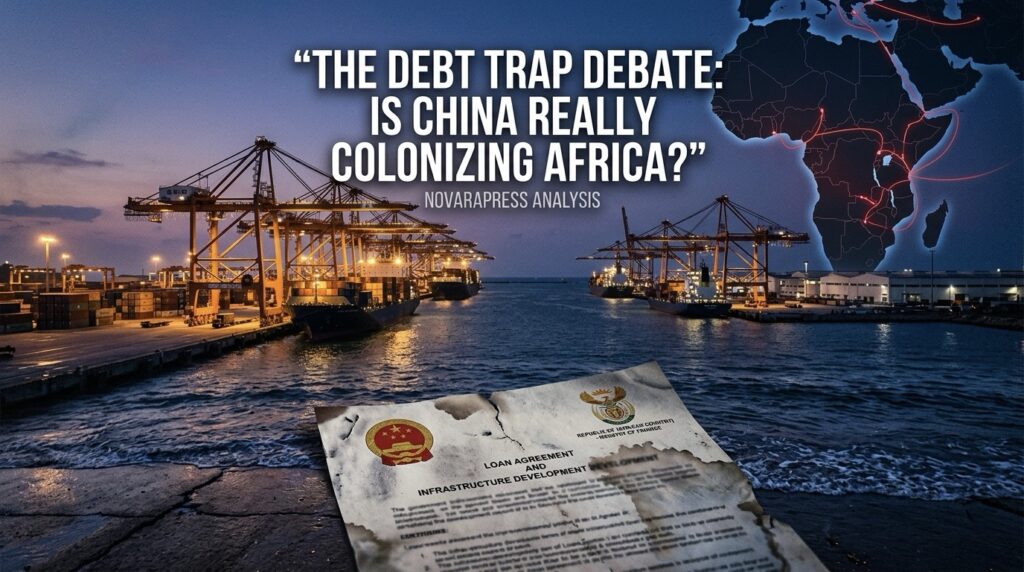
In 2017, Sri Lanka handed over the Hambantota port to a Chinese state-owned company on a 99-year lease. The port had been built with Chinese loans that the Sri Lankan government could not repay. Western commentators declared it the definitive proof of China’s “debt trap diplomacy” — a strategy of deliberately engineering debt to seize strategic assets from vulnerable countries.
The story spread everywhere. It was cited in US congressional testimony, in European policy documents, in op-eds across dozens of countries. It became the founding narrative of Western concern about Chinese investment in the developing world.
There was one problem. The narrative was largely wrong — and the researchers who examined it most carefully said so, loudly, for years, while the story continued to circulate as established fact.
The Hambantota port was not seized by China. It was offered by a Sri Lankan government desperate for foreign exchange, over Chinese reluctance to accept it, as part of a deal that included $1.1 billion in fresh loans that Sri Lanka needed more than it needed to keep the port. China did not engineer the debt trap. Sri Lanka’s own governance failures built it, and China accepted the port because refusing would have been diplomatically awkward.
This distinction matters — not because China’s behavior in Africa and the developing world is beyond criticism, but because getting the critique wrong produces the wrong policy responses and leaves the actual problems unaddressed.
What the Research Actually Shows
The debt trap diplomacy thesis — the claim that China deliberately designs loans to fail so it can seize strategic assets — has been examined by researchers at Johns Hopkins University, the Brookings Institution, the Rhodium Group, and numerous academic institutions. The consistent finding is that the evidence for a deliberate debt trap strategy is thin to nonexistent.
AidData, a research lab at William & Mary that tracks Chinese development finance, analyzed 165 Chinese loan contracts across 142 countries. The contracts contained provisions that were concerning — cross-default clauses, collateral arrangements involving state assets, restrictions on borrowers discussing the loan terms — but they did not reveal a pattern of deliberate asset seizure. China has rescheduled debt for struggling borrowers far more often than it has seized assets. Zambia, which defaulted on Chinese debt in 2020, spent years in restructuring negotiations. China did not take its copper mines.
This does not mean Chinese lending is benign. The loan terms documented by AidData include provisions that give China significant leverage over borrowers — the ability to accelerate repayment if the borrower takes actions China dislikes, confidentiality requirements that prevent borrowers from disclosing terms to other creditors, and preferential treatment for Chinese state entities in dispute resolution. These are instruments of influence, even if they are not instruments of deliberate asset seizure.
The Real Problems With Chinese Lending
Setting aside the debt trap narrative, the actual problems with Chinese development finance in Africa are more mundane and more structural than a conspiracy to seize ports.
Chinese loans are frequently more expensive than concessional lending from Western-backed institutions like the World Bank or African Development Bank. Interest rates on Chinese commercial loans have typically ranged from 4 to 6 percent — not predatory by market standards, but significantly higher than the 1 to 2 percent rates available through multilateral development banks. For countries with limited fiscal space, this difference in borrowing costs compounds over time into significantly higher debt burdens.
Procurement requirements attached to Chinese loans — requirements that Chinese companies be used for construction and that Chinese workers fill a defined share of project employment — limit the degree to which infrastructure investment builds local capacity. A road built by Chinese workers with Chinese equipment and Chinese materials generates less local employment, less skills transfer, and less development of local supply chains than a road built with equivalent financing but open procurement. The infrastructure is real. The development spillovers are reduced.
Project selection has also been problematic. The Hambantota port — the founding case of the debt trap narrative — was a genuinely bad investment. The port was built in a location with limited commercial rationale, driven by the political interests of then-President Mahinda Rajapaksa rather than economic analysis. Chinese lenders financed a project that should not have been built, and both parties are responsible for that outcome.
The Governance Problem Nobody Wants to Name
The most consistent factor in African debt distress — whether the creditor is China, Western commercial banks, or international bond markets — is not the terms of the lending. It is the governance of the borrowing.
Countries that borrow wisely, invest in productive capacity, and maintain fiscal discipline do not end up in debt traps regardless of who lends to them. Countries that borrow to fund prestige projects with limited economic returns, that allow corruption to divert loan proceeds, and that accumulate debt faster than their economies can service it end up in distress regardless of whether the lender is Chinese, American, or European.
Zambia’s debt crisis — which made it the first African country to default during the COVID-19 pandemic — was not primarily a Chinese debt problem. Zambia borrowed heavily from multiple sources, including Eurobond markets, and its fiscal position deteriorated because of a combination of commodity price dependence, governance failures, and borrowing decisions that prioritized short-term financing over long-term sustainability.
China held approximately 30 percent of Zambia’s external debt at the time of default. Western commercial creditors held more. The debt trap narrative, focused exclusively on the Chinese portion, obscured the more complex reality of a country that had borrowed beyond its means from multiple sources.
What China Actually Wants in Africa
Understanding Chinese engagement in Africa requires setting aside both the debt trap narrative and the Chinese government’s own framing of its activities as “South-South cooperation” driven by solidarity and mutual benefit. Both are distortions in opposite directions.
China’s primary interests in Africa are consistent and identifiable. Access to raw materials — particularly the minerals required for industrial production and the energy transition — is the most fundamental driver. Market access for Chinese manufactured goods is the second. Political support in multilateral forums — the UN General Assembly, the Human Rights Council, the WTO — where African votes matter is the third. Strategic positioning in ports, telecommunications infrastructure, and logistics networks that could have military utility in a future great power conflict is the fourth.
None of these interests requires a debt trap strategy. They are served by straightforward commercial and diplomatic engagement — lending money at rates that generate returns, building infrastructure that creates dependencies, and cultivating political relationships through investment, education programs, and direct support for African leaders whose cooperation is valued.
This is not fundamentally different from what Western powers have done in Africa for decades — it is simply being done by a different actor with different specific interests and different rhetorical packaging. The outrage that Western governments express about Chinese engagement in Africa is partly genuine concern about governance and sustainability, and partly competitive anxiety about losing influence to a rival that is playing a similar game more effectively in this particular theater.
Africa’s Agency in Its Own Story
Perhaps the most important correction to the debt trap narrative is the one that restores African agency to the story.
The debt trap framing positions African governments as passive victims — naive or corrupt leaders tricked into signing agreements they did not understand by sophisticated Chinese strategists. This framing is condescending and inaccurate. African governments are sovereign actors making choices — sometimes wise, sometimes poor — about how to finance their development. They choose Chinese loans over Western alternatives for reasons that include cost, speed, conditionality, and political relationship, not because they have been trapped.
Several African governments have successfully renegotiated Chinese loan terms, canceled projects they determined were not in their interest, and maintained their autonomy in the face of Chinese pressure. Ethiopia renegotiated the terms of its Chinese railway debt. Tanzania canceled a Chinese port project over terms it found unacceptable. These are not the actions of countries that have been trapped.
The challenge for Africa in managing Chinese engagement is the same challenge it faces in managing all external engagement: building the institutional capacity, governance quality, and negotiating sophistication to extract maximum benefit from external investment while minimizing the dependencies and costs that external investment can also create.
That challenge is real. It is not made easier by a narrative that attributes African debt problems primarily to Chinese malice rather than to the complex interaction of external lending practices, domestic governance failures, and structural economic vulnerabilities that actually produces them.
The Conversation Worth Having
The debt trap narrative has crowded out a more important conversation about what fair development finance for Africa would actually look like.
African countries face a genuine infrastructure financing gap — estimated by the African Development Bank at $68 to $108 billion annually. Closing that gap requires external financing at a scale that neither Chinese lending nor Western-backed multilateral institutions are currently providing. The terms on which that financing is provided — interest rates, procurement requirements, transparency standards, conditionality — matter enormously for whether infrastructure investment produces development or debt distress.
A serious policy conversation would focus on those terms — on building an international framework for infrastructure finance that serves African development needs rather than the strategic interests of competing external powers. That conversation is harder and less politically satisfying than the debt trap narrative. It requires acknowledging Western failures alongside Chinese ones, and it requires centering African preferences rather than great power competition.
The Hambantota port is not a cautionary tale about Chinese strategy. It is a cautionary tale about what happens when infrastructure investment is driven by the interests of lenders and borrowing governments rather than the development needs of the populations it is supposed to serve.
That lesson applies to every external actor in Africa. Not just the one that is currently most convenient to blame.
If this analysis interests you, read next: The Quiet War Over African Resources