
Governments used to send ambassadors. Now they send mercenaries.
When a state wants influence in an unstable region without the political cost of official intervention, the calculation has changed. The tool of choice is no longer a diplomatic mission or even a covert intelligence operation. It is a private military company — deniable, deployable, and disposable.
No organization illustrated this shift more clearly than the Wagner Group.
What Wagner Was — and What It Represented
Wagner was never simply a mercenary outfit. It was a foreign policy instrument with a business model attached.
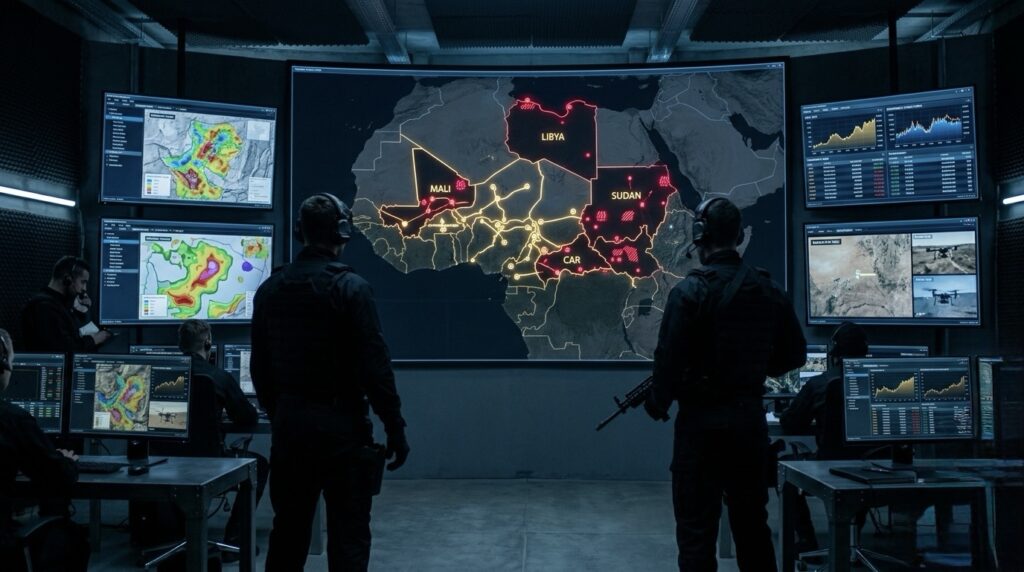
Founded and funded by figures with direct ties to the Kremlin, Wagner operated in conflicts where Russian official involvement would have been politically costly. Syria, Libya, Central African Republic, Mali, Sudan, Mozambique — in each case, Wagner arrived not just to fight but to extract. Mining concessions, resource deals, and security contracts followed the guns.
This was the innovation. Previous mercenary operations sold violence. Wagner sold a complete package: military support, political protection for incumbent regimes, and resource extraction that financed the entire operation. The host government got security. Wagner got minerals. Moscow got influence. Nobody had to sign anything official.
The Africa Pivot
Wagner’s most consequential expansion was into sub-Saharan Africa, arriving at a moment when several governments were actively looking for alternatives to Western security partnerships.
The pitch was straightforward. Western partners came with conditions — human rights benchmarks, democratic governance requirements, oversight mechanisms. Wagner came with none of that. It offered immediate armed support, no questions asked, in exchange for access.
In the Central African Republic, Wagner fighters became the de facto praetorian guard for President Faustin-Archange Touadéra. In Mali, they replaced French forces after a military junta expelled Western partners. In Libya, they supported Khalifa Haftar’s campaign against the UN-recognized government.
The pattern was consistent. Find a regime under pressure. Offer unconditional support. Secure resource contracts. Repeat.
The Business Model Behind the Guns
What made Wagner different from earlier private military companies was the integration of military and commercial operations.
In Sudan, Wagner’s involvement predated the 2023 war. The organization had established relationships with the RSF and with gold mining networks that allowed Russian-linked entities to move Sudanese gold out of the country with limited international scrutiny. The guns and the mining operations were not separate activities. They were the same activity.
This model — armed protection in exchange for extraction rights — created a self-financing loop. Wagner did not need Kremlin subsidies to operate in Africa. The resources it secured paid for the operation itself. This made it more sustainable and more dangerous than a conventional state-sponsored proxy force.
After Prigozhin: Did Wagner Die or Evolve?
In June 2023, Wagner chief Yevgeny Prigozhin launched a short-lived armed mutiny against Russian military leadership. Two months later, he died in a plane crash.
Western analysts quickly concluded that Wagner was finished.
That conclusion was premature.
The organization did not dissolve. It reorganized. Operations in Africa continued under restructured command, with greater formal integration into Russian state structures. The brand changed — in some contexts replaced by the Africa Corps designation — but the personnel, the contracts, and the operational model largely remained.
What Prigozhin’s death demonstrated was not that Wagner was fragile. It demonstrated that the model he had built was valuable enough that the Russian state wanted to absorb it rather than abandon it.
The Imitators
Wagner’s success — measured in influence gained and resources extracted at relatively low official cost — did not go unnoticed.
Other states began developing comparable instruments. Iran had long operated through proxy militias, but the Wagner model offered something different: a commercially self-sustaining force with a corporate structure. The Gulf states invested in private security networks. Turkish-backed Syrian fighters were deployed in Libya and Azerbaijan.
The broader lesson absorbed by multiple governments was that private military forces offer something conventional armies cannot — deniability combined with genuine military capability. When things go wrong, no official had to authorize anything. When things go right, influence accrues quietly.
What This Means for Diplomacy
The proliferation of private military actors has fundamentally altered the cost-benefit calculation of intervention.
States can now project force into unstable regions at a fraction of the political cost of official military deployment. They can support one faction in a civil conflict without formally taking sides. They can extract resources from war zones without appearing in any government budget.
The result is a world where the line between war and commerce, between state policy and private enterprise, has become deliberately blurred. Conflicts that might once have been resolved through diplomatic pressure or sanctions are now sustained by actors who have a direct financial interest in continued instability.
Wagner did not invent this logic. But it refined it, scaled it, and proved that it worked. That proof of concept is now being replicated across multiple theaters by multiple state and non-state actors.
The Accountability Gap
Private military companies operate in a legal gray zone that the international system has not resolved.
International humanitarian law applies to armed actors in conflict regardless of their formal status — but enforcement requires political will that rarely materializes when the actors involved are useful to powerful states. Wagner fighters committed documented atrocities in Mali, CAR, and Libya. The accountability mechanisms that would apply to a state military have not been applied with equivalent force to private actors operating on behalf of states.
This gap is not accidental. It is a feature, not a bug. The deniability that makes private military forces attractive to sponsoring states depends on that accountability gap remaining open.
Closing it would require the states that benefit most from private military proxies to agree to mechanisms that constrain their own tools. That agreement has not been forthcoming.
The New Normal
Wagner is not an anomaly. It is a preview.
The combination of resource extraction, armed protection, and state deniability that Wagner pioneered in Africa is now a template available to any state willing to invest in it. The barriers to entry are lower than they appear. The returns — in influence, in resources, in avoided political costs — are demonstrably real.
Diplomacy has not disappeared. But it now competes with a parallel system in which influence is purchased with guns, resources are extracted under armed protection, and accountability is structurally avoided.
Understanding that system is not optional for anyone trying to understand how power actually moves in the world today.
If this analysis interests you, read next: Why Ceasefires Fail: A Pattern Nobody Talks About