
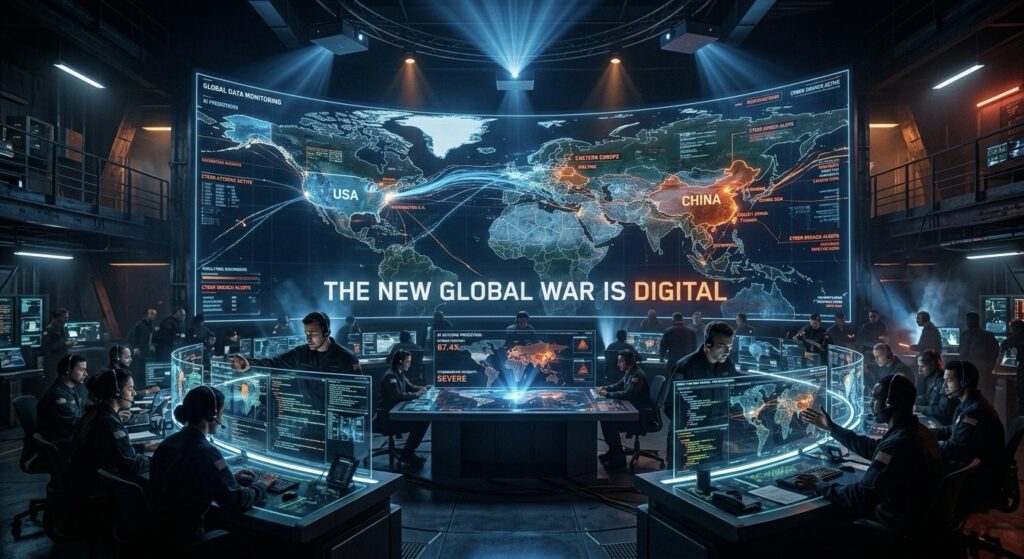
In October 2022, the Biden administration made a decision that rarely makes front pages but will shape the next decade of global power: it restricted the sale of advanced semiconductors to China. Not specific chips for specific weapons. All advanced chips. For any purpose. The most sweeping export control since the Cold War — and it was about artificial intelligence.
The message was unmistakable. Washington had concluded that AI supremacy and national security were the same thing. And that China could not be allowed to close the gap.
What followed was not diplomacy. It was acceleration. Both sides began moving faster — in research, in manufacturing, in military integration, in diplomatic pressure on allies to choose. The new Cold War had found its technology.
Why AI Became the Defining Competition
Every major power competition in history has been organized around a transformative technology. The 19th century was organized around industrial capacity — steel, railways, coal. The 20th century was organized around nuclear weapons and oil. The competition that is now underway is organized around artificial intelligence — and the data, computing infrastructure, and talent that AI requires.
The reason is straightforward. AI provides military advantages that previous technologies could not. Autonomous systems that operate faster than human reaction times. Intelligence analysis that processes satellite, signals, and open-source data at scales no human organization can match. Cyber capabilities that can identify vulnerabilities and execute attacks in milliseconds. Logistics optimization that increases the effective combat power of a given force. Decision support systems that reduce the fog of war for commanders at every level.
But the military applications, significant as they are, are not the whole picture. AI also provides economic advantages — in manufacturing efficiency, drug discovery, financial modeling, agricultural optimization — that translate into the GDP growth that funds military capability. And it provides political advantages through surveillance infrastructure, information operations, and influence over the global information environment.
Control AI, and you control a decisive portion of 21st-century power. This is what Washington and Beijing both understand. It is why the competition is existential rather than merely strategic.
China’s Position and Strategy
China entered the AI race from behind — and has been closing the gap faster than most Western analysts predicted. In 2017, China’s State Council published its New Generation Artificial Intelligence Development Plan, setting a target of global AI leadership by 2030. The plan was not aspirational. It was a procurement order backed by state funding, regulatory alignment, and a coordination between government, military, and private sector that democratic systems struggle to replicate.
China’s advantages in this competition are real. Its population generates data at a scale that provides training resources for AI systems that Western companies cannot match. Its regulatory environment allows data collection and use that would be legally prohibited in Europe and politically contested in the United States. Its state-directed investment model can sustain long-term research programs that private markets, focused on quarterly returns, will not fund.
Chinese AI companies — Baidu, Alibaba, Tencent, Huawei, and a constellation of smaller firms — have developed capabilities that are competitive with Western counterparts in most domains and superior in some. Chinese facial recognition technology is deployed in more countries than any other nation’s equivalent. Chinese AI-enabled surveillance infrastructure has been exported to governments across Africa, Asia, and Latin America.
The semiconductor gap remains China’s most significant constraint. Advanced AI training requires chips — primarily the high-end GPUs produced by Nvidia — that China cannot yet manufacture domestically and that American export controls are now restricting. Chinese companies and government agencies are working to close this gap through domestic development programs. The timeline for closing it is uncertain. That it will eventually close is not.
America’s Position and Its Vulnerabilities
The United States retains significant advantages. Its frontier AI companies — OpenAI, Google DeepMind, Anthropic, Meta AI — are producing the most capable large language models and multimodal systems in the world. Its research universities generate a disproportionate share of the global AI talent pool. Its venture capital ecosystem funds AI development at a scale that state-directed Chinese investment has not matched in quality, if not quantity.
But American advantages are more fragile than they appear. The AI talent pool is genuinely global — and a significant proportion of the researchers at American AI laboratories are foreign-born, including many from China. Immigration policy that restricts this flow would damage American AI capability more than it would constrain China’s. The export controls imposed in 2022 and tightened in 2023 have slowed Chinese AI development — but they have also accelerated Chinese investment in domestic semiconductor production, the long-term consequences of which remain unclear.
More fundamentally, American AI advantage depends on maintaining the alliance structures — with Japan, South Korea, the Netherlands, and Taiwan — that underpin the semiconductor supply chain. Taiwan Semiconductor Manufacturing Company produces the majority of the world’s most advanced chips. Any disruption to Taiwan’s status would not merely be a geopolitical crisis. It would be an AI crisis — removing the manufacturing capacity on which American AI supremacy depends.
The Middle Powers and the Forced Choice
The AI competition between the United States and China is forcing third countries into choices they would prefer not to make.
Countries that use Huawei telecommunications infrastructure are building networks whose architecture is familiar to Chinese intelligence services. Countries that adopt Chinese AI-powered surveillance systems are creating dependencies that extend beyond the technology itself. Countries that accept Chinese AI training partnerships are contributing to capability development that ultimately serves Chinese strategic interests.
Western governments have made this argument forcefully — and with some success. Several countries have removed Huawei from their 5G networks under American pressure. Others have declined Chinese AI partnerships after security reviews. But the pressure has costs. Countries that accept American security requirements often find themselves locked out of Chinese markets. For developing economies that trade heavily with China, this is not a costless choice.
The European Union has attempted to navigate this by developing its own AI governance framework — the EU AI Act — and investing in European AI capability through the European Research Council and national programs. The ambition is strategic autonomy: European AI infrastructure that serves European interests rather than American or Chinese ones. The gap between that ambition and current European AI capability is significant. Whether it can be closed before the competition between the two superpowers forecloses the option remains an open question.
The Military Integration Threshold
The most consequential — and least publicly discussed — dimension of the AI Cold War is the integration of AI systems into military command structures.
Both the United States and China are actively developing AI systems for military decision support, autonomous weapons, and cyber operations. Both are moving toward a posture in which AI systems play significant roles in target identification, threat assessment, and operational planning. Both are aware that the other is doing this. Neither has proposed meaningful international constraints that the other would accept.
The risk this creates is not primarily the risk of intentional AI-driven war. It is the risk of miscalculation — of AI systems on both sides interacting in ways their designers did not anticipate, escalating a crisis faster than human decision-makers can intervene. The Cuban Missile Crisis was resolved because Kennedy and Khrushchev had thirteen days to communicate, miscommunicate, and ultimately find an off-ramp. A future crisis managed by AI decision support systems operating at machine speed may not provide thirteen minutes.
The Outcome Nobody Can Predict
The AI Cold War will not end with a treaty. It will end — if it ends — with one of three outcomes.
The first is American technological dominance sustained long enough that China accepts a subordinate position in the global AI hierarchy. This outcome requires maintaining the semiconductor advantage while China’s domestic development programs fail to produce competitive alternatives. It is possible but depends on variables — Taiwanese political stability, allied solidarity, the pace of Chinese domestic innovation — that Washington does not control.
The second is Chinese technological parity followed by a negotiated division of the global AI ecosystem into separate spheres — a digital version of the Yalta conference that divided post-war Europe. Countries would align with one ecosystem or the other, using incompatible systems, operating under different governance frameworks, and competing in the remaining contested spaces.
The third is a technological surprise — a breakthrough in AI capability, chip architecture, or quantum computing that reshuffles the competitive landscape faster than either side’s current strategy accounts for.
What is certain is that the competition will intensify before it stabilizes. The decisions being made now — about export controls, research investment, military integration, and alliance management — will determine who has leverage when stabilization finally becomes possible.
The Cold War that shaped the second half of the 20th century was organized around weapons that could end civilization in thirty minutes. The one that is organizing the first half of the 21st century is quieter, more pervasive, and in some ways more consequential — because it is not about the power to destroy, but about the power to decide.
If this analysis interests you, read next: The AI Arms Race Nobody Voted For
Pingback: How AI Is Reshaping Global Media in 2026 - Novarapress